The asphalt near Jamsil Olympic Stadium doesn’t usually hum, but on this specific Tuesday, it vibrated with a low-frequency tension that had nothing to do with traffic.
Imagine a young woman named Hana. She has saved for three years, skipping cafeteria lunches and walking to work to afford a single ticket. She is standing behind a police barricade, her hands trembling as she grips a lightstick that feels like a scepter. To a passerby, she is just a fan. To the South Korean government, she is one of several hundred thousand variables in a massive, high-stakes security equation.
Seoul didn't just prepare for a concert. It prepared for a siege of love.
The Blue Wall
By noon, the heart of the city had transformed. The usual neon chaos of the Songpa district was replaced by a rigid, geometric precision. Five thousand police officers—young men in dark uniforms, many of them barely older than the performers they were there to protect—lined the boulevards. They didn’t look like they were at a musical event. They looked like they were guarding a summit of world leaders.
In a sense, they were.
The return of BTS to a live stage in their home country isn't a mere "show." It is a cultural reclamation. After years of digital screens, social distancing, and the sterile silence of empty arenas, the sheer physical pressure of a million fans descending on a single point in space creates a terrifying kind of physics. When that many heartbeats gather in one place, the oxygen changes. The police know this. They aren't worried about the music; they are worried about the crush.
The lockdown wasn't a punishment for the fans. It was a scaffold. Authorities cordoned off the main arteries of Seoul, creating a series of human valves. If the pressure became too great at one gate, another would open. If the subway platforms swelled toward the tracks, the trains would simply stop coming until the tide receded.
The Logistics of Longing
Every great gathering has a shadow side—the silent, invisible labor that keeps the spectacle from turning into a tragedy.
Consider the local shopkeeper, Mr. Park, whose convenience store sits just outside the stadium perimeter. To him, the "lockdown" meant his supply trucks couldn't reach his door after 8:00 AM. He spent the previous night stacking crates of water and energy drinks until his back screamed. He watched the police tape go up with a mix of exhaustion and awe.
"I've seen presidents come through here," he might tell you while wiping a counter. "I've seen the Olympics. But this? This is different. People aren't just here to watch. They are here to find something they lost during the pandemic."
That "something" is what the authorities truly fear. It is the irrational, overwhelming desire to be close to the light.
The security measures were surgical. Drones hovered above the Han River, their lenses tracking the flow of purple-clad crowds like white blood cells moving through an artery. Facial recognition software hummed in mobile command centers. It felt heavy. It felt restrictive. Yet, for the girl like Hana, the sight of a thousand officers was a comfort. It meant that the world acknowledged the gravity of her joy. It meant her safety was worth the price of a city paralyzed.
The Silence Before the Scream
As the sun began to dip, casting long, bruised shadows over the concrete, the atmosphere shifted from logistical to spiritual.
The police officers stopped shouting orders through megaphones. They began to simply point. The fans stopped chatting and started looking at their watches. The "lockdown" had created a vacuum—a pocket of protected space where, for a few hours, the outside world and its mundane problems could not enter.
Security isn't just about preventing a riot. It is about creating a sanctuary. By locking down the streets, the city gave the fans permission to lose themselves. They didn't have to worry about cars, or pickpockets, or the crushing weight of a poorly managed crowd. The state had taken on the burden of order so the individuals could embrace the chaos of emotion.
The stakes were higher than anyone admitted. If something went wrong, it wouldn't just be a news story about a concert. It would be a stain on the national identity. BTS is South Korea’s most potent export, a symbol of a modern, disciplined, and vibrant nation. A security failure at their homecoming would be a failure of the Korean dream itself.
The Human Cost of Order
There is a strange loneliness in the middle of a massive security operation.
An officer standing at Gate 3 had been on his feet for twelve hours. He hasn't listened to a single song by the band. He doesn't know their names. But he knows the weight of his riot shield. He knows the scent of thousands of different perfumes blending into a single, floral fog. He watches a group of fans from Brazil hug a group of fans from Japan, and for a second, he forgets he is a barrier. He is a witness.
The "cold facts" of a police lockdown are usually written in terms of numbers: 50,000 tickets, 600 buses, 30 miles of tape. But the truth is written in the sweat on a sergeant’s brow and the frantic hope in a teenager’s eyes.
The city of Seoul didn't just close its roads. It held its breath. It braced itself for the impact of a collective catharsis that has been building since the world shut down in 2020.
As the first note finally ripped through the air, vibrating the very barricades the police were holding, the tension snapped. The lockdown remained, the officers stayed at their posts, and the streets remained empty of cars. But inside that circle of steel and law, something moved that no amount of policing could ever truly contain.
Hana didn't see the police anymore. She didn't see the drones. She only saw the light.
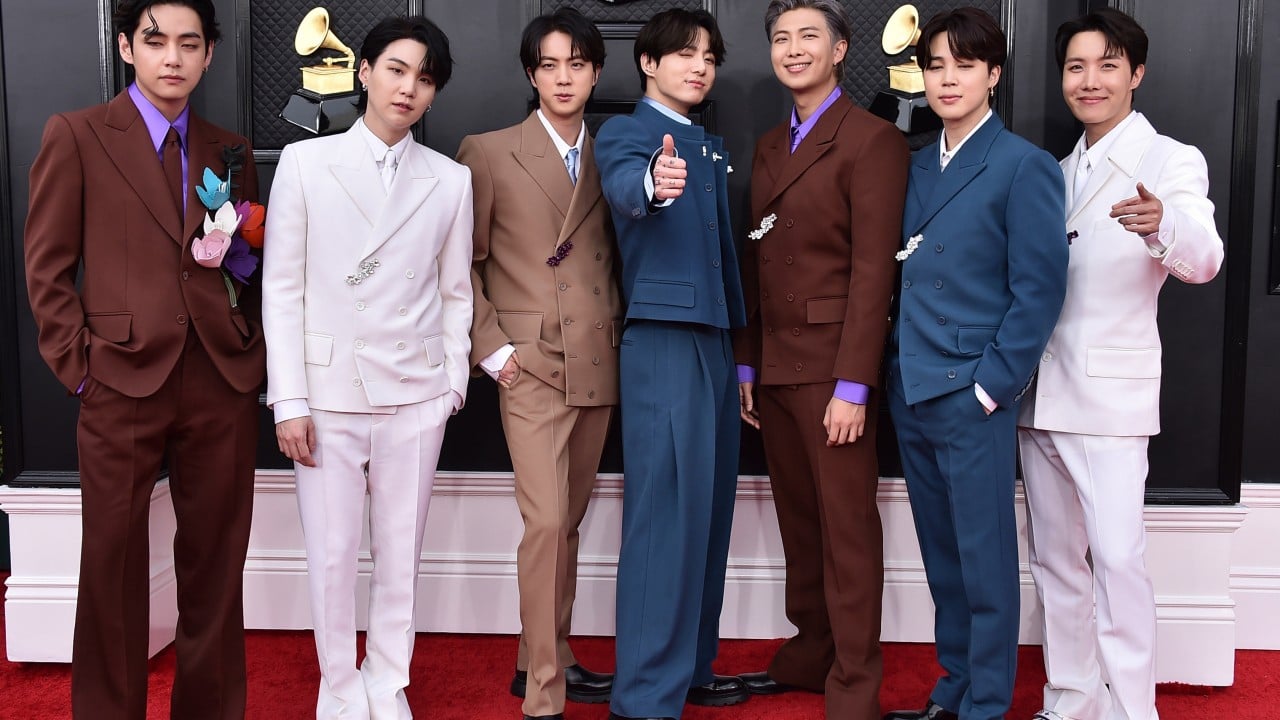
Outside, the city was a ghost town of empty boulevards and flashing blue lights, a silent monument to the power of seven men to make a metropolis stand still. The silence of the streets was the only thing loud enough to match the roar coming from inside the stadium.
A single purple ribbon, tied to a police barricade, fluttered in the wind as the bass kicked in, a small, fragile reminder that even the most rigid structures of the state eventually have to bow to the music.
Would you like me to generate an image showing the contrast between the intense police security and the vibrant fans outside the stadium?