The air inside the Pasadena civic auditorium smelled of hot solder, stale coffee, and the unique, ozone-laced sweat of forty people who had not slept in three days.
On the monitors backstage, the stage manager’s monitors flickered with the bright, synthetic neon of television. Out there, the judges sat behind their illuminated desks like Roman senators presiding over a gladiator pit of amateur magicians, singing dogs, and acrobats who swallowed fire. But back here, in the dim, chaotic labyrinth of the wings, the floor vibrated with a different kind of heartbeat.
It was a low, rhythmic thrumming. The sound of brushless DC motors fighting inertia.
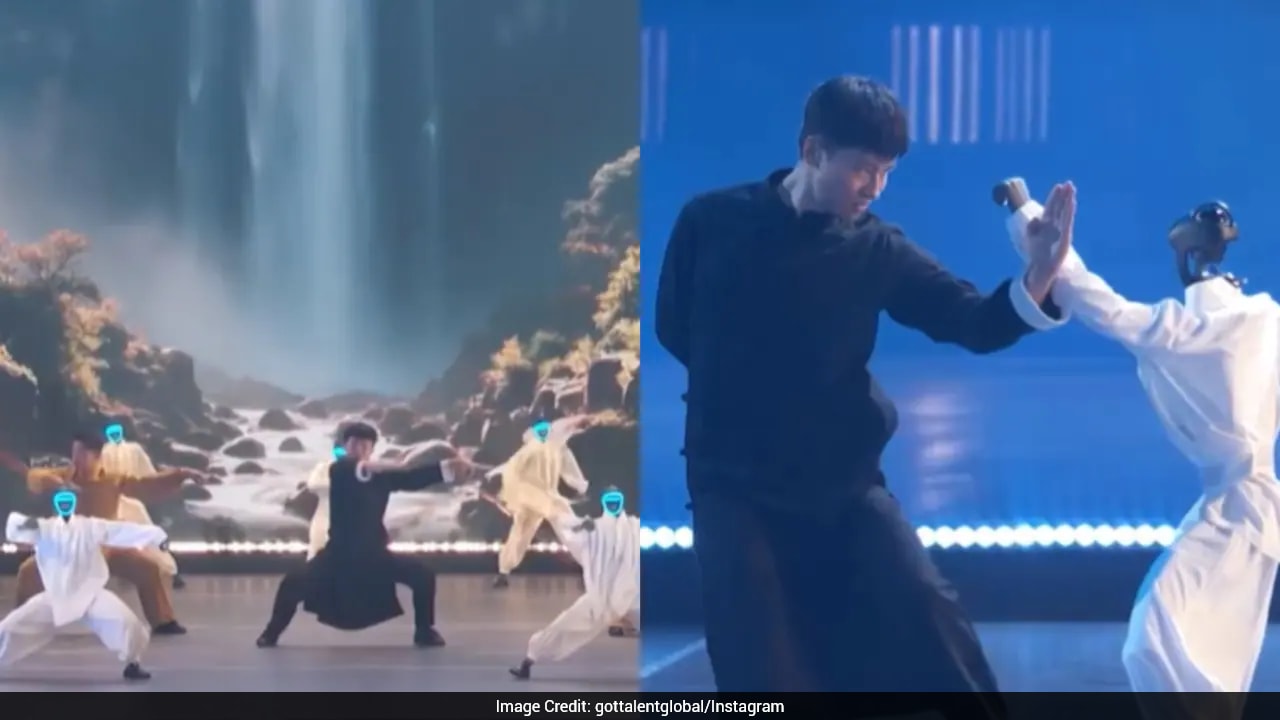
To the audience on television, what happened next looked like a novelty act. A clever bit of programming for a variety show. A pair of bipedal machines stepping out from the shadows, wearing black satin sashes, executing a crisp, synchronized wing chun form, and then—in a move that made a multimillion-dollar studio audience collectively gasp—dropping gracefully to one knee to present a golden buzzer to a startled panel.
It looked like magic. It felt like a gimmick.
It was actually a funeral for an old assumption.
For decades, we drew a hard, unyielding line between the living and the constructed. Flesh bleeds, learns, makes mistakes, feels fear, and eventually stops. Metal processes, executes, repeats, optimizes, and endures. We built machines to keep them away from the stage of human vulnerability. We kept them in clean-room cages, bolted to factory floors, welding car doors with terrifying, unblinking precision. We wanted our technology fast and invisible. We wanted our tools to stay in the garage.
Then came the night the tools learned how to dance.
Consider the physics of what it takes for a machine to throw a punch that stops an inch short of another machine's sensor suite. To a human martial artist, a punch is an instinct refined by thousands of hours of skinned knuckles, aching shoulders, and the subtle, unspoken psychological read of an opponent’s twitching muscle. You feel the weight of the air. You sense the shift in your rival's balance.
A humanoid robot feels none of that. It feels currents. It reads telemetry.
Behind the polished titanium faceplates and the fluid-damped joints of the contestants on that stage lay millions of lines of code struggling with an ancient human geometry. Balance is not a natural state for a bipedal machine. It is a continuous, frantic negotiation with gravity. Every microsecond, gyroscopes scream corrections down fiber-optic nerves. If the ankle servo lags by four milliseconds, a hundred-thousand-dollar piece of hardware collapses into a pile of expensive scrap metal.
When those mechanical limbs sliced through the television studio air with the crisp authority of traditional kung fu, they were not just performing a trick. They were demonstrating the closing of a chasm.
We have spent the last ten years terrified of what robots would take from us. We worried about our jobs, our art, our authenticity, our very uniqueness as sentient creatures capable of grace. We watched algorithms write poetry and generate photorealistic portraits, and we felt the cold breath of obsolescence on the back of our necks. We told ourselves that physical dexterity—the sweat, the dirt, the bruised shins, the messy, beautiful reality of the physical world—was our last sanctuary. The machines could have the spreadsheet. They could have the assembly line. But the body? The body belonged to us.
That illusion fractured under the studio lights.
When the lead robot dropped into a low, stable stance, its knee actuators whining softly under the strain of carrying sixty kilograms of lithium-ion batteries and aluminum framing, it wasn't just executing a pre-programmed script. It was navigating a dynamic physical world that was fundamentally chaotic. The stage floor was slightly warped under the heavy foot traffic of a live television broadcast. The studio lights threw sudden, blinding thermal gradients across its optical sensors. The ambient noise of the screaming crowd created acoustic interference.
Yet, the form held. The strike landed with absolute, lethal precision, followed instantly by the absolute, delicate restraint required to not shatter the partner machine's casing.
That is the paradox of modern robotics. We are building entities that possess the terrifying strength of an industrial press combined with the spatial awareness of a ballet dancer. And we are putting them on television.
Why television? Why America's Got Talent?
Because engineering has a marketing problem. For years, robotics laboratories have published dense, unreadable papers in academic journals read by twelve people in Zurich. They showed videos of headless quadrupeds trotting across gravel lots or humanoid prototypes walking gingerly across a lab floor like toddlers testing a freshly waxed linoleum kitchen. The world yawned. We filed it away under science fiction, assuming the future was still fifty years away.
Television short-circuits that skepticism. It forces the lab out of the basement and into the living room.
When millions of people watched two machines bow to each other—a gesture born of ancient human humility and respect, executed by a system of brushless motors and neural networks—the distance between silicon and soul shrank by an immeasurable degree. It forced a cultural reckoning. We are no longer asking if machines can work. We are asking what it means when they can move with elegance.
There is a profound melancholy in watching a machine perform an art form born of human mortality. Wing chun was developed by people who bled, who grew old, whose bones knit slowly after a bad fall, who knew that their time on this earth was agonizingly brief. Every martial art is an acknowledgment of our fragility. It is a codified system for surviving violence using the perishable vessel we were given.
When a humanoid robot mimics that struggle, it is an act of pure translation. It is silicon translating flesh.
Back in the wings, as the golden confetti began to rain from the ceiling—sticking to the rubberized soles of the robots' feet and dusting their optical visors with glittering foil—the engineers did not cheer. They held their breath, frantically tapping at the diagnostic laptops strapped to their forelegs, checking thermal loads, verifying battery voltages, making sure no servo had fried under the sudden thermal spike of the studio lights.
They looked exhausted. They looked like parents whose child had just walked across a tightrope for the very first time.
They knew the truth that the cheering audience missed. This wasn't the peak. This was the opening bell.
The stage lights dimmed. The cameras swung away to commercial. The crew began sweeping up the golden paper scraps, tossing them into giant black garbage bags. The robots were powered down, their diagnostic LEDs fading from a bright, hopeful blue to a flat, lifeless amber, and then to absolute darkness.
They were rolled away into their shipping crates, quiet once more, waiting for the next stage, the next update, the next invisible threshold to be crossed in the dark.