The air in Artibonite doesn't smell like politics. It smells like roasted corn, damp soil, and, on some nights, woodsmoke floating from backyard kitchens.
On an ordinary evening, the soundscape of Pont-Sondé is predictable. Crickets. The low hum of motorcycles negotiating unpaved roads. The distant sound of a radio playing compas music. You might also find this connected story interesting: The Map Makers in the Room Where History Bends.
Then came the darkness. Not the familiar blackout of a tired power grid, but a silence so sudden it felt heavy.
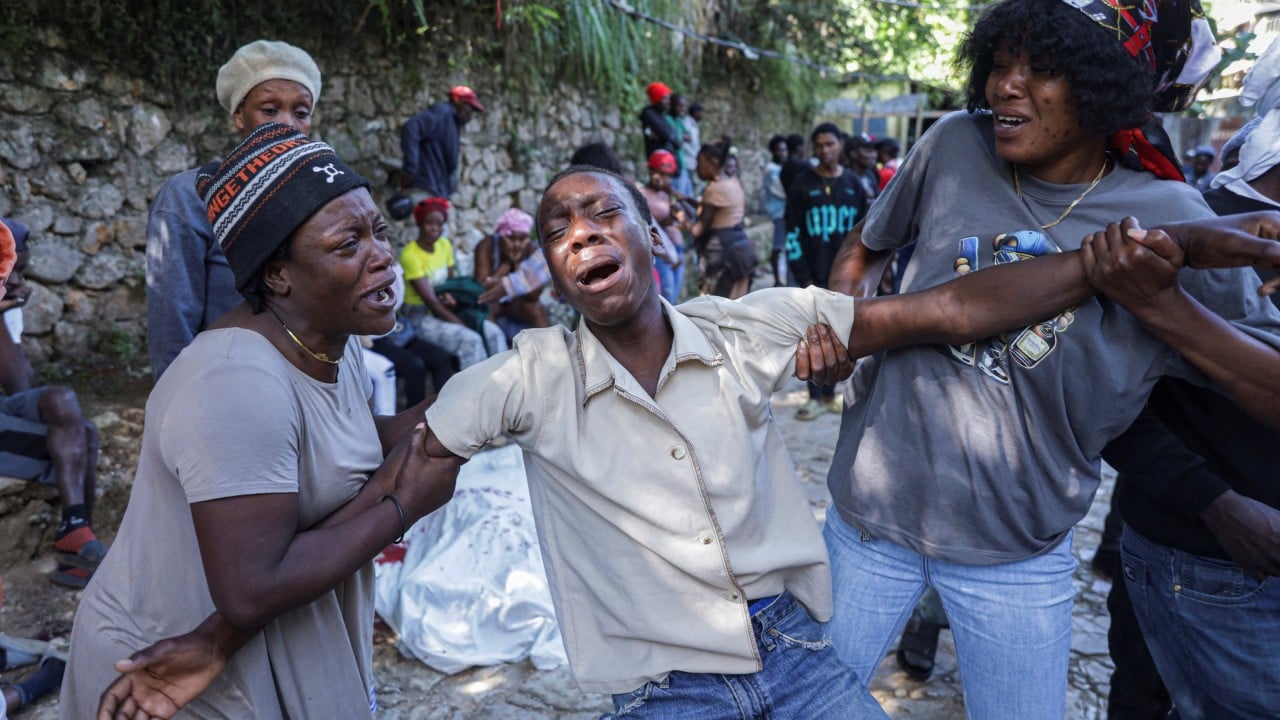
Before dawn broke over western Haiti, that silence shattered. Automatic gunfire echoed through the streets. Flames licked the thatch and tin roofs of modest family homes. By the time the sun fully rose, at least 47 people were dead. Dozens more lay wounded, their blood soaking into the dust of a town that had spent months begging for protection that never arrived. As extensively documented in latest reports by The New York Times, the implications are worth noting.
Numbers tell a story, but they rarely tell the truth. A body count of 47 is a statistical headline for a wire service. In reality, it is 47 empty chairs at breakfast tables. It is dozens of children who will never hear their mothers call them in for dinner. It is an entire agricultural hub reduced to a crime scene while the institutions built to protect it look the other way.
The Anarchy of an Abandoned Valley
To understand how a armed gang can roll into a quiet town and massacre scores of innocent civilians, you have to look at the map of despair that Haiti has become.
For years, Port-au-Prince held the monopoly on terror. News cameras focused on the capital, where heavily armed coalitions controlled entire neighborhoods, turning streets into battle zones. But terror is a business. Like any business, it expands when it runs out of room.
The Gran Grif gang did not materialize out of thin air. They grew in the shadows of political neglect, slowly asserting control over the Artibonite region—Haiti’s breadbasket.
Think of a state’s security apparatus like a dam. When the dam holds, communities downstream can farm, trade, and build lives. But when small cracks appear and no one fills them, the water begins to seep. Eventually, the dam collapses entirely. What hit Pont-Sondé was not a surprise wave; it was the inevitable flood after years of structural failure.
Gang members arrived on motorcycles and in trucks. They did not just target local rivals or police outposts. They targeted everyone. They burned houses with families inside. They shot people fleeing down narrow alleys. They executed farmers who had nothing to give but the dirt on their boots.
The assault lasted for hours. Hours.
Consider what an hour feels like when you are hiding under a wooden bed, holding your hands over your child's mouth so their breath doesn't betray your location. Minutes turn into eternities. You listen to the crunch of boots outside your window. You hear shouting, screaming, the relentless pop-pop-pop of automatic rifles.
And through it all, you wait for the sirens. You wait for the flashing lights of the National Police. You pray for the armored vehicles to tear down the main road and reclaim the night.
The sirens never came.
The Weight of a Silent Phone
Public outrage did not begin after the bodies were cleared; it had been simmering for months.
In the hours following the attack, survivors and local officials expressed a bitter, familiar anger. The police had been warned. Community leaders had sent signals, desperate pleas, clear intelligence that an attack was imminent.
Imagine calling the authorities to report that armed men are gathering on the edge of your town, only to hear excuses. Or worse, silence.
The Haitian National Police are understaffed, under-equipped, and outgunned. That is a factual reality. Officers often lack basic body armor, ammunition, or functional vehicles. Many have not been paid in months. Some have abandoned their posts altogether, joining the mass exodus of citizens fleeing the country.
But understanding the tactical limitations of a police force does nothing to soften the blow for a mother who watched her home burn. Systemic failure is an abstract concept; a dead relative is permanent.
When a state loses its monopoly on violence, citizens are left with an impossible choice. They can flee, abandoning their ancestral land to live in overcrowded, disease-ridden makeshift camps in larger cities. They can form self-defense groups, taking up crude weapons and fueling an endless cycle of vigilante vengeance. Or they can stay, quiet and terrified, paying extortion fees to local warlords just for the privilege of waking up tomorrow.
Trust is a fragile structure. It takes decades to build a social contract where citizens pay taxes and respect laws in exchange for security. In Haiti, that contract hasn't just been broken—it has been shredded and scattered to the wind.
International Promises and Ground-Level Realities
Far away from the dirt roads of Artibonite, in air-conditioned conference rooms in New York and Washington, diplomats speak of stabilization missions.
They talk about mandates, troop deployments, and strategic frameworks. A Kenya-led multinational security support mission was deployed to help local forces reclaim control. On paper, it represents international solidarity. On paper, help is on the way.
Ground-level reality moves at a vastly different speed than international bureaucracy.
A foreign security force operating in a country where they don't speak the language, where they don't know the alleyways, and where they lack clear operational integration with local units faces an uphill battle. While international leaders debate funding packages and logistics, the gangs adapt. They shift tactics. They move from established strongholds into unprotected rural zones like Pont-Sondé, striking where resistance is weakest.
The math is brutal. A few hundred foreign officers scattered across a nation gripped by hundreds of distinct gang factions cannot be everywhere at once.
When international intervention is announced with great fanfare but yields slow, barely perceptible results on the ground, it leaves the population feeling twice betrayed. First by their own government, and then by the global community that promised to save them.
The Invisible Cost of Survival
We often measure disasters in immediate casualties. Forty-seven dead. Hundreds wounded. Thousands displaced.
The true cost, however, is invisible, compounding quietly in the weeks and months that follow.
Artibonite is the primary rice-producing region of Haiti. When gangs terrorize these towns, farmers cannot tend to their fields. Crops rot in the soil. Irrigations systems fall into disrepair. The immediate security crisis morphs into an impending famine.
A family that loses its patriarch in an attack loses its primary earner. A child whose school is burned down loses their only bridge out of generational poverty. A small shop owner whose inventory is looted loses their life savings in a single afternoon.
Trauma settles over the land like thick fog. It changes how people walk, how they talk, how they look at strangers. It robs a community of its future by forcing everyone to focus entirely on surviving the next ten minutes.
In Pont-Sondé, the survivors spent the morning after the attack sifting through smoldering rubble. They carried bodies on improvised stretchers made of wooden doors and woven blankets. There were no mass ambulances, no grief counselors, no coordinated relief efforts arriving with supplies. There were only neighbors helping neighbors collect what was left of their lives.
A woman sat on an overturned plastic bucket near the center of town, her dress stained with gray ash. She didn't cry. Her eyes were fixed on a scorched patch of earth where her neighbor's kitchen used to stand.
"We asked them to come," she said quietly to a local reporter, her voice flat, devoid of energy. "We told them yesterday. We told them last week."
She didn't name the police. She didn't name the government. She didn't have to. Everyone knew who had failed to show up.
The sun climbed higher, baking the valley in intense, unyielding heat. Life in the town began to move again, but it moved haltingly, like a clock with broken gears. People gathered their belongings into plastic sacks, tied them tightly, and began to walk away from the river, away from their farms, away from the place they had called home.
Behind them, the road stretched out empty, waiting for a rescue that belonged only to memory.