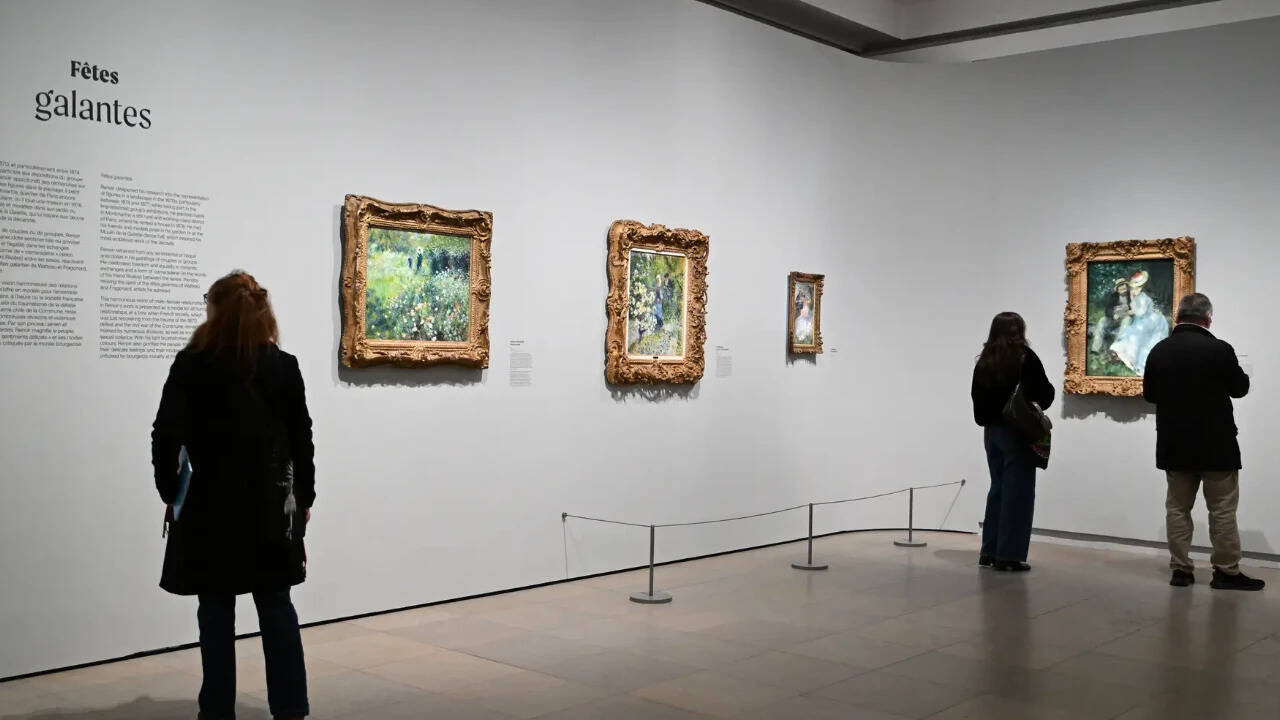
The alarm did not scream. It whispered. In the dead of a quiet night, tucked away in the French countryside, a museum holding centuries of light and brushstrokes became a ghost town long before the guards realized the shadows had moved.
Pierre stood in the center of the gallery floor, staring at the raw, pale patches of wallpaper where Pierre-Auguste Renoir’s masterpieces had hung only hours before. The wall was sunburned in reverse—the exposed fabric vibrant, the surrounding areas darkened by decades of atmospheric exposure. Four paintings, valued at roughly ninety-three crore rupees, gone. Vanished into the damp Mediterranean air.
He was not a detective, but a man who spent his life cleaning glass cases and adjusting track lighting. He knew the brushwork of those stolen canvases better than he knew the faces of his own neighbors. He knew how Renoir captured the unfiltered shimmer of sunlight dappling through Parisian trees, the way a woman’s cheek on canvas could feel warmer than the cold stone floor of the exhibit hall. To the world, the loss was an astronomical figure, a cold statistic splashed across morning headlines in Mumbai and Paris alike. To Pierre, it felt like someone had reached into his chest and torn out a handful of memories he had not yet finished making.
Art theft is rarely the cinematic masterpiece Hollywood promises. There is no sleek tuxedo, no laser grid dance, no intellectual sparring with a charming inspector. It is crude, messy, and desperate. Consider the physical reality of the crime at the Renoir museum. Four canvases, saturated with history, wrenched from their frames by gloved hands working frantically against the ticking clock of a silent alarm. The thieves moved with the brutal efficiency of people who understood market value but possessed zero reverence for creation.
And then, clumsily, human error intervened.
As they fled into the night, scrambling toward a getaway vehicle with engines roaring to break the rural silence, one of the stolen paintings slipped. A Renoir canvas—irreplaceable, fragile, soaked in the gentle blues and warm rose tones of the late nineteenth century—hit the asphalt.
Picture the sound. The dull slap of canvas against cold road. The sudden intake of breath by a panicked thief in the dark.
They scooped it up, tossed it into the trunk, and vanished. But the damage was done. A priceless fragment of human expression treated like a dropped bag of groceries. That singular detail exposes the grotesque irony of high-end art theft. The underworld covets what it cannot possess, steals what it cannot display, and breaks what it pretends to value.
The black market for stolen art is a strange, suffocating purgatory. Masterpieces worth crores cannot simply be hung above a criminal’s mantelpiece. You cannot show them off at dinner parties. You cannot sell them at Christie’s. They sit rolled up in PVC pipes, hidden behind boxes in damp basements, or buried beneath floorboards, slowly deteriorating from humidity and neglect. The thieves steal the soul of a painting, leaving themselves with a hostage they can neither ransom nor safely release.
Why do they do it? Greed is the obvious answer, but it is rarely the truest one. Greed is a ledger balance. Art theft is an act of supreme arrogance, a belief that beauty can be owned if you are violent enough to take it. It treats culture as a commodity, forgetting that a painting is not just oil and flax; it is a conversation across centuries. When a Renoir is stolen, the conversation is abruptly muted. The public is robbed of the chance to stand before a canvas on a Tuesday afternoon and feel entirely, uncomfortably alive.
In the days following the heist, the museum doors remained shut. The press vans departed, leaving behind tire tracks on the gravel. The investigators dusted for prints that would likely lead nowhere, tracing digital whispers and scanning surveillance feeds that caught only grainy, faceless silhouettes.
Pierre went back inside the empty room. He walked up to the pale scar on the wall where his favorite portrait used to hang. He reached out a trembling hand, stopping an inch away from the fabric, refusing to touch the ghost of the painting.
The canvas might eventually be recovered. Sometimes miracles happen in dusty warehouses, and a anonymous tip leads police back to a rolled-up treasure. But even if it returns, carrying the microscopic scuff of an asphalt drop on its corner, it will never be innocent again. It will carry the invisible scar of the night it was treated like currency instead of art.
The thieves are still out there, hiding in the vast, noisy anonymity of the world, staring at a stolen canvas they are too afraid to unroll. And the wall waits, remembering the exact angle where the sun used to live.