The rain in southern China doesn’t just fall. It heavy-packs the air until breathing feels like swallowing wet wool. On a Tuesday evening that felt indistinguishable from a thousand others, the commuters of Guangdong province were just trying to get home. They were thinking about dinner. They were thinking about wet shoes. They were not thinking about the structural integrity of the concrete beneath their tires.
Then came the sound.
It wasn’t an explosion. It was a wet, tearing groan—the sound of thousands of tons of reinforced engineering suddenly deciding it could no longer fight gravity.
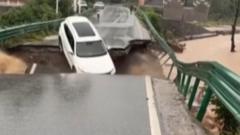
Within seconds, a massive section of the highway dissolved into the raging, muddy torrent of the river below. Headlights swept wildly through the darkness as drivers slammed on brakes, the smell of burning rubber mixing with the scent of pulverized stone. For one vehicle, the realization came a heartbeat too late. The tail lights dipped, swung, and vanished into the foam.
We watch these videos on our phones in ten-second loops. We see the terrifying plunge, the water swallowing steel, the distant shouts of bystanders captured on low-resolution dashcams. We click "next." But when you look past the viral shock factor, you find yourself staring into a much deeper, darker pool of human vulnerability. It is the sudden, violent shattering of the invisible contract we sign with the modern world every single time we step outside.
The Illusion of Solid Ground
Every day, we outsource our survival to strangers.
Think about it. We hurtle across massive chasms at sixty miles an hour, encased in fragile metal boxes, trusting that a team of engineers we’ve never met used the right grade of concrete twenty years ago. We assume the soil beneath the pillars is stable. We trust that the inspectors weren’t tired on the day they signed the safety certificates.
This trust is comfortable. It is also entirely hallucinatory.
When a bridge fails during a flash flood, it isn’t just a failure of concrete and rebar. It is a failure of prediction. Extreme weather events are no longer anomalies; they are the baseline. Rivers that used to swell gently now transform into hydraulic battering rams within hours, choked with debris and moving with the force of a freight train.
Consider a hypothetical driver—let’s call him Zhou. Zhou is forty-two. He knows this road like the back of his hand. He drives it twice a day. To Zhou, the bridge isn't an engineering marvel; it is just a five-minute stretch where he can look at the river and check if the water level is rising. He has no reason to believe that tonight, the river is eating away at the very foundations of his routine.
When the asphalt gave way, Zhou wasn't dealing with a traffic delay. He was witnessing the sudden collapse of predictability.
The Mechanics of Sudden Chaos
How does a structure designed to hold thousands of vehicles simply disappear?
The answer lies in a process engineers call scour. Imagine holding a garden hose on a patch of loose dirt. The water quickly carves out a hole. Now multiply that hose by a billion, muddy the water with logs and boulders, and slam it against a concrete pillar for forty-eight hours straight.
The water acts like sandpaper. It systematically erodes the riverbed around the bridge supports. You can paint the bridge, you can pave the road, you can make the guardrails look pristine. But underneath the surface, out of sight of every passing motorist, the bridge is being hollowed out.
The terrifying part of this engineering reality is that a bridge undergoing scour looks perfectly fine right up until the second it isn’t. It doesn’t sag gently to give you a warning. It doesn’t creak or groan for days in advance.
The foundation vanishes. The weight remains. The math becomes impossible.
Then, the snap.
The Anatomy of the Plunge
When the vehicle in Guangdong went over the edge, the physics of the situation transformed instantly from an infrastructure problem into a brutal fight for oxygen.
Have you ever tried to open a car door underwater? It is physically impossible until the interior of the vehicle completely fills with water, equalizing the pressure. To someone trapped inside, every instinct screams to push against the glass, to fight the incoming torrent. But the weight of the river is a physical wall.
Witnesses on the bank described the terrifying speed of the current. In a flood, a river isn't just water; it is a thick slurry of mud, branches, and debris. It is heavy. It moves with a kinetic energy that can roll a two-ton SUV like a tin can.
Those watching from the severed edge of the highway could only shine their flashlights into the brown abyss. The light beams hit the mist, scattered, and died. The river took the car, and the darkness took the river.
The Cost of Living in the Aftermath
We live in an era of hyper-connectivity, where a disaster on the other side of the planet lands in our palms before the dust has even settled. We analyze the footage. We debate the infrastructure budgets of foreign nations. We point fingers at climate patterns or construction standards.
But the real problem lies elsewhere. It rests in the quiet, creeping anxiety that stays behind after the emergency vehicles turn off their sirens.
The next morning, thousands of people in that same province had to drive to work. They had to cross other bridges, spanning other rivers, under the same heavy, relentless rain. Imagine the tightening in the chest as the tires hit the expansion joints. Imagine the involuntary glance down at the water level.
That is the true casualty of infrastructure failure. It robs us of our collective peace of mind. It turns a mundane commute into a game of Russian roulette with the elements.
The search and rescue teams eventually found the vehicle, miles downstream, battered and filled with river silt. The news reports updated their headlines with the final casualty numbers, transitioned to a different story about economic data, and the world kept spinning.
But for those who stood on the edge of that broken highway, looking into the gap where civilization used to be, the world will never look quite as solid again. The rain continues to fall, the rivers continue to rise, and beneath the smooth, black asphalt we trust so implicitly, the water keeps digging.