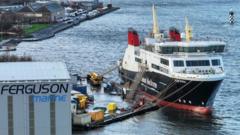
The Scottish government just handed Ferguson Marine a massive win. It's the kind of news that makes people in Port Glasgow breathe a little easier. After years of headlines dominated by delays, soaring costs, and political finger-pointing over the two late ferries, the shipyard is finally getting a fresh start with contracts for four new vessels.
This isn't just about building boats. It’s about survival. For a long time, the narrative around Ferguson Marine was one of failure. Critics argued the yard couldn't compete. They said the state-owned facility was a money pit. But these four new small vessels—intended for the Clyde and Hebrides ferry services—represent a strategic pivot. Instead of chasing the glory of massive, complex dual-fuel ships that broke the bank, the yard is returning to what it does best. Small, reliable, and essential workhorses.
If you've followed the "ferry fiasco" involving the Glen Sannox and the yet-to-be-named Hull 802, you know the stakes are high. Those ships are years overdue and hundreds of millions over budget. By awarding these new contracts to Ferguson Marine, the government is betting that the yard has learned its lessons. They're betting on the workforce. Most importantly, they're betting on the future of the Scottish industrial base.
Breaking the Cycle of Delays at Ferguson Marine
Everyone wants to know if this time will be different. It’s a fair question. The previous projects became a cautionary tale for government intervention in industry. However, the scope of these four new ships is fundamentally different. We aren't looking at experimental green tech that hasn't been scaled properly. These are standard, small-scale ferries designed for shorter routes.
The decision to bypass a full international tender process for these specific ships has raised some eyebrows in the world of maritime law. Usually, these things have to go out to the lowest bidder, often in Turkey or Poland. But the Scottish Government used a "direct award" mechanism. They’re justifying this by focusing on the "Teckal" exemption, which allows public authorities to award contracts to their own companies without a massive competitive circus.
It's a bold move. It’s also a necessary one. If Ferguson Marine didn't get these contracts, the yard likely would have faced a "workload gap." In shipbuilding, a gap is a death sentence. You lose your skilled welders. Your engineers move to Rosyth or south of the border. Once those skills leave the Clyde, they don't come back. By plugging this gap now, the government is keeping the lights on and the hammers swinging.
What the Four Small Vessels Mean for Island Communities
For the people living on the islands, these ships aren't political footballs. They're a pulse. The current fleet is aging rapidly. Some vessels are nearly forty years old. They break down. They get pulled for emergency repairs. When a ferry is out of action, the supermarket shelves go empty. Kids can’t get to school. Tourists cancel bookings.
These four new ships are specifically designed for the "Small Vessel Replacement Programme" (SVRP). They'll serve routes like Lochranza to Claonaig and Colintraive to Rhubhodach. These aren't the long hauls across the Minch. They're the short, high-frequency hops that keep the islands functioning.
- Reliability: Newer ships mean fewer cancellations due to technical faults.
- Capacity: These designs often allow for better vehicle deck layouts, even on small hulls.
- Standardization: Building four of the same type allows for easier maintenance and interchangeable parts across the fleet.
Honest talk? The islands have been neglected. The focus on the two big "mega-ferries" distracted from the crumbling infrastructure of the smaller routes. This contract finally addresses the bread-and-butter needs of the Hebrides.
The Economic Reality of State Owned Shipbuilding
Let's talk about the money because it’s a lot of taxpayer cash. Some economists argue that if a yard can't win a contract on the open market, it shouldn't exist. They'll tell you it's cheaper to buy ships from abroad. On paper, they’re right. A yard in Asia or Eastern Europe can often undercut a Scottish yard by 20% or 30%.
But that’s a narrow way to look at an economy. When you build a ship in Port Glasgow, that money stays in the local community. It pays for apprenticeships. It supports a local supply chain of steel stockholders, electricians, and plumbers. It keeps the "Govan DNA" of shipbuilding alive.
There's also a national security and sovereign capability argument here. If the UK—and Scotland specifically—loses the ability to build its own essential infrastructure, we become entirely reliant on global supply chains that have proven fragile lately. Building these four ships at Ferguson Marine is an investment in "social value" that a spreadsheet from a Turkish yard can't replicate.
Overcoming the Ghost of Glen Sannox
The shadow of the Glen Sannox is long. That ship became a symbol of everything that can go wrong when politics meets procurement. The complicated dual-fuel LNG system was a nightmare to integrate. The design was changed mid-build. The communication between Caledonian Maritime Assets Ltd (CMAL) and the shipyard was, frankly, toxic for a long time.
For Ferguson Marine to succeed with these four new ships, the management structure has to be ironclad. We've seen leadership changes at the yard recently. There's a push for more transparency. The workforce is talented, but they need a stable environment.
You can't just blame the workers for the past mistakes. Most of the issues were at the top—contractual disputes and design specs that shifted like sand. With the new contracts, the specifications are locked in. The goal is "repeatability." Build the first one. Learn. Build the second one faster. By the time they get to the fourth ship, the process should be a well-oiled machine.
Technical Specs and the Move Toward Greener Shipping
While these four ships are simpler than the giant ferries currently under construction, they aren't low-tech. The maritime industry is under massive pressure to decarbonize. Scotland has some of the most ambitious net-zero targets in the world.
These vessels will likely feature hybrid propulsion systems. This means they can use battery power for maneuvering in and out of ports, significantly cutting down on local emissions and noise pollution. It’s better for the marine life and better for the residents living near the piers.
Building these "clean" small vessels gives Ferguson Marine a niche. If they can prove they are the masters of small, hybrid ferry technology, they can export that expertise. Other island nations and coastal regions are looking for exactly this type of solution. It’s about turning a local necessity into a global business case.
The Political Stakes for Holyrood
The Scottish Government is under a microscope here. They took Ferguson Marine into public ownership because they had to. The alternative was the total collapse of the yard and the loss of hundreds of jobs. But "nationalization" is only a success if the company eventually becomes self-sustaining.
This contract is the bridge to that sustainability. If the yard delivers these four ships on time and on budget, it proves the state-ownership model can work. If they fail, or if costs spiral again, it will be a political disaster that no amount of spin can fix.
The opposition parties are already circling. They'll be watching every penny spent on this new contract. The pressure on the shipyard's management is immense. They aren't just building ships; they’re defending a political ideology.
What Happens Next on the Clyde
Work won't start tomorrow. There’s a period of design finalization and procurement of materials. But the psychological impact is immediate. For the apprentices at Ferguson Marine, this means a future. It means they’ll finish their training working on active hulls rather than just sweeping the floors of a quiet shed.
The yard needs to move fast. They need to demonstrate progress early to win back public trust. You should expect to see steel cutting ceremonies and milestone updates more frequently than before.
If you're a local business in Inverclyde, now's the time to look at your own capacity. The "ripple effect" of a busy shipyard is huge. From the cafes that feed the workers to the specialized engineering firms that consult on the builds, the whole region gets a lift when the yard is full.
Stop waiting for the "perfect" moment for Scottish industry. It doesn't exist. There are only moments of opportunity. This contract is exactly that. It’s a chance to move past the errors of the last decade and prove that the Clyde can still build world-class ships. The workforce is ready. The money is allocated. Now, it's time to get the job done.
Monitor the official Scottish Government procurement updates and the Ferguson Marine project milestones over the next six months. If you are a supplier in the maritime space, ensure your certifications are up to date for public sector contracts. For everyone else, keep an eye on the "steel cutting" dates—that's when the real work begins.