The thumb hovered. It was a rhythmic, almost unconscious motion—the same twitch that millions of us perform while waiting for the coffee to brew or sitting in the back of a taxi. But when Donald Trump’s thumb pressed "post" on Truth Social, it didn't just share a picture. It launched a digital ghost.
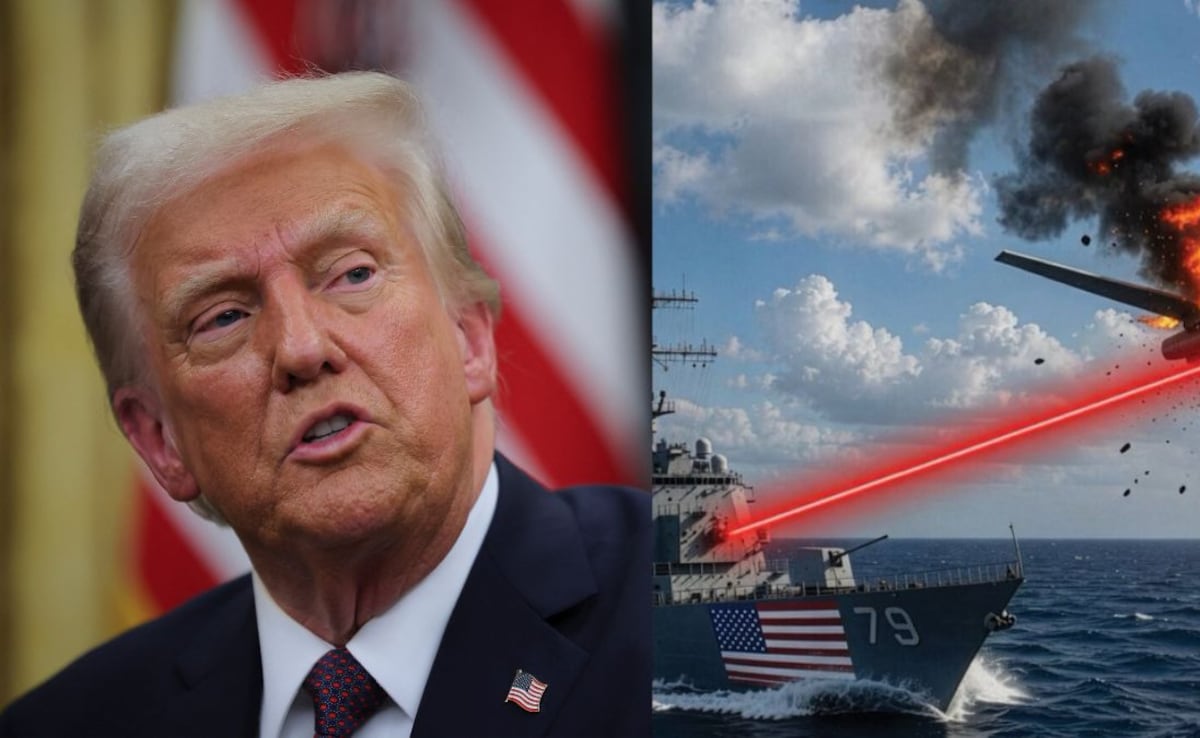
The image was hyper-vivid. It possessed that strange, uncanny sheen common to artificial intelligence: colors too saturated to be real, edges too sharp to exist in the dusty atmosphere of a physical world. It depicted an Iranian aircraft caught in the crosshairs of a futuristic laser beam. A bolt of concentrated light, clean and surgical, slicing through the air. Above it, the words "Bing, Bing, Gone" echoed the rhythmic sound effects Trump often uses at his rallies to describe military prowess.
It was a cartoon of war. Yet, the implications were heavy with the weight of real-world lead.
The Sound of a New Reality
We have entered an era where the sound of a "bing" is no longer just an onomatopoeia for a successful hit. In the current political theater, it represents a fundamental shift in how we process truth. When a former president and current candidate shares an AI-generated fantasy of a military strike, the boundary between policy and fan fiction doesn't just blur. It vanishes.
Consider the person sitting in a small apartment in Tehran, scrolling through the same feed. They don't see a "cool" digital edit. They see a projection of intent. They see the digitized dream of their own destruction. For them, the "bing" isn't a joke; it’s a vibration in the floorboards.
Hypothetically, imagine a junior analyst at a foreign intelligence agency. Their job is to monitor social media for "indications and warnings." Suddenly, an image appears showing a high-tech attack on their national assets. In the high-stakes seconds of geopolitical tension, does that analyst stop to check for the tell-tale blurring of AI-generated pixels? Or do they signal an alert? The friction between a digital hallucination and a kinetic response is now thinner than a smartphone screen.
The Aesthetics of Aggression
The images in question weren't grainy surveillance footage or a shaky cell phone video from a combat zone. They were polished. They had the aesthetic of a high-budget video game. This is the "gamification" of international relations. By using AI to create these visuals, the horror of conflict is stripped away, replaced by a sanitized, glowing triumph of light and energy.
When we look at a real photo of war, we see the grit. We see the smoke that stings the eyes and the twisted metal that smells of burnt fuel. AI removes the smell. It removes the grit. It turns a lethal engagement into a satisfying visual "pop." This transition matters because it changes how the public consents to or demands conflict. If war looks like a neon masterpiece, the psychological barrier to starting one lowers.
History has always had its propaganda. We’ve seen the posters of the 1940s and the grainy televised broadcasts of the 1990s. But those were curated by departments and committees. Today, a single person can generate a thousand variations of a "victory" that hasn't happened yet, tailoring the dopamine hit to the exact specifications of their audience's expectations.
The Invisible Stakes of the "Bing"
Behind the bright lights of the laser beam lies a much darker technical reality. AI is being used here as a tool for "strategic ambiguity." If the image is criticized, it can be dismissed as a joke, a meme, or a "creative" way of making a point. But the message is received by the base as a promise. It is a dual-track communication: one for the critics to scoff at, and one for the followers to rally behind.
This isn't just about one man or one post. It’s about the erosion of the shared ledger of history. If we can manifest our desired outcomes through digital imagery, why bother with the messy, difficult work of actual diplomacy or documented fact?
Think about the ripples. Every time an AI image of this nature is shared, it trains the viewer to distrust their own eyes. We are being conditioned to live in a state of permanent skepticism, where nothing is true and everything is possible. This creates a vacuum. And in a vacuum, the loudest voice—the one with the most "bings"—wins.
The Human Cost of Hyper-Reality
The most significant victim of this digital shift isn't a political opponent or a foreign government. It is our collective sense of empathy.
Real war is a tragedy of the human spirit. It is the story of a pilot with a family, a mechanic with a mortgage, and a civilian on the ground who just wanted to buy bread. When we replace those humans with AI-generated shapes being erased by lasers, we lose the ability to see the cost. We become spectators in a coliseum where the lions and the gladiators are made of code.
There is a specific kind of vertigo that comes with realizing that the world’s most powerful leaders are now operating in the same creative sandbox as teenagers making deepfakes in their bedrooms. The gravity of the office is being pulled into the orbit of the meme. This isn't a "pivotal" moment—it is a total restructuring of the floor we stand on.
The laser in the image didn't hit a plane. It hit the concept of a shared reality.
As the scroll continues and the next post replaces the last, the image of the laser-struck aircraft fades from the screen but lingers in the subconscious. We are left with a lingering question that no algorithm can answer. If we can no longer distinguish between a leader's intent and a machine's imagination, who is actually flying the plane?
The "bing" eventually stops echoing. But the silence that follows is far more deafening than the sound itself. It is the silence of a world where we have forgotten how to tell the difference between a dream and a nightmare, until the moment we wake up and realize the house is already on fire.