Bureaucratic mix-ups happen everywhere, but rarely do they trigger a cross-continental debate about sovereignty, military hardware, and currency design. Military social media pages are usually predictable. They post grainy footage of exercises, congratulate retiring generals, and occasionally share holiday messages.
Recently, the people running the online accounts for NATO's Airborne Early Warning and Control (AWACS) Force threw out the rulebook. They decided to redesign European Union currency.
The resulting digital panic exposed a very real confusion about where Brussels ends and the transatlantic military alliance begins. It sounds like a joke. It basically was one. But the internet took it seriously, because symbols matter.
The Euro Note Mockups That Started the Fire
The European Central Bank is currently reviewing designs for its upcoming series of euro banknotes. They're looking at historical figures and native birds. Normal stuff.
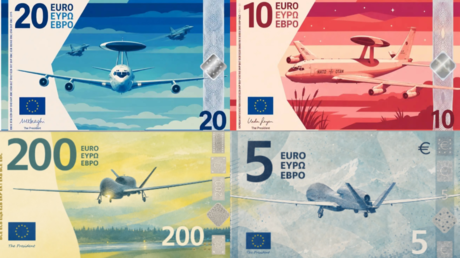
NATO's AWACS team had a different idea. They posted concept art featuring a US-made Boeing E-3 Sentry surveillance aircraft flying over European landscapes. They doubled down with an image of American F-16 fighter jets accompanying the design on a twenty-euro note.
"What if the new European banknotes had a little more...air superiority?" they asked in the caption.
Soon after, NATO's Intelligence, Surveillance and Reconnaissance (ISR) Force joined the joke. They posted currency mockups featuring an American RQ-4D Phoenix drone.
The military units thought it was lighthearted banter. The public viewed it through a much sharper lens.
Why the Confusion Matters
People got upset for a good reason. The European Union and NATO are entirely separate entities, even if they share many of the same member states.
Putting American military hardware on European civil currency creates a weird visual contradiction. Fifteen of NATO's thirty-two members do not use the euro. Meanwhile, four Eurozone countries—Austria, Cyprus, Ireland, and Malta—stay proudly outside of NATO.
Mixing the two signals public messaging sloppiness. Critics online quickly pointed out that plastering US defense assets onto European money looks less like a joke and more like a Freudian slip about geopolitical hierarchy.
One commenter suggested redesigning the note with a Saab Globaleye, noting it is at least half European. Others called the stunt a coordinated public relations push to blur the lines between European economic integration and American military dominance.
The Reality of European Defense Dependency
This design blunder hits a nerve because of ongoing arguments about European strategic autonomy. NATO Secretary General Mark Rutte has openly stated that Europe cannot defend itself without American backing.
When military communication channels playfully stamp US aircraft onto the currency of a distinct political union, it feeds into a narrative of permanent dependency. Citizens want to feel economically and politically sovereign. Seeing a Boeing jet on a euro note triggers anxieties about who's really running the show.
The European Central Bank's actual shortlist features figures like Marie Curie and Leonardo da Vinci. Those designs will move forward. The military mockups will remain internet artifacts.
Communications teams need to check their boundaries before posting next time. Europe's currency belongs to its citizens, not to the alliance keeping watch from above.
NATO Chief Warns Europe Can't Defend Itself Without US Amid Greenland Tensions
This video provides important context on the ongoing tensions and debates surrounding European defense independence and its reliance on the United States.