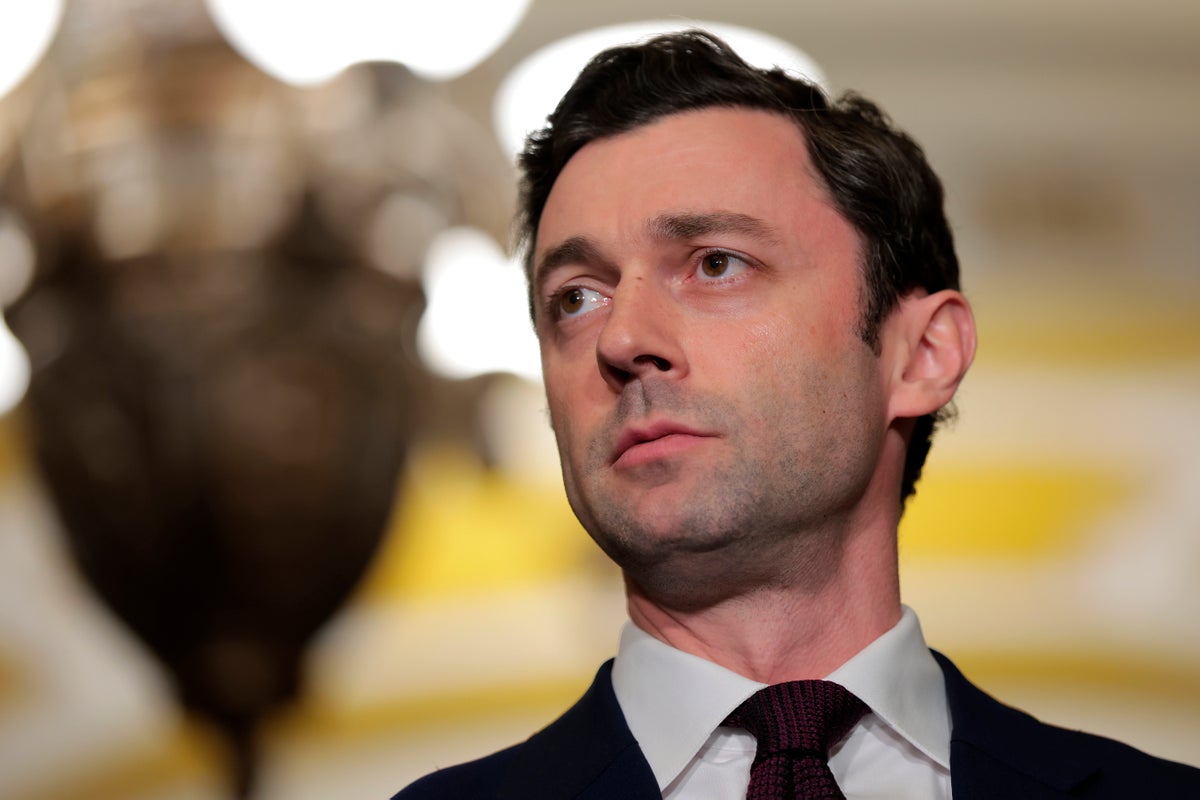
The political ecosystem of Washington operates on proximity, a currency often more valuable than policy or pedigree. When Senator Jon Ossoff stepped onto a Georgia campaign stage this past Sunday, he did not just deliver a standard critique of the administration. He shattered the opaque glass surrounding the president’s personal orbit by naming a single aide: Natalie Harp.
By mocking the president’s preference to "build his ballroom and travel with Natalie," Ossoff did more than land a punchline. He bypassed the traditional layers of the White House press office and struck directly at the psychological center of the administration. The explosive, visceral reaction from the president and his communication team suggests that the Georgia senator identified a vulnerability that goes far beyond partisan bickering. It revealed a touchiness that hints at a narrowing, increasingly insulated circle of trust.
The administration’s counter-offensive was immediate and disproportionate. President Trump reached for a cultural relic, labeling Ossoff a "Pee-wee Herman look-alike". Communications director Steven Cheung, known for his abrasive style, escalated the rhetoric to a degree that effectively signaled the White House had lost its equilibrium. This was not a calculated rebuttal. It was a reflex.
To understand why this specific jab caused such a frantic response, one must look at the unique role Natalie Harp occupies. She is not merely a staffer; she is a constant, a fixture in the president’s daily itinerary who is often seen just feet away from him at public functions. Her rise from a television host at a right-wing network to a gatekeeper of the presidential digital presence is a study in the consolidation of power through personal loyalty.
Inside the administration, that proximity has become a source of quiet frustration for others. The "human printer" nickname, coined during the 2024 campaign for her role in ensuring positive coverage reached the president, highlights the precise nature of her utility. In a structure where information flow is the ultimate prize, controlling what the leader sees is the highest form of influence. This is why the reaction to Ossoff was so sharp. By questioning the nature of that time spent, the senator inadvertently exposed the thin layer of personnel guarding the president’s attention.
The fragility of this arrangement is not lost on veteran observers. When power is concentrated in such a narrow aperture, the system becomes hypersensitive to even minor outside criticism. A staffer who effectively dictates Truth Social posts or physically carries the president’s communications needs is an easy target for allegations of undue influence. When that aide is singled out by a high-profile political opponent, it forces the administration into a defensive posture that makes them appear smaller, more petty, and increasingly detached from the broader national conversation.
Critics like David Axelrod have noted the risk in such tactical choices, pointing out that personal attacks often muddy the waters of substantive critique. There is a fine line between exposing a flaw in governance and engaging in a tawdry sideshow. Yet, for Ossoff, the benefit was likely calculated. He needed to illustrate a president disconnected from his duties—delegating the labor of office to a few select loyalists while pursuing personal projects like the controversial ballroom renovation.
The ballroom itself serves as a perfect metaphor for the administration's current state. It is an inward-facing construction project, a literal expansion of the president’s private space at a time when the external world demands his full attention. Ossoff’s framing of the "defenseless flying palace" and the president’s desire to escape the burdens of his office serves to paint an image of a leader who is more concerned with his personal comfort and curated entourage than with the mechanics of governing.
The tension within the White House surrounding Harp is likely exacerbated by the fact that she represents a departure from traditional staff structures. Where traditional advisors provide policy input and professional debate, Harp provides an environment of near-total confirmation. For a president who has historically valued loyalty over institutional expertise, this is the ideal setup. For the rest of the staff, it creates a bottleneck where their access is constantly filtered through or superseded by a single, ever-present aide.
This dynamic creates a feedback loop. Because Harp is the gatekeeper, she becomes the primary target for any external attack on the president's decision-making. When she is hit, the president feels the blow personally. His subsequent anger, manifesting in name-calling and erratic public statements, only validates the premise of the initial attack: that the administration is operating in a state of emotional volatility, untethered from the restraint expected of the office.
The real danger here is not the controversy itself but what it signals about the future of the administration's stability. When an organization—political or otherwise—becomes this sensitive to individual critiques, it is often a precursor to further isolation. The internal team becomes more guarded, the vetting process for information becomes more restrictive, and the leader becomes increasingly sequestered with a small group of "true believers" who are unwilling or unable to offer dissenting views.
History shows us that such cycles rarely end well. As the circle of trust shrinks, the quality of decision-making tends to degrade. The focus shifts from executing a long-term strategic agenda to managing the daily firestorm caused by the leader's reactions to perceived slights.
The "Natalie Harp effect" is ultimately a warning sign. It demonstrates that the administration has reached a point where the personal, petty grievances of the president are prioritized over the institutional decorum of the White House. When a senator’s offhand remark at a regional rally can trigger a cascade of vitriol from the executive branch, it suggests that the machinery of government is being diverted to serve the ego of the officeholder.
For the public, this is a clear window into how the current White House operates. It is a place where access is proximity, where loyalty is the primary metric of performance, and where a single aide can become the lightning rod for a national political struggle. Whether this strategy serves the president’s long-term interests is highly questionable. What is certain is that the intensity of the reaction has only guaranteed that the subject of the aide's role and her influence will remain at the forefront of the news cycle.
The administration’s inability to ignore the jab reflects a lack of confidence in their own narrative. A secure presidency would have allowed such a remark to pass without comment, treating it as the noise of a campaign cycle. Instead, they chose to engage, dragging the office down into the mud to defend a staffer who has now become synonymous with the president's most vulnerable traits.
This is the state of the modern executive branch: reactive, insular, and perpetually on the defensive. As long as the primary criteria for proximity remain uncritical devotion and the management of the president’s personal comfort, the door will remain open for more such disruptions. The question is not who will be the next target, but how much further the administration can drift from the core responsibilities of the state before the internal pressures, already heightened by this latest episode, finally force a structural breaking point.
The administration has made its choice. They have prioritized the protection of their own over the dignity of their mission. In doing so, they have exposed the very fragility they were so desperate to hide. The focus will now inevitably shift to the next incident, the next aide, and the next moment where the personal facade crumbles under the weight of external scrutiny. The cycle is self-sustaining, and it is far from reaching its conclusion.