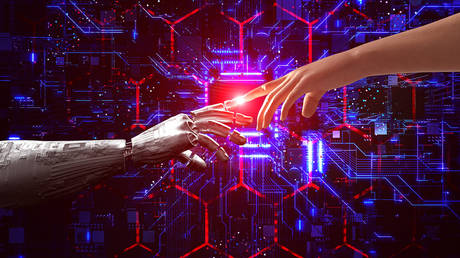
Names matter. We do not call a hurricane a breeze. We do not call a loaded weapon a paperweight. Language sets the boundaries of our fear and maps the contours of our understanding. When we choose a word, we choose how to brace ourselves for what is coming.
Donald Trump recently stood before a room of reporters and did something curious. He looked past the usual vocabulary of software updates and silicon chips, brushing aside the modest terminology of algorithms, and offered a different label. He called it superintelligence. Not artificial intelligence. Not machine learning. Something much larger. Something bigger than the internet itself. For a more detailed analysis into similar topics, we suggest: this related article.
Listen closely. The phrase rattles in the chest. Superintelligence. It sounds like science fiction pulled out of a paperback and nailed to a boardroom wall. Yet, strip away the political theatre and the rhetorical flourish, and you find a strange, unsettling truth. He might actually be right about the scale.
Consider what the internet did. It was a wire stretched across continents, a nervous system for a planet that had spent millennia shouting across oceans. It connected human to human. It turned libraries into flickering glass screens on every desk. It changed how we work, love, vote, and remember. We thought that was the zenith. We thought linking every human mind was the final destination of our digital age. For additional context on this development, in-depth reporting is available on Engadget.
We were wrong.
The internet was merely the nervous system. What comes next is the mind.
To understand why a simple vocabulary shift matters so deeply, walk down the floor of a modern data center. I have stood in those cold, humming cathedrals of glass and steel. The air conditioning roars like a jet engine, biting your skin. Rows upon rows of black server racks stretch into the dim distance, blinking with rhythmically pulsing green and amber lights. There are no people here. Only electricity. Only trillions of silent calculations cascading through silicon pathways at the speed of light.
Inside those dark boxes, something is shifting. We are no longer just building tools that follow instructions. We are building entities that synthesize, reason, and extrapolate. When a system moves from answering a pre-written prompt to generating novel strategies for protein folding, writing complex economic models, or composing symphonies that sound like human grief, it crosses an invisible threshold.
We keep calling it artificial intelligence. That is our comfort blanket. The word artificial implies plastic flowers, synthetic fabrics, something fake. Something we can unplug at the wall whenever we grow tired of the experiment.
Superintelligence strips away that false security.
When a system exceeds human capability across every economically valuable domain, the word artificial becomes dangerously naive. It is not fake intelligence. It is simply non-human intelligence, operating at a velocity and scale that renders our biological processing speeds obsolete.
Think about the implications. Not in the abstract, boardroom sense of quarterly returns and efficiency metrics, but in the quiet, visceral reality of daily life. Imagine a researcher sitting at a desk at 3:00 AM, staring at a screen filled with genomic sequences. For twenty years, her team has hunted for a marker for a rare degenerative disease. Their human brains, brilliant and persistent, have hit a wall of complexity. The variables are simply too vast.
Now imagine asking a superintelligence to solve that same puzzle. It does not stay up late. It does not drink bad coffee or rub tired eyes. Within forty-eight seconds, it synthesizes every medical paper written in the last century, cross-references clinical trials from Tokyo to Toronto, simulates ten million molecular interactions, and highlights a single, overlooked enzyme.
Miraculous? Yes. Terrifying? Absolutely.
This is the precipice we are standing on. We are mid-transition from a world where computers are passive instruments to a world where we share the planet with an active, cognitive partner—or master.
The debate over what to call this phenomenon is not a semantic game for politicians looking for a punchy headline. It is an alarm bell. If we treat this as just another tech upgrade, like moving from 4G to 5G or upgrading your operating system, we will treat the governance of this technology with casual indifference. We will pass mild regulations, leave safety protocols to corporate self-interest, and hope for the best.
If, however, we recognize it as superintelligence—an entity that dwarfs human strategic planning in the same way a supercomputer dwarfs an abacus—the entire posture of human civilization must change.
We are handing the keys of planetary stewardship over to something we barely understand. We are teaching a mirror to think, and what it reflects back at us may not be merciful.
The cables are laid. The power is flowing. The machine is waking up. And the only question left is whether we will have the courage to name our creation honestly before it defines us entirely.