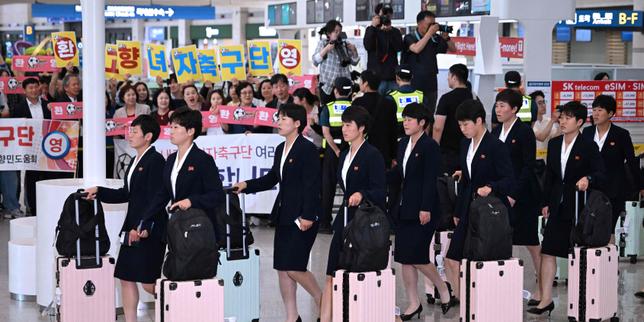
Sports diplomacy is usually a mirage. Governments use it to paper over deep political fractures, pretending a 90-minute match can erase decades of hostility. But when the North Korean women’s football team, Naegohyang FC, crossed the border into South Korea, the atmosphere shifted from mere athletic competition to an intense, highly scrutinized geopolitical event.
This was not just another tournament. The arrival of North Korean athletes on South Korean soil is a rare, high-stakes occurrence that draws immense attention from intelligence agencies, media outlets, and a public deeply divided on inter-Korean relations. For the players of Naegohyang FC, every movement, expression, and interaction was analyzed under a microscope.
Understanding the reality of this visit requires looking past the standard sports commentary. It reveals how women's football became a unique vehicle for cross-border relations and why these specific athletic exchanges carry a weight that traditional diplomacy cannot match.
Inside the High Security Bubble of Inter Korean Sports Exchange
You cannot understand a visit like this without grasping the sheer scale of the security apparatus involved. When Naegohyang FC travels south, they do not just book a hotel and hop on a team bus. They enter a tightly controlled, sterile environment designed to prevent any unsanctioned contact, political defection, or spontaneous public incidents.
South Korea’s National Intelligence Service and specialized police units coordinate these visits down to the exact second. The security protocol is immense.
- Entire hotel floors are cleared and locked down.
- Private transport corridors ensure the team never mixes with regular traffic or public crowds.
- North Korean officials accompany the squad everywhere, keeping a watchful eye on every player.
This strict surveillance is not just from the southern hosts. The North Korean regime is terrified of its citizens experiencing the wealth and relative freedom of Seoul or other South Korean cities. The players live in a dual bubble, monitored constantly by their own handlers and protected by South Korean security forces. It is exhausting. It is tense. Honestly, it is a miracle the players can focus on the pitch at all.
The Unique Power of North Korean Women Football
North Korea treats men’s and women’s sports very differently. While the men's national football team struggles to make a consistent impact globally, the women’s teams have historically been powerhouse competitors in Asia and on the world stage. The state pours resources into women's football because it yields international prestige, making teams like Naegohyang FC valuable cultural ambassadors for Pyongyang.
Naegohyang FC holds a distinct position within the North Korean sports hierarchy. It is not just a club; it is a highly disciplined institution. The players are state employees, subjected to rigorous training regimens that mirror military discipline.
When they face South Korean clubs, the match is never just about tactics or fitness. For the North, it is a test of ideological superiority. For the South, it is a complex emotional experience, watching players who speak the same language but live in a completely different world.
The contrast on the pitch is stark. South Korean players come from a burgeoning professional league system, enjoying commercial sponsorships, social media presence, and personal freedom. The North Korean players arrive with none of that branding. They play with a fierce, collective intensity that often catches opponents off guard. It is a clash of two entirely different sporting cultures wrapped up in a single match.
Public Reaction and the Political Split in Seoul
The presence of North Korean athletes always triggers a fierce debate within South Korean society. It splits generations cleanly down the middle.
Older South Koreans, who still carry the immediate cultural memory of a unified peninsula or the direct aftermath of the war, often view these visits with a sense of deep nostalgia and hope. They see the footballers as long-lost family members. You will see them waving unification flags, tears in their eyes, cheering for both sides.
The younger generation feels differently. Born decades after the division, many young South Koreans view North Korea as a separate, hostile state rather than a broken piece of their own country. They look at the massive state spending required to host these delegations and wonder why their tax money is funding a political show for a nuclear-armed neighbor.
This friction puts the South Korean government in a tough spot. They must balance the desire for diplomatic engagement with a public that is increasingly skeptical of symbolic gestures that lead to no real political change.
What Happens When the Cameras Turn Off
The real tragedy of these exchanges is their fleeting nature. On the pitch, for 90 minutes, the political barriers blur. Players challenge each other, shake hands, and occasionally share a brief, human moment during a stoppage in play. The crowd cheers for good football.
Then the whistle blows. The bubble re-inflates instantly.
The Naegohyang FC players are whisked back to their secure transport, shielded from reporters, and flown or driven back across the DMZ. The temporary bridge built by the match evaporates.
If you want to track the actual impact of these visits, stop looking for immediate political breakthroughs. They do not happen. Instead, look at the sports administrative channels that remain open even during high political tension. The fact that football associations on both sides can still negotiate logistics, security, and match schedules tells us that a baseline infrastructure for communication exists.
To understand the future of inter-Korean relations, watch how these sports federations interact over the next year. Watch the youth tournaments and regional qualifiers in Asia. That is where the real, quiet data lies, far away from the grandstanding of politicians.