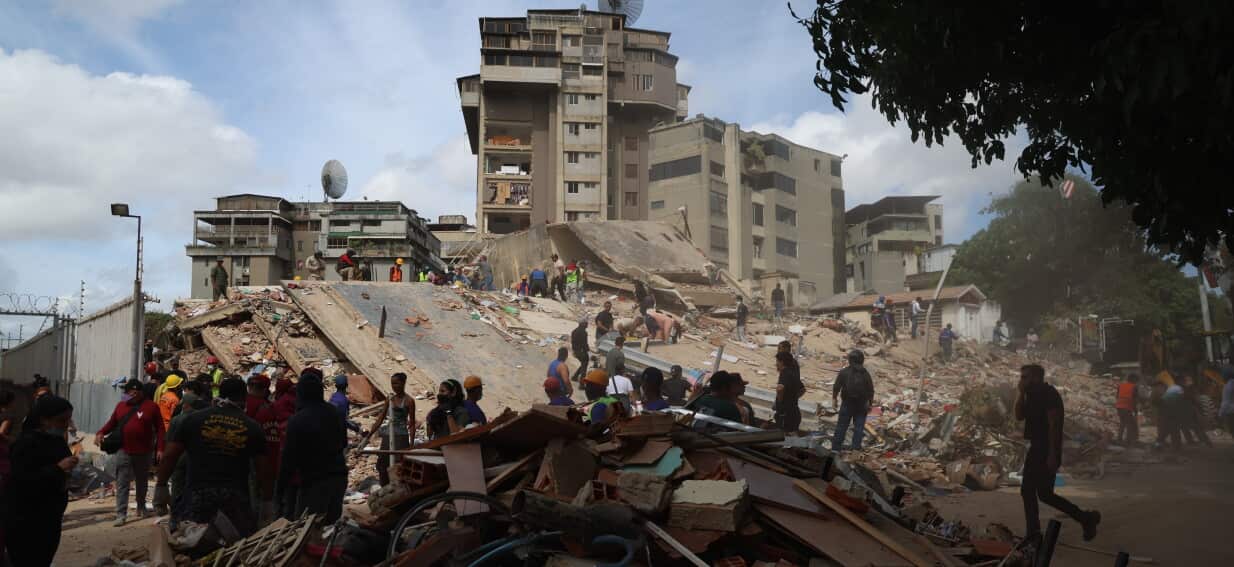
The media coverage surrounding the June 24, 2026, twin earthquakes in northern Venezuela is a masterclass in scientific deflection. Headlines are obsessing over a semantic distraction, asking whether a 7.2 magnitude event followed 39 seconds later by a 7.5 magnitude event constitutes a genuine "seismic doublet." They treat the disaster like an unpredictable cosmic anomaly—a freak "double tap" from nature that no one could have built for.
This narrative is a lie. Calling this a rare anomaly protects the institutions, politicians, and engineers who spent decades pretending that concrete slapdash housing in Caracas and La Guaira could withstand a highly active plate boundary. You might also find this connected article insightful: The Semiotics of Scarcity: Strategic Mass-Market Posturing in Modern Political Communications.
As a structural forensic analyst who has spent twenty years crawling through collapsed concrete columns from Izmit to Port-au-Prince, I know exactly what happened when the San Sebastián fault system ruptured. The term "doublet" is not a diagnosis of an unpredictable mystery; it is standard operating procedure for a mature, highly segmented strike-slip system. The real story isn't the 39-second gap between the two ruptures. The real story is the decades-long gap between known tectonic reality and criminal engineering neglect.
The Semantic Trap of the Doublet
Mainstream reporting frames an earthquake doublet as a bizarre geological quirk. They write about it as if two completely separate, unrelated bolts of lightning hit the exact same spot. Seismologically, this is an incredibly lazy interpretation. As discussed in detailed articles by The New York Times, the effects are notable.
Earthquakes are not isolated points on a map, despite the colorful dots the United States Geological Survey (USGS) drops on its public tracking portals. They are rapid, dynamic unzippings of a fault plane. When a major strike-slip boundary like the plate boundary between the Caribbean and South American plates moves at roughly 20 millimeters per year, it does not store stress uniformly. It behaves like an old, rusted zipper. Pull on it hard enough, and one tooth snaps, instantly throwing the load onto the tooth right next to it.
That is not a freak coincidence. It is basic Newtonian physics.
When the initial magnitude 7.2 foreshock ripped through the crust east-northeast of Yumare at 18:04 local time, it released a massive pocket of strain. But that energy did not vanish. It shifted. Through a process known as Coulomb stress transfer, the displacement of the first fault segment loaded instantaneous, critical pressure onto the adjacent segment of the San Sebastián fault system. The second segment was already sitting at its breaking point, primed by more than a century of tectonic loading since the devastating 1900 San Narciso disaster.
The 7.2 quake did not just happen to occur before a 7.5 quake. It directly manufactured it. It forced the second segment to fail 39 seconds later by transferring its mechanical load across a few kilometers of brittle crust. To frame this as a rare, unpredictable roll of the geological dice is to fundamentally misunderstand how fault networks communicate.
The Kinetic Reality of the 39-Second Hammer
To understand why the destruction in Caracas, Chacao, and Puerto Cabello was so total, we have to look at the mechanics of structural resonance rather than the vocabulary of geeks in lab coats.
Imagine a scenario where you strike a concrete wall once with a sledgehammer. The wall cracks. The internal steel rebar bends, deforming to absorb the kinetic energy. The building is severely damaged, but it remains standing because its internal skeletal structure utilizes its remaining plastic deformation capacity to hold up the dead load of the roof.
Now, strike that exact same wall a second time, 39 seconds later, while the dust from the first blow is still settling.
During those 39 seconds, the building is in its most vulnerable physical state. The concrete has spalled—meaning it has cracked and flaked away from the internal reinforcement. The steel columns are already buckled and stripped of their lateral support. The building no longer possesses its engineered capacity to dissipate energy. When the magnitude 7.5 mainshock hit from a shallower depth of 10 kilometers, it did not face a standing city. It faced a city that was already structurally dead but had not yet realized it needed to fall down.
The shallower depth of the second shock meant that the high-frequency seismic waves hit the surface with almost no geometric attenuation. They slammed directly into foundations that had been sheared loose less than a minute prior. This is why high-rise buildings in southeastern Caracas did not just crack—they experienced catastrophic pancake collapses, where floor plates dropped directly on top of each other because the vertical load-bearing columns were instantaneously pulverized.
The Fallacy of the Building Code Deficit
Every time an earthquake claims thousands of lives in a developing or economically strained nation, the immediate response from international non-governmental organizations is to call for better building codes. This is another distraction. Venezuela does not lack building codes. The country has had comprehensive seismic engineering standards on paper for decades, modeled directly after rigorous international criteria.
The problem is the massive chasm between a document sitting in a municipal office in Caracas and the concrete being poured on a hillside in Petare or La Guaira.
True structural resilience requires three things that money cannot easily buy when an economy is unravelling: high-grade clean aggregate, precise ratios of Portland cement, and rigorous field inspection to ensure contractors actually install the specified amount of steel rebar. When inflation skyrockets and supply chains freeze, contractors cut corners. They use unwashed beach sand full of corrosive salts that eat away at the internal rebar over decades. They water down the concrete mix to stretch their supply, reducing a specified 3,000 PSI compressive strength down to a brittle, chalky substance that fails under minor shear forces.
Furthermore, the geographical reality of northern Venezuela features steep topography prone to severe landslides and liquefaction. When seismic waves pass through saturated, poorly consolidated coastal soils—like those near the Simón Bolívar International Airport in La Guaira—the ground temporarily loses its shear strength and behaves like a liquid. No standard building code protects a structure when the very earth beneath its footings turns to soup. The issue isn't code design; it is systematic zoning corruption that allowed dense, high-density infrastructure to expand into high-risk geomorphic corridors.
Unconventional Structural Auditing
If you own or manage infrastructure anywhere along a major strike-slip fault system, waiting for municipal updates or trusting a pre-disaster occupancy permit is a recipe for catastrophe. The standard methods of checking building health are fundamentally broken.
To protect assets and human lives from highly probable sequential fault ruptures, look at structural mechanics through an entirely different lens:
- Audit for Non-Ductile Concrete: Buildings constructed prior to modern seismic detailing often feature short, widely spaced column ties. These are the metal hoops that wrap around vertical rebar. If these ties are spaced more than four inches apart in critical joint zones, the column will burst outward during a secondary shock.
- Identify Soft-Story Conditions: Look at the ground floor. If it features open parking spaces, large glass windows, or retail storefronts without heavy structural shear walls, the building has a soft-story vulnerability. The first shock will shift the mass, and the second shock will fold the ground floor like a cardboard box.
- Independent Foundation Validation: Never assume a building is safe just because the walls look intact after minor tremors. Micro-fissures at the foundation-to-soil interface can severely compromise structural integrity, leaving the property defenseless against the next major stress redistribution event.
The 2026 Venezuela disaster demonstrates that nature does not care about our administrative definitions of a mainshock or an aftershock. The San Sebastián fault system merely did what mature plate boundaries always do: it moved, it transferred its stress, and it cleared its throat. The tens of thousands of collapsed rooms are not the fault of an anomalous doublet. They are the direct, quantifiable result of engineering fraud hidden behind a facade of geological bad luck. Stop looking at the sky wondering when the next freak event will happen, and start looking at the concrete beneath your feet.
For a deeper look into the ground mechanics, fault segmentation, and how the USGS monitors real-time stress transfers during strike-slip events, watch this detailed breakdown on the USGS Earthquake Hazards Program which tracks the exact fault lines and tectonic movements that triggered this specific Venezuelan sequence.