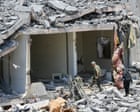
The global foreign policy establishment is running its standard playbook today. Israel strikes targets in Lebanon. The United States and Iran cancel a back-channel meeting in Switzerland. The cable news tickers flash red, oil traders spike the price of Brent crude by two bucks, and the consensus machine starts churning out panicked editorials about an impending regional apocalypse.
They are missing the entire point.
The media treats these moments like sudden, catastrophic breaks in geopolitical stability. They look at a canceled diplomatic summit in Geneva or Bern as a tragic lost opportunity for peace. This view is fundamentally flawed. It misreads the nature of modern statecraft, misunderstands how proxy conflicts actually operate, and falls for theater designed specifically to keep markets jumpy and taxpayers compliant.
Having analyzed regional defense infrastructure and economic data for over fifteen years, I have seen this exact cycle play out dozens of times. The headline says "Crisis." The reality is "Status Quo."
Let us break down the mechanics of what is actually happening behind the closed doors of the diplomatic hotels and along the Blue Line.
The Switzerland Cancellation Fallacy
The current consensus laments the suspension of US-Iran talks in Switzerland as a massive setback. The narrative implies that diplomats were on the cusp of a breakthrough until a kinetic strike disrupted the schedule.
This is a fundamental misunderstanding of back-channel diplomacy.
High-level talks between adversaries do not stop because a skirmish breaks out. They stop because one or both parties need to adjust their leverage using that skirmish.
- Diplomacy is Not an Alternative to Force: In the Middle East, diplomacy and kinetic actions are the exact same currency, just spent in different shops. A strike in southern Lebanon is not an interruption of a negotiation; it is a line item on the agenda.
- The Theater of Direct Talks: Officially canceling a meeting allows Washington to signal toughness to a domestic audience and regional allies. Simultaneously, it allows Tehran to posture as unbowed by Western pressure.
- The Unbroken Wire: The idea that the US and Iran have stopped talking because a Swiss room is empty is laughably naive. The Swiss government holds the protecting power mandate for a reason. The secure telex lines, the intelligence intermediaries, and the third-party financial channels never shut down. They get busier.
When we look at the historical data, major diplomatic shifts—like the implementation of the JCPOA framework years ago—did not happen during periods of serene calm. They happened immediately following intense periods of escalation. Canceling a public meeting is often the clearest sign that the real, ugly, cynical bargaining is about to begin.
The Broken Logic of Border Escalation
The second pillar of today's panic is the Israeli strikes on Lebanese targets. The standard analysis warns that this is the trigger for an uncontrollable regional war that will draw in global superpowers.
It won't.
The escalation between Israel and Hezbollah is governed by a highly calibrated, mutually understood mathematical formula. Both sides have spent decades mapping every square inch of the border, calculating acceptable thresholds of pain, and establishing implicit rules of engagement.
- The Target Matrix: Look closely at the data regarding these strikes. They are almost always confined to specific military infrastructure, launch sites, and open fields within a clearly defined geographic band.
- The Deterrence Equilibrium: Neither entity can afford a total war. Israel’s economy relies heavily on its high-tech sector and international investment, both of which dry up if main cities face sustained rocket fire. Hezbollah knows that turning Beirut into a war zone completely destroys its remaining political legitimacy within Lebanon's fractured domestic landscape.
What the mainstream media calls an "outbreak of violence" is actually a violent stabilization mechanism. It is how two heavily armed adversaries release pressure without blowing up the entire boiler room. It is a grim, destructive dance, but it is highly managed.
The Oil Market Disconnect
Every time a headline drops about Lebanon or canceled Iranian talks, algorithmic trading programs buy energy futures. The financial press screams about supply chain vulnerabilities and the Strait of Hormuz.
This is the wrong financial metric to watch.
The true test of regional instability is not the speculative price of oil on a Tuesday morning; it is the shipping insurance premiums and sovereign bond yields. If the deep-pocketed underwriters in London and Zurich are not drastically repricing maritime risk across the entire Persian Gulf, then the smart money knows the conflict is contained.
Currently, the global energy market is insulated by structural changes that the "crisis" narrative ignores. US shale production remains near historic highs, non-OPEC supply is robust, and global demand curves are flattening. The geopolitical premium added to oil during these media frenzies is brief, artificial, and quickly erased by automated selling the moment the news cycle shifts to a new topic. Investors who panic-buy during these headlines are simply funding the liquidity of institutional market makers.
Dismantling the "People Also Ask" Assumptions
If you look at what people are searching for during these flashpoints, the premises of the questions are entirely wrong.
Question: Will the cancellation of US-Iran talks lead to a direct military conflict between the two nations?
The Brutal Answer: No. The US and Iran have been engaged in a gray-zone conflict for over forty years. Neither state desires a direct kinetic confrontation because the cost-benefit analysis makes zero sense for either side. Washington does not want another multi-trillion-dollar ground entanglement in Asia. Tehran knows a conventional war would devastate its infrastructure and threaten regime survival. The proxy model works perfectly for both; it allows friction without total destruction. Canceling a meeting changes none of this underlying math.
Question: Can international mediators force Israel and Lebanon to agree to a permanent ceasefire?
The Brutal Answer: No, because a permanent ceasefire requires solving the underlying structural realities that neither side wants to touch. For Israel, Hezbollah's presence on its northern border is an existential security threat that no diplomatic piece of paper can erase. For Hezbollah, its status as a resistance movement is its entire reason for being; if it disarms, it becomes just another corrupt Lebanese political faction. Mediation can manage the boundaries of the conflict, but it cannot cure the disease.
The Real Risk Everyone Is Ignoring
While the world watches the smoke over the Lebanese border and the empty chairs in Switzerland, the actual shift is happening quietly in the global financial architecture.
The true danger of prolonged tension and cyclic diplomatic breakdowns is not a sudden world war. It is the steady, incremental decoupling of regional economies from Western systems. Every time the US uses the threat of secondary sanctions to shut down financial channels or cancel talks, it accelerates a trend that should terrify Western policymakers.
- Alternative Clearing Systems: Countries in the region are actively building and testing financial networks that bypass the SWIFT system entirely.
- Bilateral Trade in Local Currencies: Major energy buyers and sellers are increasingly settling transactions in currencies other than the US dollar.
- Strategic Realignment: The long-term consequence of permanent diplomatic friction is that non-Western powers move in to fill the vacuum, offering infrastructure investment and security arrangements without the baggage of Western political demands.
This is the nuance the competitor piece misses completely. They focus on the immediate, noisy events—the airstrike, the canceled press conference—while ignoring the silent tectonic shifts that actually reshape the global order.
Stop looking at the map of southern Lebanon. Stop reading the schedules of Swiss diplomats. Look at the balance sheets, the trade flows, and the hard realities of state survival. The crisis isn't that the system is breaking down today; the crisis is that this broken system is exactly how everyone involved intends to keep operating.