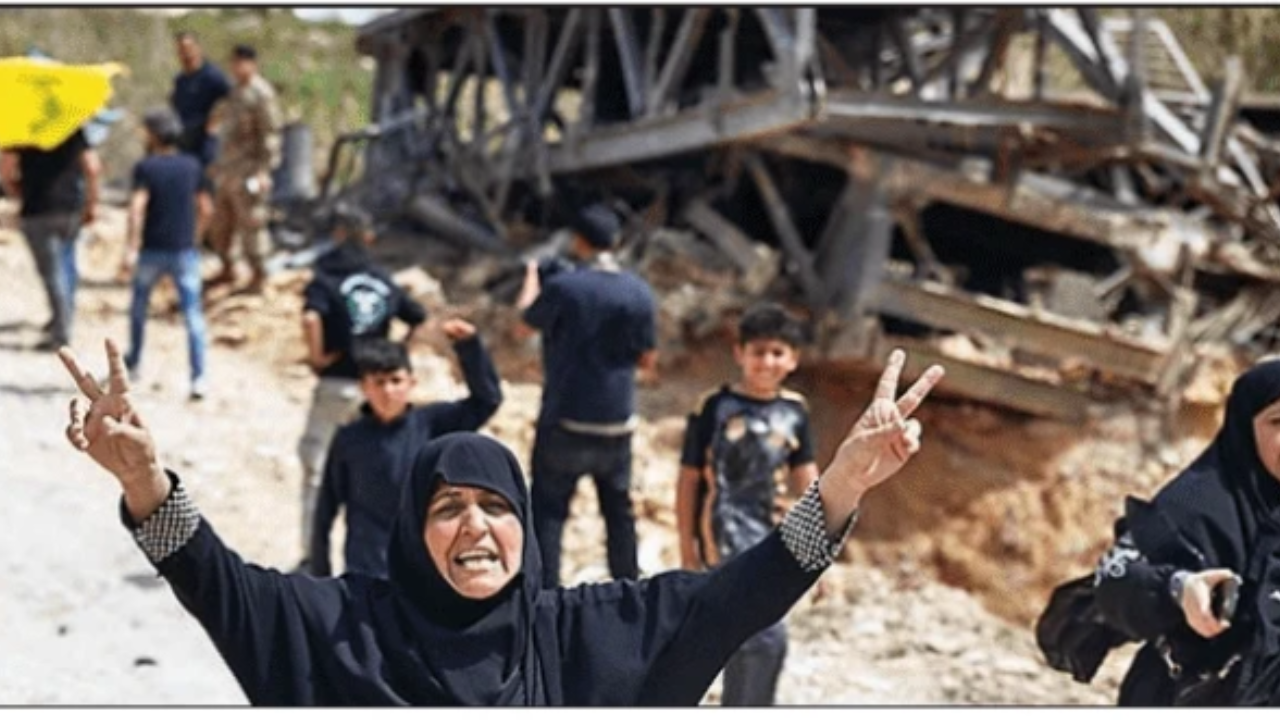
Media outlets are currently flooded with images of traffic jams on the coastal highways leading to South Lebanon. They call it a homecoming. They paint it as a triumph of the human spirit over the machinery of war. They are wrong. What we are witnessing isn't a victory or even a sustainable return; it is a desperate, economically driven gamble fueled by a "resilience" narrative that has become Lebanon’s most toxic export.
To suggest that areas pulverized by months of high-intensity conflict are suddenly "habitable" because a piece of paper was signed in Washington or Paris is more than optimistic. It is a lie. This isn't a return to life. It’s a return to the wreckage of a failed state that lacks the infrastructure to support a population, let alone a reconstruction effort of this magnitude.
The Resilience Trap
For decades, the world has romanticized the Lebanese people's ability to "bounce back." We’ve seen the headlines: "Lebanon: The Phoenix that Always Rises." This trope is a convenient excuse for international observers and local politicians to ignore the structural rot. When you label a population as naturally resilient, you give yourself permission to let them suffer.
In the current context, this resilience is being weaponized to justify sending civilians back into zones where the basic requirements for human survival—potable water, electricity, and unexploded ordnance (UXO) clearance—are non-existent. The "unliveable" label isn't a subjective opinion; it’s a technical reality. When the electrical grid is a memory and the water table is contaminated by the runoff of munitions, "going home" is a slow-motion catastrophe.
The Arithmetic of Ruin
Let’s look at the numbers that the "feel-good" return stories ignore. Reconstruction isn't just about pouring concrete. It’s about the Capital Expenditure (CAPEX) required to rebuild a shattered economy from a negative baseline.
Lebanon’s GDP has already contracted by more than 50% since 2019. The banking sector is a zombie. There is no credit. There is no insurance. If you are a shopkeeper returning to a pile of rubble in Bint Jbeil, you aren't "restarting." You are operating in a vacuum.
Imagine a scenario where a small business owner returns to find their inventory destroyed and their building structurally compromised. In a functioning economy, they would access a bridge loan or an insurance payout. In Lebanon, they are digging through the dust for scrap metal to sell. This isn't "entrepreneurial spirit." It’s the final stage of economic cannibalism.
The cost of clearing rubble and demining the South is estimated in the hundreds of millions. The cost of rebuilding the housing stock is in the billions. Without a centralized, transparent mechanism for funding—which the current sectarian framework is incapable of providing—the "return" is merely a temporary relocation of poverty.
The Geopolitical Illusion of "Mostly Holds"
The phrase "the ceasefire mostly holds" is a masterclass in linguistic evasion. In the world of security and risk assessment, "mostly" is a synonym for "unreliable."
Investors and families require certainty. A ceasefire that relies on the "restraint" of multiple non-state actors and a scorched-earth military doctrine on the other side is not a foundation for life. It is a pause button.
The status quo assumes that the absence of active shelling equals peace. It doesn't. Peace is the presence of civil order, the rule of law, and the ability to plan more than forty-eight hours into the future. By encouraging a mass return now, the international community is effectively using the civilian population as a human buffer zone to solidify a fragile diplomatic agreement.
The Failure of Urban Intelligence
We talk about "smart cities" and "technological integration" in the West, yet we ignore the "dumb destruction" happening in the Levant. The technology exists to map every crater, every unexploded cluster munition, and every severed water line using satellite imagery and AI-driven spatial analysis.
Why isn't this data being used to coordinate a phased, safe return? Because the data would prove the return is premature.
I’ve analyzed supply chains in conflict zones for years. You cannot run a supply chain for food or medicine when the roads are intermittently blocked by debris or military checkpoints. You cannot maintain a cold chain for vaccines or perishables when the power is out 22 hours a day. The logistical infrastructure required to support the hundreds of thousands moving south simply does not exist.
The Myth of the "Unliveable" Label
Critics will say, "People have nowhere else to go. The schools-turned-shelters in Beirut are overflowing."
This is true, but it’s a failure of policy, not an endorsement of the return. The choice between a crowded classroom floor and a collapsed roof in a minefield is a false dichotomy manufactured by a government that has abdicated its responsibility.
The term "unliveable" shouldn't be used as a deterrent; it should be used as a standard.
- Environmental Safety: Is the soil lead-heavy? Are there chemical residues from white phosphorus?
- Structural Integrity: Are the "standing" buildings actually safe, or will the first winter rain bring them down?
- Utility Access: Is there a path to 24/7 power that doesn't involve a private generator mafia?
If the answer to these is "no," the area is unliveable. Period. To say otherwise is to gaslight the victims.
Stop Celebrating the Traffic Jams
Every time a news outlet posts a video of families piling mattresses onto cars and driving south, they are cheering for a disaster. They are celebrating the fact that these people have been pushed to such an edge that they prefer a war zone to the "safety" of a displacement camp.
We need to stop asking "When will they go home?" and start asking "What are they going home to?"
If the answer is a landscape of toxic dust and shattered dreams, then the return isn't a sign of recovery. It’s the final act of a tragedy where the survivors are forced to bury themselves in the ruins of their former lives because the world found it too expensive to offer them a real future.
The ceasefire isn't a solution. It’s a transition from acute violence to chronic neglect. Don't call it a homecoming. Call it what it is: a desperate retreat into the debris.
Stop romanticizing the struggle. Start demanding the infrastructure. Until the lights stay on and the mines are gone, the South is still a graveyard, no matter how many cars are on the road.