Diplomacy is Just War by Other Means
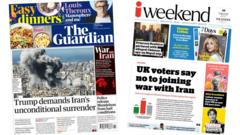
The headlines are screaming about "surrender" and "refusal." They paint a picture of a world standing on a knife-edge, where one man’s ego clashes with a nation’s exhaustion. It is a neat, cinematic narrative. It is also completely wrong.
When media outlets claim Donald Trump is demanding Iran’s "surrender," they are falling for the oldest trick in the geopolitical playbook: confusing posture with policy. This isn't a demand for a white flag; it is a price discovery mechanism. In the high-stakes bazaar of Middle Eastern optics, you don't start by asking for a handshake. You start by asking for the building.
Similarly, the narrative that British voters are simply "saying no" to war suggests a sudden lapse into pacifism. It isn’t. It’s a sophisticated, if cynical, calculation of ROI. The British public hasn't turned into a collective of Quakers; they’ve turned into skeptical shareholders who no longer believe the Board of Directors can deliver a return on the blood and treasure invested.
The Surrender Fallacy
Let’s dismantle the word "surrender." In the context of the Joint Comprehensive Plan of Action (JCPOA) and its subsequent collapse, "surrender" is a placeholder for "total verification."
The lazy consensus suggests that Trump’s maximum pressure campaign is a binary path to war. I’ve sat in rooms where these policies are drafted. The goal is never the explosion; it is the squeeze. The mistake analysts make is assuming that the Iranian regime is a monolithic entity that will either break or fight.
In reality, the Iranian leadership is a collection of competing power centers—the IRGC, the clerics, and the technocrats. Maximum pressure is designed to turn these groups against each other. When you demand "surrender," you are actually providing ammunition to the internal factions who want to survive at any cost.
- Misconception: Trump wants a regime change via invasion.
- The Reality: The administration wants a regime change via bankruptcy.
The data backs this up. Look at the $inflation$ rates and the value of the $rial$. When a currency loses over 50% of its value in a fiscal year, the "surrender" isn't a signed document on a battleship; it’s the quiet concession of nuclear ambitions in exchange for basic economic liquidity.
The UK’s "No" is Actually a "How?"
The British press is obsessed with the idea that the UK is retreating from the world stage. They point to polling data suggesting a majority of voters oppose military intervention in the Middle East.
This isn't isolationism. It's trauma.
Since 2003, the UK has been promised "quick wins" and "liberal interventionism" that resulted in decade-long quagmires and zero strategic gain. When a voter tells a pollster they don't want to join a war, they aren't saying the UK should hide behind the White Cliffs of Dover. They are saying they no longer trust the intelligence services or the political class to define what a "win" looks like.
The Cost of Ghost Alliances
The "special relationship" is often treated as a suicide pact. The contrarian truth is that the UK gains more leverage by saying "no" than by saying "yes."
Imagine a scenario where the UK blindly followed every US kinetic impulse. It ceases to be an ally and becomes a satellite state. By signaling resistance, the British government forces the US to actually negotiate the terms of engagement. It’s a power move, not a white flag.
The Nuclear Physics of Sanctions
Mainstream reporting treats sanctions like a dial you can turn up or down. It’s more like a chemical reaction.
$$E = mc^2$$ is for bombs; for diplomacy, the equation is $Pressure = (Scarcity \times Time) / Internal Resistance$.
The "surrender" demand is the catalyst. It forces the target to prioritize survival over expansion. The IRGC’s regional proxies—Hezbollah, the Houthis, the militias in Iraq—cost money. Real money. When the tap is dry, the "Axis of Resistance" becomes an "Axis of Overhead."
Critics argue that sanctions hurt the people, not the leaders. This is a half-truth. In a kleptocracy, the leaders are the economy. When the leaders can't pay their internal security forces, the "surrender" starts from the inside out.
Stop Asking if War is Coming
The most common question in the "People Also Ask" section of search engines is: "Will the US go to war with Iran?"
It’s the wrong question.
We are already in a state of war. It’s just not the kind of war that involves paratroopers. It is a war of cyber-attrition, currency manipulation, and proxy strangulation.
If you are waiting for a formal declaration, you are living in the 19th century. The modern "surrender" happens when a nation’s power grid blinks out, its central bank clears its ledgers, and its youth decide that the price of bread is more important than the enrichment of uranium.
The Strategy of Strategic Ambiguity
Trump’s rhetoric is often dismissed as chaotic. It isn't. It is the application of the "Madman Theory" popularized by Nixon, but updated for a social media age. By demanding the impossible (surrender), you make the improbable (a new, more restrictive deal) look like a victory for the other side.
The UK’s refusal to participate is the necessary "Good Cop" to the US's "Bad Cop." If everyone is screaming for blood, the target has no choice but to fight. If one ally is holding back, the target has a door to walk through.
The Brutal Truth of the "Voter No"
British politicians are terrified of another Iraq. That fear is a strategic asset. It prevents the UK from being dragged into conflicts that serve US domestic political cycles rather than UK national interests.
The "no" from the voters is a demand for a new doctrine:
- Defined Endpoints: No more nation-building.
- Technological Superiority: If we can’t win it with drones and code, we shouldn't be there.
- Economic Justification: How does this intervention lower the price of energy or secure trade routes?
If an intervention doesn't meet these three criteria, the British public is right to reject it. This isn't a lack of courage; it's an abundance of common sense.
The Hidden Winners
While the headlines focus on the two main actors, the real shifts are happening elsewhere.
- Russia wins when the US is bogged down in Middle Eastern rhetoric.
- China wins when the US uses the dollar as a weapon, as it accelerates the move toward a multi-currency global reserve system.
- Regional Powers like Saudi Arabia and the UAE are forced to decide if they are customers or partners.
The "demand for surrender" is a stress test for the entire global order.
Stop Reading the Headlines
If you want to understand the truth, ignore the quotes from press secretaries. Look at the shipping insurance rates in the Strait of Hormuz. Look at the gold reserves in Tehran. Look at the recruitment numbers for the British Army.
The "surrender" isn't coming because it’s already being negotiated in the shadows. The "no" from the voters isn't a retreat because the battlefield has already moved to the digital and financial realms.
The status quo is a lie designed to keep you clicking. The reality is a cold, calculated game of chess where the pieces are made of oil, bytes, and debt.
Stop waiting for the explosion. The fuse has been burning for years, and the smoke is the only thing the "experts" are actually seeing.