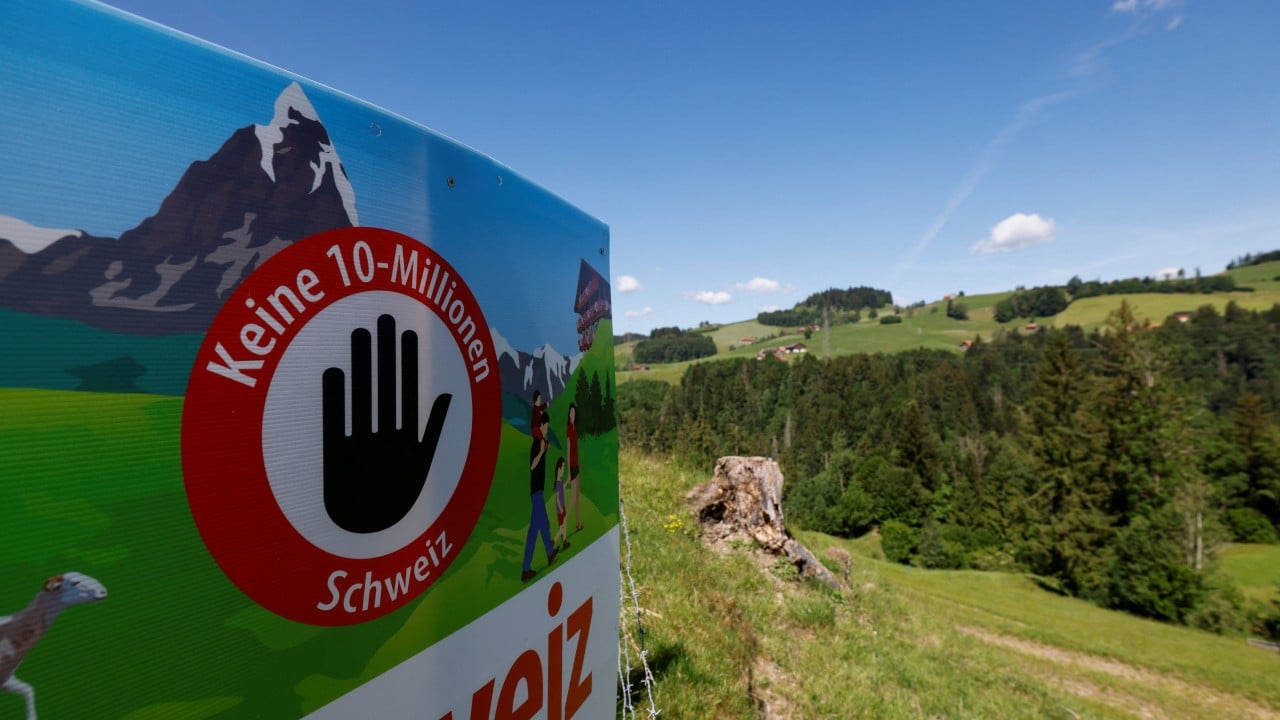
The mainstream media is treating the recent collapse of the Swiss right-wing initiative to cap the population at 10 million as a simple victory for globalism and economic continuity. They are wrong. They are looking at a thermometer and confusing the temperature with the weather.
The lazy consensus dominating European financial pages right now goes something like this: Swiss voters looked into the abyss of labor shortages, rejected isolationism, and saved their export-driven economy from self-inflicted strangulation. It sounds logical. It fits neatly into the standard center-left versus populist-right narrative.
It completely misses the structural reality of modern economics.
Capping a population at an arbitrary number like 10 million is a blunt, foolish instrument. But celebrating the rejection of that cap as a win for long-term stability is pure delusion. The Swiss electorate didn't vote for prosperity; they voted to delay an inevitable reckoning with an unsustainable economic model that relies on importing raw human capital to hide systemic productivity stagnation.
The Mirage of GDP Growth via Headcount
Every major bank from Zurich to Geneva quieted its public relations department after the vote, breathing a collective sigh of relief. Their entire model relies on aggregate GDP expansion. If you add 100,000 people to an economy every year, your GDP will almost certainly go up.
But aggregate GDP is a vanity metric used by politicians to secure reelection. The metric that actually dictates quality of life is GDP per capita.
When you look under the hood of the Swiss economic engine over the last decade, a troubling pattern emerges. Aggregate growth looks steady, but GDP per capita has been flatlining. Switzerland is not getting richer because its industries are becoming more efficient or innovative. It is getting larger because it is adding more bodies to the room.
This is the "headcount trap." I have watched corporate boards across Europe make this exact mistake for twenty years: expanding market share by diluting margins, then wondering why their net profitability per employee is cratering.
An economy that requires constant population expansion just to maintain a flatline standard of living is not robust. It is an economic chain letter. The right-wing populists wanted to slam the brakes on the car without checking the rearview mirror. The pro-immigration coalition wants to keep pressing the gas even though the road ends at a cliff. Both sides are fundamentally illiterate about the real problem: structural demographic aging.
The Math of the Non-Working Ratio
Let us dismantle the premise of the "People Also Ask" columns that popped up all over Google during this referendum.
Does Switzerland need more immigrants to fund its pension system?
The standard answer from economists is an enthusiastic yes. Without young workers entering the system, the old-age and survivors insurance (AHV) collapses.
This is mathematically illiterate over any horizon longer than twenty years.
Immigrants grow old. They enter the pension system themselves. To fund their retirement, you need an even larger cohort of immigrants in the next cycle. You create a geometric progression that requires infinite population growth in a finite geographic space. Unless you plan on turning the entire Swiss plateau from Lake Geneva to Lake Constance into a single, continuous suburban strip mall, the math fails.
The real crisis is not the total number of people living between the Alps and the Jura. It is the dependency ratio—the balance between those who produce and those who consume without producing.
| Metric | The Media Narrative | The Structural Reality |
|---|---|---|
| Population Growth | Driven by a desire for economic expansion. | Used as an emergency IV drip for the pension system. |
| Labor Shortages | High-tech sectors desperate for global talent. | Domestic labor misallocation driven by bloated administrative sectors. |
| Infrastructure Strain | A temporary bottleneck fixable with tax revenue. | A hard physical limit that erodes the premium value of the Swiss brand. |
If you cap the population at 10 million today without changing your pension mechanics, the system goes bankrupt by 2035. If you do not cap the population and let it run to 12 million by 2045 just to keep the pensions liquid, the infrastructure cost destroys the very productivity advantages that attracted businesses to Switzerland in the first place.
The High Cost of Cheap Labor
Corporate lobbies fought the 10 million cap because they wanted cheap, flexible labor from the European Union via the free movement of persons agreement. They argued that Swiss businesses would lose their competitive edge without access to the European talent pool.
Let us look at what actually happens when a wealthy country relies on a steady stream of imported labor to fill structural gaps. It subsidizes corporate inefficiency.
When labor is scarce and expensive, companies are forced to innovate. They invest in automation, they streamline operations, they cut out bureaucratic waste, and they train their domestic workforce. When labor is cheap and abundant, companies stop investing in capital equipment and simply throw more hours at the problem.
By importing hundreds of thousands of workers to fill mid-level administrative, service, and manufacturing roles, Switzerland has allowed its domestic productivity growth to stall. It has chosen extensive growth (more inputs) over intensive growth (better outputs).
This creates a secondary, cultural crisis that the elite in Zurich choose to ignore. The Swiss premium—the reason companies pay high taxes and high wages to operate there—is built on Swiss stability, punctuality, and world-class infrastructure. When trains run late because the tracks are congested, when housing prices in Zurich and Geneva price out the local middle class, and when health insurance premiums rise to fund an expanding system, the "Swiss Advantage" evaporates.
The Real Alternative: Absolute Productivity
The contrarian solution to the Swiss dilemma is painful, politically toxic, and entirely necessary. It requires abandoning the fetish of nominal GDP growth and focusing exclusively on maximizing output per hour worked.
To achieve this, Switzerland needs to do three things immediately:
- Tie immigration visas strictly to high-marginal-productivity sectors. If an industry cannot afford to pay a worker significantly above the median Swiss wage, that industry should not be importing labor. It should be automating or outsourcing that specific function.
- Rehearse the hard choice on pensions. The retirement age must be indexed directly to life expectancy. No exceptions. No political bargaining. Trying to fix a retirement funding gap by importing millions of future retirees is like drinking salt water to cure thirst.
- Impose infrastructure tariffs on corporations. If a multinational corporation wants to bring 5,000 workers into the Lake Geneva region, that corporation should bear the full capital cost of expanding the rail, school, and medical infrastructure required to support them. Right now, corporations privatize the profits of immigration while socializing the infrastructure costs onto the Swiss taxpayer.
This approach has downsides. It means some low-margin businesses will go bankrupt. It means the local hospitality and retail sectors will have to radically re-engineer their service models. It means aggregate economic growth will slow down significantly, which will make the front pages of financial newspapers look terrifying to the untrained eye.
But it preserves the actual wealth of the population.
The voters who rejected the 10 million initiative thought they were choosing safety and status quo stability. In reality, they voted to accelerate the transformation of Switzerland from a unique, high-value, hyper-efficient enclave into just another crowded, stagnating European administrative zone.
Stop asking when the country will hit 10 million. Start asking why your leadership needs 10 million people to do the work that 8 million used to do better.