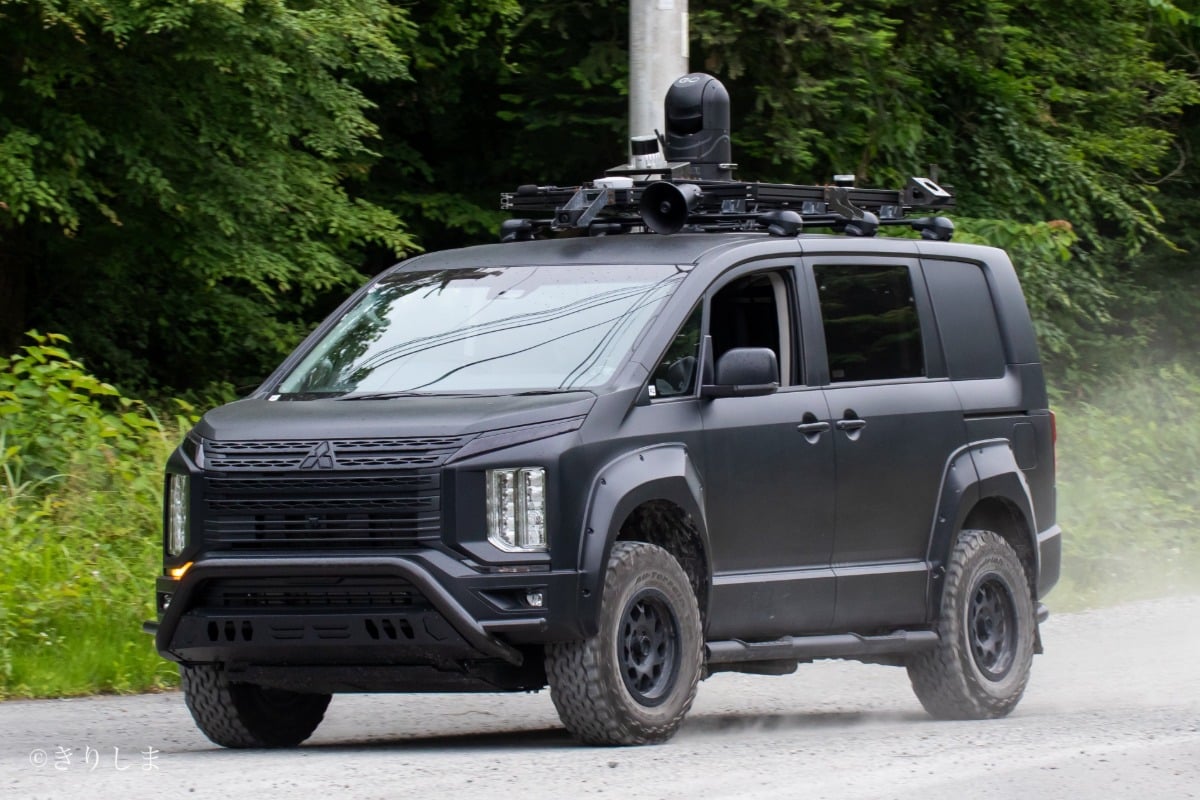
You don't expect to see a phantom vehicle prowling the foothills of Mount Fuji without plates. Yet, local spotters recently caught an entirely blacked-out Mitsubishi Delica D:5 doing exactly that. It didn't have standard dealer tags. It completely lacked Ground Self-Defense Force unit markings.
Instead, this matte-black minivan carried a massive rooftop rig packed with optical sensors, radar housings, and data links.
If you think it's just a tuning shop showing off a rugged overlanding build, you're missing the bigger picture. This is a mobile development testbed hiding in plain sight. Japan is quietly ramping up its field trials for autonomous ground combat systems. The location isn't a coincidence either. The East Fuji Maneuver Area sits right there, serving as the premier testing ground for the Japan Ground Self-Defense Force (JGSDF).
The Stealth Minivan Strategy
Automotive manufacturers use heavy camouflage wraps to hide the body lines of upcoming models. Defense contractors take a completely different route. They buy a standard, ultra-reliable commercial platform, strip the identifying trim, paint it a flat color, and load it with classified electronics.
The Mitsubishi Delica D:5 is the perfect choice for this kind of work in Japan. It features a robust four-wheel-drive system derived from the Outlander, decent ground clearance, and enough interior volume to house racks of power supplies and data-logging computers.
By utilizing a civilian silhouette, engineers can drive the vehicle on public access roads surrounding the military ranges without drawing the immediate attention that a multi-wheeled armored vehicle would.
The gear on top tells the real story. Observers noted a combination of solid-state LiDAR units, multiple electro-optical cameras providing a 360-degree view, and high-bandwidth satellite communication antennas. This isn't a consumer-grade driver assistance system. This setup is designed for high-level localization and mapping in environments where GPS signal jamming might be active.
Why Tokyo is Obsessed With Unmanned Logistics
Japan faces a demographic reality that is forcing the military's hand. The population is shrinking, and the JGSDF continuously struggles to meet its recruitment quotas. You can't man a massive logistics tail when you don't have enough boots on the ground.
Autonomous ground vehicles (UGVs) are the only logical solution to this personnel crisis. The goal isn't necessarily to build terminator tanks immediately. The immediate, urgent need is for autonomous resupply.
Imagine moving ammo, fuel, and medical supplies from a beachhead or an airfield to the frontline without risking a single human driver. That's what this blacked-out Mitsubishi is teaching the engineers.
- Terrain Mapping: Generating highly accurate 3D point-cloud maps of rugged off-road paths around Mount Fuji.
- Sensor Fusion: Testing how commercial-off-the-shelf sensors hold up against dust, rain, and vibration.
- AI Convoy Following: Developing algorithms that allow a line of uncrewed supply vehicles to follow a single manned lead vehicle.
The Ministry of Defense has been very clear about doubling its defense spending to two percent of GDP. A significant portion of that capital is flowing directly into uncrewed systems. They are moving fast.
The Heavy Armor Connection
While a modified minivan handles the software validation on gravel roads, the hardware endgame is much more aggressive. Mitsubishi Heavy Industries (MHI) has already revealed concept renders showing a massive transformation of the classic Type 89 infantry fighting vehicle into a heavy UGV platform.
The software being refined inside that Delica near Fuji will eventually control heavily armored, tracked combat machines.
[Commercial Testbed: Delica D:5] ──> Validates Sensor Fusion & Navigation Software
                                              │
                                              ▼
[Heavy Combat Platform: Type 89 UGV] ──> Integrates Autonomy into Tracked Armor
Developing autonomy software on a 27-ton tracked vehicle is incredibly expensive and logistically difficult. Every hour of operation wears down expensive tracks and burns massive amounts of fuel. If a software bug causes a steering failure, a heavy armored vehicle can easily demolish a building or flip over.
Using a lightweight, inexpensive civilian vehicle allows engineers to rack up thousands of testing miles at a fraction of the cost. They can iron out the bugs in the perception algorithms before flashing that code onto a machine equipped with a 35 mm autocannon.
Software Acceleration is Changing the Timeline
The development cycle for Japanese defense tech used to take decades. Not anymore. MHI recently partnered with American autonomy firm Shield AI to test their Hivemind flight-control software on domestic drones, compressing months of testing into fewer than 60 days.
We are seeing that exact same aggressive timeline philosophy applied to the ground domain. The Ministry of Defence is no longer waiting for perfect, bespoke military components. They are leveraging commercial tech, bolting it onto existing platforms, and getting it out into the dirt to see what breaks.
This approach matches international trends. The US Army has been testing similar technology through its Robotic Combat Vehicle program, and the UK has experimented with autonomous logistics providers. Japan is making sure it doesn't fall behind in the Indo-Pacific region, where logistical endurance over rugged island terrain is everything.
How to Track What Happens Next
If you want to watch this space, stop looking for official press releases from the Ministry of Defense. They won't comment on blacked-out testbeds spotted on public roads. Instead, watch the local testing areas.
Keep an eye on public flight and ground restrictions around the Fuji training grounds. Look for joint venture announcements between traditional Japanese industrial giants like MHI or Komatsu and software startups specializing in machine learning or computer vision.
The next time someone tells you they saw a weird, matte-black custom van tooling around the mountains of Japan, don't write it off as car culture. You're looking at the prototype architecture of a future uncrewed army.