The Chesapeake does not die all at once. It goes quietly.
You smell it first on mornings when the wind dies down and the humidity presses flat against the water. It smells like old copper and stagnant breath, the heavy scent of an ancient system slowly suffocating under its own weight. If you grew up on these shores, you learn to read the water the way other people read traffic lights. A clear blue bay is a liar; it means the algae has starved the life out of the column. A murky, green-brown chop is closer to the truth, though even that truth is fraying at the edges.
Water remembers. Land forgets.
For centuries, the edge where the Virginia mainland met the bay was a messy, stubborn negotiation. Salt marsh grasses threw their roots deep into the muck, slowing the storm surges down to a gentle sigh. Oysters filtered the turbidity out of the water by the gallon, acting as living lungs for the estuary. Then we paved the buffer zones. We straightened the creeks. We treated the shoreline like a bathroom mirror that needed a clean, hard frame.
Concrete doesn't breathe. Bulkheads don't bargain with a hurricane. When the water rose—and it is always rising, an inch here, a foot there, chewing away the foundations of grandmother’s dock—the hard edges simply shattered.
Consider what happened along one particular stretch of this bruised coastline recently.
It looks modest on paper. One point zero nine miles of restored shoreline. That is the official tally recorded by planners and engineers who measure the world in linear feet and cubic yards. But numbers are cowoids; they hide the blood and the sweat. They hide the heavy thud of dump trucks grinding down narrow county roads at dawn, hauling tons of rock and sand to a place that looked like it was sliding into the drink.
(Note: The statistics regarding the length of the restoration and the creation of marsh and reef acreage are drawn directly from state environmental records, though the early morning truck traffic is a composite depiction of coastal construction reality.)
Meet Marcus. He isn't a real person, but he is every waterman who ever watched his family's oyster leases shrink while the marsh grass behind his house turned into open water.
Marcus stands on the bow of a flat-bottomed skiff, squinting against the glare of the noon sun off the bay. He remembers when the marsh out by Plum Tree Point was thick enough to hide a skiff from the wind. By the time his son was ten, that marsh was gone, replaced by a scoured mud flat that offered zero shelter when a nor'easter blew out of the east. The waves rolled straight into the low-lying farmland, chewing the banks back five feet a year.
You cannot legislate a coastline into staying put. You have to give it something to fight with.
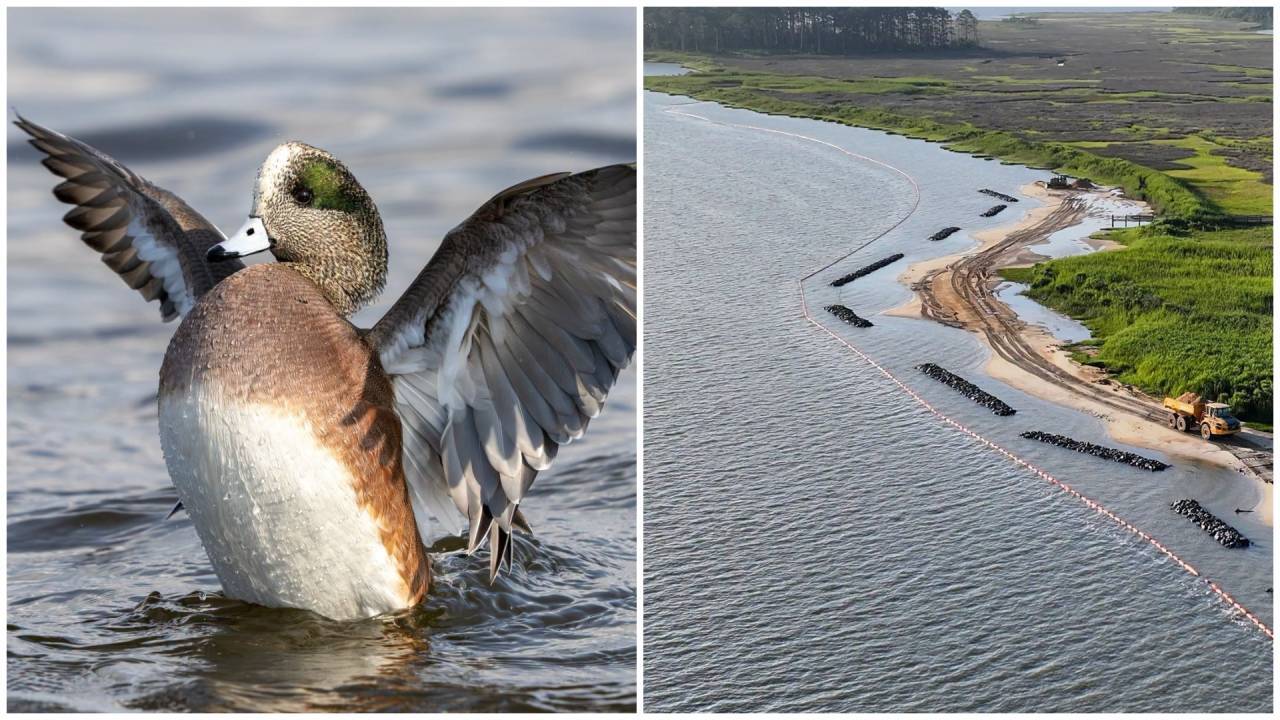
That is where the engineering meets the mud. Over the course of months, heavy machinery moved in not to conquer the water, but to recreate an ancient geometry. Crews dropped massive sills of stone offshore—breakwaters designed to break the punch of incoming swells before they ever touched the dirt. Between those breakwaters and the eroding bank, they pumped in sand. Thousands of tons of it. They reshaped the slope, grading it so the tide could crawl up gently instead of slamming into a wall.
Then came the planting.
Picture thousands of tiny plugs of smooth cordgrass, stuck by hand into the raw, wet mud by restoration crews sinking to their knees in muck that smells like rotten eggs and primordial soup. It looks hopeless at first. A scattering of green hair on a bald scalp of sand.
Nature is ruthless. But she is also remarkably eager to heal if you just give her the right tools.
Within a single season, the grass catches. The roots knit together beneath the surface, weaving an invisible subterranean net that locks the sand in place. The water clears, just a fraction, because the sediment has nowhere to run.
And then, the quiet miracle happens beneath the surface.
On the offshore stone sills, workers planted oyster spat. Millions of microscopic bivalves clinging to recycled shells, dropped into the cool, dark water just behind the breakwaters. Oysters are ecosystem architects. They don't just sit there. They eat the suspended silt. They create complex three-dimensional reefs that attract crabs, juvenile rockfish, and herons looking for an easy meal.
The 1.09 miles of restored shoreline in Virginia is not just a line on a map. It is a biological sponge.
When the next autumn gale swept across the Chesapeake, the waves rolled in heavy and grey. They hit the offshore stone breakwaters, losing their teeth. They washed over the newly graded sand, but the dense, newly established marsh grass grabbed the momentum and wrung the energy out of the water drop by drop. The bank didn't crumble. The farmland behind it stayed dry. The mud held.
We spend billions trying to outsmart rising seas with high-tech walls and pumps that fail the moment the power cuts out. We look for complicated, expensive answers in corporate boardrooms.
Sometimes the answer is just mud, rock, grass, and a few million oysters doing what they have done for ten thousand years.
Marcus cuts the engine of his skiff and lets the hull drift toward the newly planted fringe. A great blue heron stands motionless in the cordgrass, staring down into water that is clearer than it has been in twenty years. A small school of silversides darts through the submerged roots of the marsh.
The tide is coming in, pushing gently against the shore, but the shoreline doesn't give an inch. It simply absorbs the weight, breathes it in, and waits for the turn.