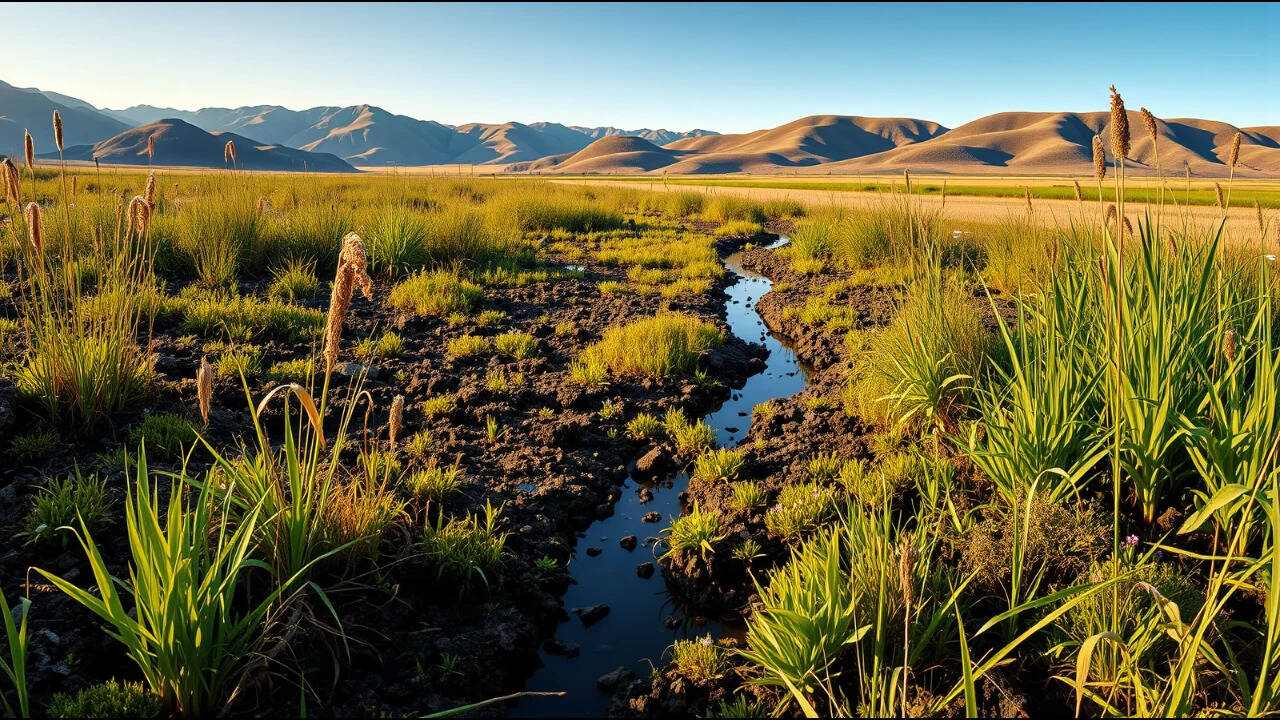
We built the dikes with our boots sinking inches into the gray, lifeless muck of the Sacramento-San Joaquin Delta. Around us, the air smelled of sun-baked mud, stagnant river water, and the sharp, chemical tang of decades-old fertilizer. For more than a century, this land had been drained, beaten into flat rectangles of peat soil, and forced to grow tomatoes and corn until the earth began to crumble away into dust.
Farmers called it reclamation. They drove heavy steel pilings deep, pumped out the water, and treated the marsh as a blank slate. But the land has a long memory. When you starve a wetland of water, the rich organic peat underneath—accumulated over thousands of years of dead tules and flooded reeds—is suddenly exposed to oxygen. Bacteria move in. They feed. And as they eat, they exhale.
For generations, California’s drained farmlands were quietly leaking vast plumes of carbon dioxide straight up into the atmosphere, causing the ground beneath our tractors to sink year after year by an inch or more. Entire farming towns are now sitting in concrete bowls far below the level of the surrounding rivers, held back only by aging levees.
So, we tried to undo it.
Environmental scientists, state agencies, and conservation groups looked at the sunken fields and proposed a grand, hopeful bargain. Let the rivers back in. Break the dikes. Flood the old pastures, plant the tules and cattails, and let the wild marsh resurrect itself. The logic was clean, mathematical, and deeply comforting: restore the wetlands, trap the carbon back in the mud, and heal the breathing of the earth.
It sounded like a clean slate. It wasn't.
Stand on the edge of one of these newly reflooded experimental restoration sites today, and you will feel a damp, heavy warmth rising from the water. It is a strange, quiet place. Great blue herons stand like statues in the shallows, and the rusted hulls of old agricultural equipment slowly disappear beneath a thick green carpet of invasive water hyacinth. The return of the birds was swift. Within months, flocks of migrating ducks and endangered shorebirds dropped out of the sky to claim the shallow pools. It looked like a triumph.
Then the gas analyzers came out.
Researchers hauling heavy aluminum tripods and infrared sensors waded into the muck to measure what the marsh was actually doing to the sky. They weren't just looking for carbon dioxide anymore. They were sniffing for something far more potent.
Methane.
When you submerge dead plant matter in standing water, oxygen vanishes. A completely different set of microbes takes over—anaerobic bacteria that do not breathe oxygen. As they break down the drowned roots and rotting vegetation, they burp methane gas into the atmosphere. Methane is a short-term atmospheric bully. Pound for pound, over a twenty-year span, it traps roughly eighty times more heat than carbon dioxide.
The study findings landed like a heavy wet blanket over the restoration community. Those restored wetlands, designed to heal the atmosphere, were actively belching greenhouse gases. In some monitored plots, the sudden surge of methane completely wiped out the climate benefits of the carbon absorbed by the growing plants.
The mud was breathing back, and it smelled like rot.
Consider the dilemma of Elena Vance, a hypothetical project manager who spent six years overseeing a multi-million-dollar delta restoration plot near Rio Vista. I spoke with scientists facing her exact predicament. She had stood on those levees with a clipboard, watching bulldozers breach the earthen walls. She had listened to the cheers of local volunteers planting tule plugs in the mud. She had believed, with every fiber of her pragmatic conservationist soul, that she was repairing a tear in the fabric of the ecosystem.
When the greenhouse gas data arrived on her desk, the numbers did not tell a simple story of success. They whispered a complicated, humbling truth: nature is not a machine with a simple reset button.
"We thought we were turning off a smoke stack," a senior researcher told me, wiping dried salt from his glasses. "Instead, we turned off a coal plant and accidentally turned on a gas stove."
This discovery forces us to confront an uncomfortable reality about how we fix our mistakes. Modern environmentalism loves neat ledgers. We want to plant a billion trees, flood a thousand acres of farmland, and receive a neat digital certificate certifying that a specific number of metric tons of carbon have been locked away forever. We treat the planet like a corporate balance sheet.
But a marsh is an ecosystem, not a spreadsheet. It is a roiling, living chemical reactor driven by millions of years of evolutionary trial and error.
When a wetland is dry, it bleeds carbon dioxide as the ancient peat oxidizes. When it is flooded, it stops bleeding carbon dioxide, but it starts exhaling methane. The net climate math depends on water depth, temperature, soil chemistry, the specific species of plants taking root, and even the micro-nutrients washing down from upstream agricultural runoff. A few inches of water too deep, and the methane production spikes. A few inches too shallow, and the dry peat starts oxidizing again.
We are not gods stepping into a garden with a hose. We are clumsy mechanics trying to tune an engine while it is already running at full throttle.
Does this mean we should stop restoring our wetlands? Absolutely not. That would be like abandoning medicine because the first trial of a drug had unexpected side effects.
The same restored delta waters that produce methane are also filtering out toxic agricultural nitrates before they reach municipal drinking supplies. They are providing critical, irreplaceable nurseries for the endangered Delta smelt and Chinook salmon. They are acting as sponge-like buffers against catastrophic sea-level rise and storm surges, protecting inland towns from being wiped off the map. They are bringing back the sound of wings to a valley that had grown dangerously quiet.
The mistake was never the restoration itself. The mistake was our arrogance in expecting perfection from a chaotic, living world.
Science is rarely a straight line from ignorance to enlightenment. More often, it is a stumbling march through a dark room, where every time you furniture-arrange one problem, you stub your toe on a brand new one. The recent studies on wetland greenhouse gas emissions do not signal the failure of restoration; they signal the end of our childish phase of environmental accounting.
Back in the Delta, the sun is beginning to drop behind the Coast Range, painting the low-hanging clouds in shades of bruised purple and burning gold. A flock of canvasback ducks cuts low across the water, their wings whistling in the damp evening air. Out in the middle of the flooded pasture, invisible to the eye, bubbles of methane rise quietly through the dark water column, pop at the surface, and drift up into the infinite blue of the upper atmosphere.
The earth is working through its history. It is metabolizing our past sins, digesting our industrial detritus, and coughing out its own complex breath. We cannot engineer our way out of the climate crisis with checklists and clean spreadsheets. We have to learn to live within the messy, complicated, breathing reality of the mud.