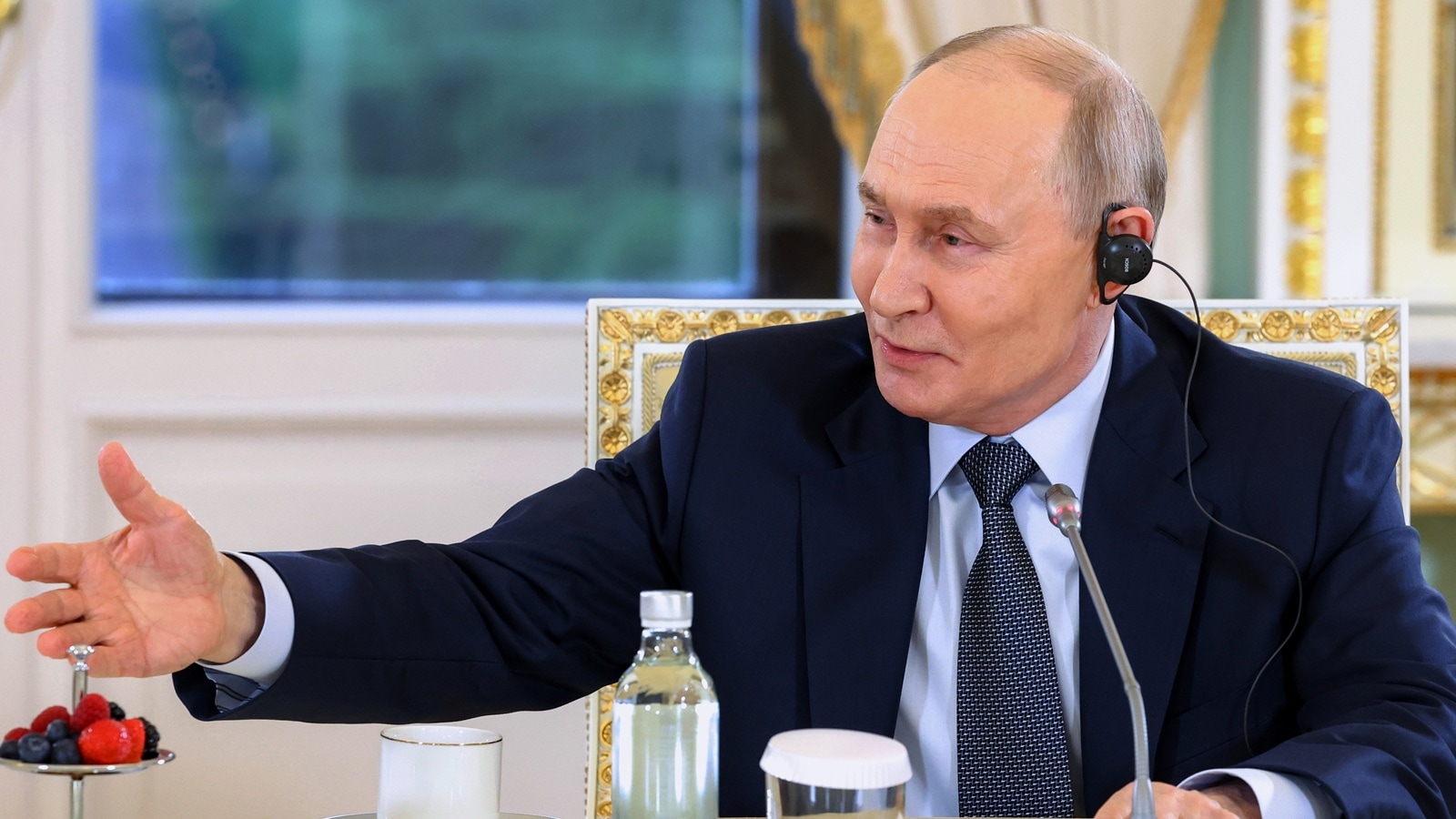
Western expectations that India would abandon its relationship with Russia under diplomatic pressure have missed a fundamental reality. New Delhi operates entirely on self-interest. When Russian President Vladimir Putin praised Indian Prime Minister Narendra Modi at the St. Petersburg International Economic Forum, calling Western pressure "futile" and "detrimental," he was not merely offering rhetorical support. He was acknowledging a structural shift in global trade that the West has failed to stop.
The conventional narrative framed India as a swing state that could be coaxed or coerced away from Moscow. This view ignores decades of deep institutional alignment and the harsh realities of India's current economic needs. Washington and Brussels viewed secondary sanctions and tariff threats as tools to isolate the Kremlin. Instead, these measures accelerated an economic reconfiguration that has pushed bilateral trade between India and Russia toward an unprecedented $100 billion target.
The failure of Western leverage became undeniably clear following the high-stakes bilateral summit in New Delhi. Despite Washington imposing a 50 percent tariff on various Indian goods as a penalty for buying Russian crude, Modi welcomed Putin with open arms. They finalized an economic cooperation program stretching to 2030. The lesson is clear: for a developing superpower responsible for 1.5 billion people, cheap energy and national security override Western geopolitical preferences.
The Arithmetic of Strategic Autonomy
To understand why Western pressure fails, one must look at the hard numbers. Before the escalation of the Ukraine conflict, bilateral trade between India and Russia was a modest fraction of what it is today. By the end of the 2024-25 fiscal year, that figure surged to $68.7 billion. This was not a gradual increase; it was a massive spike driven almost entirely by Indian refiners devouring discounted Russian Urals crude.
Western capitals assumed that India's growing alignment with the United States via the Quad security framework would force New Delhi to choose. This assumption miscalculated the core tenet of Indian foreign policy: strategic autonomy. India does not enter alliances; it enters partnerships. It views its relationship with Washington as essential for countering Chinese assertiveness in the Indo-Pacific. Simultaneously, it views its relationship with Moscow as essential for maintaining a stable Eurasian balance of power and keeping its economy fueled.
The economic math makes compliance with Western demands impossible for New Delhi. Consider the alternative. If India ceased importing Russian crude, global oil markets would experience an immediate supply shock, sending crude prices well past $100 a barrel. India, which imports over 80 percent of its petroleum needs, would face severe inflation, fiscal deficits, and domestic unrest. No democratic Indian leader will trigger a domestic economic crisis to satisfy a strategic objective defined by NATO.
Overcoming the Trade Imbalance and the Rupee Problem
The current economic relationship is not without serious structural flaws. The trade volume is heavily skewed. Out of the $68.7 billion in bilateral trade, Indian exports to Russia accounted for a mere $4.88 billion. The rest belongs to Russian energy and fertilizer imports, creating a massive trade deficit for New Delhi.
This imbalance created a technical nightmare for both nations: the accumulation of stranded rupees. Because of Western sanctions and the expulsion of major Russian banks from the SWIFT network, the two nations attempted to settle trade in national currencies. Russian exporters quickly found themselves holding billions in Indian rupees that they could not easily spend, convert, or repatriate due to India's capital controls.
+-----------------------------------------------------------------+
|               RUSSIA - INDIA TRADE BREAKDOWN                    |
+-----------------------------------------------------------------+
| Total Bilateral Trade (FY 2024-25):     $68.7 Billion           |
| -> Russian Exports to India (Energy):   $63.8 Billion           |
| -> Indian Exports to Russia:             $4.88 Billion          |
|                                                                 |
| Projected Target by 2030:              $100.0 Billion           |
+-----------------------------------------------------------------+
Instead of abandoning the trade, Moscow and New Delhi adapted. The 2030 economic cooperation program directly targets this imbalance by diversifying the relationship beyond raw energy. Russia is actively moving to invest its accumulated rupee reserves directly back into the Indian economy. These funds are being channeled into massive infrastructure projects, petrochemicals, banking, and joint manufacturing ventures.
Simultaneously, India is aggressively pushing to eliminate non-tariff barriers to increase its exports. The areas targeted for expansion include:
- Pharmaceuticals: India is ready to fill the void left by Western drug manufacturers that exited the Russian market.
- Agricultural Products: Increasing shipments of dairy, meat, and grain to secure Russia's food supply chains.
- Labor Mobility: New frameworks to safely deploy skilled Indian engineers, construction workers, and tech professionals to labor-scarce regions in Russia.
Redefining the Defense Supply Chain
For decades, Moscow was New Delhi’s primary arms merchant. Most of India’s conventional military hardware—from fighter jets to submarines—carries a Soviet or Russian lineage. Western analysts argued that supply chain disruptions from the Ukraine war and Western export controls would force India to permanently decouple its defense apparatus from Russia.
The reality has proven far more complex. Supply chain bottlenecks did delay the delivery of India’s remaining Russian-made S-400 surface-to-air missile systems. Yet, instead of walking away from the relationship, New Delhi and Moscow are fundamentally reshaping how their defense cooperation works.
The era of India acting as a simple buyer of finished Russian military hardware is ending. It is being replaced by a model aligned with India's domestic manufacturing goals. The shift focuses on joint research, development, and the localized production of advanced defense platforms. This includes manufacturing spare parts, components, and assemblies directly within Indian facilities. By producing these components locally, India ensures its existing military hardware remains operational while shielding its defense supply chains from external sanctions or foreign logistics disruptions.
The China Factor and the Limits of Western Leverage
The most significant miscalculation by Western policymakers is failing to see how pushing Russia into a corner affects the broader Asian balance of power. A completely isolated Russia would have little choice but to become a junior partner to Beijing, a scenario that poses a direct threat to Indian security.
India and China share a tense, militarized border that saw active conflict in 2020. Since then, New Delhi has worked to manage its rivalry with Beijing. During his St. Petersburg remarks, Putin explicitly stated that Moscow would not interfere in the delicate bilateral relations between India and China, expressing confidence that both capitals are committed to resolving their disputes.
By maintaining a robust relationship with Moscow, India ensures that Russia retains a strategic stake in South Asia that is independent of Beijing. If India were to cut ties with Russia to satisfy the West, it would remove a critical diplomatic bridge and accelerate the formation of a monolithic, Sino-Russian bloc. New Delhi knows that a multi-polar world requires a multi-polar Eurasia, and keeping Moscow engaged is central to that strategy.
Washington's punitive measures, such as the aggressive tariffs pushed by the U.S. administration to force a ceasefire in Europe, have underestimated Indian resilience. While the West views trade policy as a tool for geopolitical compliance, India views its energy and defense procurement as matters of basic national survival. When a superpower treats its survival as negotiable, it misunderstands the nature of sovereign states.
The West must accept that India cannot be managed as a traditional client state. The Moscow-New Delhi axis is not built on shared ideology or political systems; it is held together by geography, economics, and realpolitik. Every tariff, sanction, and diplomatic warning issued by Western capitals has not broken the link. It has merely forced two old partners to build a more resilient financial and industrial infrastructure to bypass the West entirely.
The video below details the recent geopolitical friction and economic discussions between the two nations, illustrating how the Kremlin views the futility of external pressure on New Delhi.



:max_bytes(150000):strip_icc()/how-many-types-of-dwarfism-are-there-2860725-v1-8dae2c531b4b47d9ae36ae404d3308a0.png)