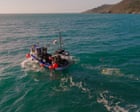
Passive commercial fishing gear operates on a fundamental structural contradiction: the attributes that maximize target species capture efficiency—such as nearly invisible monofilament webbing deployed in high-density marine foraging zones—simultaneously maximize non-target mortality. In coastal gillnet fisheries, this contradiction manifests as an ecological externality where diving seabirds, including guillemots, razorbills, and shags, entangle and drown while pursuing forage fish. Traditional mitigation strategies, ranging from acoustic pingers to high-intensity net illumination, frequently founder on economic viability, power supply constraints, or habituation by target and non-target species alike. Recent operational shifts among Cornish fishers utilizing surface-level floating visual deterrents provide a concrete case study in low-cost, passive sensory modification. Deconstructing this intervention reveals the underlying mechanics of avian sensory ecology, gear economics, and operational trade-offs in small-scale fisheries management.
The Economic and Regulatory Cost Function of Bycatch
To evaluate the operational adoption of bycatch mitigation gear, one must examine the cost function governing coastal gillnetting. Fishers operate within narrow profit margins dictated by fuel costs, market pricing for demersal and pelagic species, and restrictive catch quotas or effort limitations. Bycatch introduces three distinct economic friction points:
- Gear Damage and Labor Overhead: Entangled seabirds twist monofilament mesh, creating structural breaches that require time-intensive mending. Hauling damaged gear reduces active soak time and increases crew labor hours per landed kilogram of target fish.
- Bait and Catch Interference: Avian predation around active sets can disrupt localized fish schooling behavior or strip bait from passive lines, degrading net efficiency.
- Regulatory Exposure and Social License: Unmitigated seabird mortality accelerates the risk of spatial closures, emergency gear restrictions, and loss of commercial certifications, threatening the long-term viability of small-vessel fleets.
When evaluated against capital-
The Economics of Bycatch Mitigation and Floating Deterrents in Cornish Fisheries
business
Commercial fishing operations face a persistent operational friction point: the unintended mortality of non-target marine species, specifically diving seabirds interacting with static gillnets. In coastal waters around Cornwall, fishers deploy bottom-set nets that intersect with the foraging trajectories of species like shags, cormorants, and guillemots. Traditional regulatory responses rely on spatial closures or gear bans, which impose severe economic penalties on fleet revenues. A structural alternative has emerged through passive physical deterrents, specifically floating scarecrows designed to alter avian diving behavior at the water surface. Analyzing this intervention requires examining the microeconomics of gear efficiency, avian sensory ecology, and the regulatory cost functions that govern artisanal and industrial marine harvesting.
The Structural Mechanics of Seabird Mortality in Static Gear
Seabird bycatch is not a random stochastic event; it is the predictable intersection of avian foraging physiology and commercial fishing deployment patterns. Shags and guillemots operate as pursuit-divers, descending from the surface to target benthic and mid-water schooling fish. When static gillnets are deployed, the monofilament mesh possesses low acoustic and visual reflectivity under low-light conditions, rendering it nearly invisible to descending birds.
The mortality mechanism operates through entanglement. A foraging bird encounters the net barrier during descent or ascent. Unable to maneuver backward due to backward-pointing barbs or mesh friction, the bird drowns within minutes due to oxygen depletion. From a systemic perspective, this creates an unpriced externality. The fishers bear the labor cost of clearing fouled nets and suffering structural gear damage, while the marine ecosystem absorbs the population depletion of apex predators.
<Carousel>
  <Video source="youtube" query="seabird bycatch mitigation gillnet deterrents visual cues" count="3"/>
</Carousel>
The video demonstration above illustrates how surface modifications and visual cues alter the approach vectors of diving seabirds near active gear deployments.
The Biophysics of Visual and Physical Deterrence
Floating scarecrows—often configured as lightweight, wind-driven surface floats, high-contrast streamers, or articulated avian silhouettes—intervene in the predator-prey search loop before the dive occurs. Avian foraging relies heavily on visual cues, contrast, and movement detection.
By anchoring floating scarecrows at regular intervals along the headline of a gillnet string, operators introduce dynamic visual noise and physical motion at the air-water interface. This disrupts two critical stages of fishery-avian interaction:
- Target Identification: The erratic motion of the scarecrow mimics predator presence or unnatural surface disturbance, signaling hazard to descending birds.
- Descent Trajectory Modification: Birds evaluating a dive path adjust their entry vectors away from the net footprint, reducing the probability of encountering invisible monofilament panels at depth.
The efficacy of this intervention depends on physical parameters such as wave action, wind velocity, and spectral contrast. In high-turbidity waters or low-light dawn periods, passive visual devices lose potency unless paired with tactile or high-reflectivity elements. Fishers deploying these devices report a marked reduction in net fouling, directly translating to labor savings during gear retrieval.
The Cost Function of Mitigation Adoption
Why do fishers hesitate to adopt passive deterrents universally? The answer lies in the microeconomic cost function of fleet operations. Every modification to a fishing gear setup introduces operational drag.
The primary cost variables include:
- Capital Expenditure: The acquisition cost of durable, marine-grade floating scarecrows resistant to salt corrosion, ultraviolet degradation, and high-wave stress.
- Operational Drag: Increased entanglement risk during shooting and hauling operations. If a floating deterrent catches on winches, rollers, or deck hardware, it causes downtime, increasing fuel burn and labor costs per metric ton of landed catch.
- Storage and Deck Real Estate: Fishing vessels operate under strict spatial constraints. Bulky surface devices reduce the storage capacity for fish boxes and sorting trays.
To achieve net-positive adoption, the economic savings from reduced gear damage and lower net-clearing labor must outweigh the combined capital expenditure and operational drag. When bycatch rates are high, the time spent untangling dead seabirds from monofilament mesh represents a significant labor drain. Eliminating this friction accelerates hauling cycles, improving vessel throughput.
Sensory Ecology and Avian Foraging Thresholds
Understanding why surface deterrents function requires evaluating the sensory thresholds of marine birds. Shags and guillemots are visual hunters relying on acute perception of light gradients and bioluminescent or schooling prey signals in the upper water column.
When floating scarecrows create intermittent shadows and surface turbulence, they violate the natural baseline of the marine interface. The cognitive processing loop of the diving bird interprets this anomaly as a high-risk predation zone or environmental hazard. Unlike acoustic pingers, which marine mammals often habituate to over time, visual surface motion combined with shifting physical structures creates a dynamic deterrent that resists behavioral habituation.
The Game Theory of Compliance and Enforcement
Regulatory frameworks governing coastal fisheries often rely on top-down monitoring, which creates an adversarial equilibrium between fleet operators and enforcement agencies. Fishers face incentives to underreport bycatch to avoid mandatory gear restrictions or spatial closures.
Integrating passive surface deterrents shifts the game-theoretic payoff matrix. When gear modifications are inexpensive, durable, and demonstrably reduce net fouling, compliance ceases to be a zero-sum compliance burden. Instead, it aligns private economic incentives (reduced labor costs, undamaged gear) with public ecological goals (lower seabird mortality). Fleet operators transition from evading regulations to self-policing gear standards to protect market access.
Strategic Operational Deployment
Optimizing the deployment of floating deterrents requires treating the gear string as an integrated spatial system rather than isolated hardware components. Fishers must calibrate spacing density based on local bathymetry, current velocity, and target species concentration.
Strategic execution involves three operational phases:
- Baseline Assessment: Mapping historical bycatch hotspots against local tidal currents to identify high-risk deployment zones where seabird foraging overlaps with net soaking times.
- Hardware Calibration: Adjusting the buoyancy and tether length of surface scarecrows to ensure continuous surface agitation without sinking the net headline or creating excessive drag in heavy swells.
- Performance Auditing: Tracking catch-per-unit-effort alongside mortality rates across seasonal cycles to quantify the exact return on investment for each deployed deterrent unit.
Integrating passive surface deterrents into standard Cornish netting operations demonstrates that ecological protection and commercial efficiency are not mutually exclusive. By treating bycatch as an operational defect rather than an unavoidable cost of doing business, fishers can protect margins while preserving the marine habitats upon which their livelihoods depend.