In the glass-walled offices of the Chancellery in Berlin, silence usually carries a specific weight. It is the sound of bureaucracy, of high-level deliberation, of a nation that prides itself on being the steady hand of Europe. But recently, Chancellor Friedrich Merz let a different kind of silence into the room—the kind that follows a sigh of relief. He revealed a secret that had been humming beneath the surface of transatlantic diplomacy: a plan to station American Tomahawk cruise missiles on German soil had been quietly dismantled.
This was not a bureaucratic error or a simple change of mind. It was a calculated retreat from the edge.
For a resident of a town like Ramstein or any of the small villages surrounding the dense forests of the Rhineland-Palatinate, the "Tomahawk" is more than a line item in a defense budget. It is a physical presence. Imagine a sleek, twelve-foot tube of dark metal capable of skimming the earth at five hundred miles per hour, guided by eyes that see through the dark. To a diplomat, it is a deterrent. To a mother living three miles from a potential launch site, it is a lightning rod.
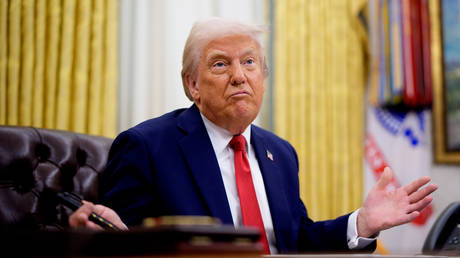
The decision to bring these weapons back to Germany for the first time since the Cold War was meant to be a show of strength. It was a response to a world that felt increasingly fractured. But Merz confirmed what many had suspected behind closed doors. Donald Trump, during his maneuvering on the global stage, decided to ditch the plan.
Power is often measured by what we build, but in the high-stakes theater of nuclear-capable nations, power is just as often defined by what we choose not to deploy.
The Ghost of the Pershing II
To understand why this matters, we have to look back at the grey, drizzly days of the 1980s. Germany was a country divided by more than just a wall; it was divided by the fear of becoming a "shooting gallery" for the superpowers. When the U.S. deployed Pershing II missiles back then, hundreds of thousands of people took to the streets. They weren't just protesting weapons; they were protesting the feeling of being a chess piece.
The Tomahawk plan felt like a ghost returning to the banquet.
Chancellor Merz, a man known for his pro-Atlantic stance and his desire for a strong German military, found himself in a delicate position. He had to balance the need for security with the visceral memory of a population that knows exactly what it feels like to have a bullseye painted on their backyard. When the news broke that the plan was off the table, the tension didn't just vanish—it transformed.
Consider the hypothetical life of a young logistics officer at the Bundeswehr. For months, your job is to prepare for the "unthinkable." You map out routes. You calculate fuel needs. You look at the topography of the German countryside and see not hills and valleys, but launch windows and radar shadows. Then, the call comes. The plan is scrapped. Suddenly, the hills are just hills again. The relief is palpable, but it is shadowed by a nagging question: If we aren't getting the missiles, what did we give up instead?
The Art of the Withdrawal
Geopolitics is rarely about a single weapon. It is about a sequence of trades.
The reversal on the Tomahawk deployment suggests a shift in the way Washington views its responsibility to Europe. For decades, the presence of American "big sticks" on the continent was the ultimate insurance policy. By pulling back, the U.S. is effectively handing the keys to the Germans. It is a vote of confidence wrapped in an abandonment.
Merz spoke of this change not as a defeat, but as a pivot. He framed it as a moment where Germany must look into the mirror and decide what its own "sovereignty" actually looks like. If the Tomahawks aren't coming, then the defense of the Rhine and the Elbe falls squarely on the shoulders of the Europeans.
The math is brutal.
$D = S \times (R / C)$
In this simplified logic of defense, your Security ($D$) is equal to your Strength ($S$) multiplied by the Reliability ($R$) of your allies, divided by the Cost ($C$) of maintaining that alliance. When $R$—the reliability—becomes a variable that changes with every election cycle in D.C., the entire equation collapses. Merz is trying to solve for a new variable. He is trying to build a German military that doesn't need to wait for a phone call from Mar-a-Lago to know if it is safe.
The Human Cost of Uncertainty
We often talk about "defense posture" as if it were a physical stance, like a boxer in a ring. But for the people living in the shadow of these decisions, the posture is one of perpetual flinching.
The uncertainty of the Trump era has created a psychological toll that no amount of military hardware can fix. It is the exhaustion of not knowing if the treaties signed today will be worth the paper they are printed on tomorrow. Merz’s revelation wasn't just a political update; it was an admission that the old certainties are dead.
Think about the factory worker in the Ruhr valley. They see the headlines and wonder if the billions of euros being diverted into "military readiness" will actually buy peace, or if it is just a down payment on a conflict they have no control over. The Tomahawk was a symbol of an American shield. Without it, the shield feels thinner, but perhaps, for the first time in eighty years, it is finally a shield that Germany has to hold with its own hands.
The decision to ditch the missiles was framed as a tactical shift, but the emotional reality is much deeper. It represents the end of the "American Century" in the German imagination. It is the moment the child realizes the parent isn't coming to the schoolyard fight.
The New Architecture of Fear
Without the Tomahawks, the sky over Germany looks the same, but the internal map has changed.
The move has forced a radical rethink of what "deterrence" means in the 2020s. We are no longer in the era of massive tank battles or grand missile exchanges across the Iron Curtain. We are in the era of gray-zone warfare—cyber attacks, energy manipulation, and the slow erosion of social trust. A Tomahawk missile is a blunt instrument in a world that requires a scalpel.
Merz is aware that his legacy will be defined by how he handles this void. If he can turn this "missed opportunity" for American weapons into a "found opportunity" for European integration, he might be remembered as the man who finally led Germany out of the post-war shadow. If he fails, he will be the man who watched the shield drop while the storm was still brewing.
There is a specific kind of loneliness in being a leader who realizes that the old alliances are fraying. You can see it in the way Merz speaks about the "necessity of European self-reliance." It isn't a slogan; it's a survival instinct.
The missiles stayed home. The silos remain empty. The trucks that were meant to haul the heavy launchers sit in depots, their engines cold.
But the silence in Berlin isn't empty. It is heavy with the realization that the safety of millions no longer rests on a button in Washington. It rests on the ability of a continent to find its own voice, to build its own walls, and to live with the terrifying, exhilarating reality of standing on its own.
The Tomahawk is a marvel of engineering, a ghost in the machine that can find a specific window from a thousand miles away. But it cannot find a way to make a nation feel secure. Only a nation can do that for itself.
As the sun sets over the Tiergarten, the lights in the Chancellery stay on. There is no more waiting for the Americans to arrive. The wait is over. The work of being a sovereign power, with all its messy, frightening, and expensive consequences, has finally begun.
The missiles are gone, but the responsibility they represented has stayed behind, resting heavily on the desks of Berlin. Merz knows this. The people know this. The air feels different now—not because of what is in it, but because of what isn't.


