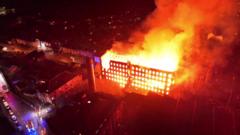
A massive fire at a local mill doesn't just end when the last ember stops glowing. If you're stuck in traffic right now or wondering why your usual route is blocked by a wall of high-visibility vests and police tape, you're likely feeling the frustration of a logistical nightmare. The reality is that the road could be shut for days, and it isn't just because of the smoke.
When a major industrial structure like a mill goes up in flames, the physics of the building changes. Steel beams warp. Brickwork that stood for a century becomes brittle and prone to sudden, catastrophic collapse. Firefighters and structural engineers aren't being overly cautious when they keep the perimeter wide. They're preventing a multi-ton wall from crushing a passing car.
The invisible dangers keeping the tarmac off limits
Most people assume that once the fire is out, the road should open. It’s a reasonable thought, but it ignores what’s happening beneath the surface and high above the street.
Heat from a blaze of this magnitude can actually damage the road surface itself. Asphalt isn't invincible. Extreme temperatures can cause the bitumen to melt or the sub-base to shift, creating sinkholes or soft spots that would swallow a delivery truck. If the council opens the road too early and a vehicle falls through a weakened patch of ground, that’s a legal and safety disaster no one wants to touch.
Then there’s the issue of hazardous materials. Mills, especially older ones, are often packed with decades of industrial bypass, dust, and sometimes asbestos. While the fire is roaring, these particles are airborne. Once the water from the high-pressure hoses settles, it creates a toxic slurry. This sludge doesn't just evaporate. It needs to be professionally cleaned, tested, and cleared before a single civilian should be allowed to drive through.
Why you should expect the cordon to stay wide
The distance from the mill to the road is often shorter than the height of the building's tallest chimney or wall. If a structure is deemed unstable, the road effectively becomes the collapse zone. Engineers have to bring in specialized equipment—sometimes drones, sometimes long-reach cranes—to inspect the structural integrity of the remaining shell. This process isn't fast.
Weather plays a massive role too. High winds or heavy rain can push a weakened wall over the edge. Until the building is either braced or safely demolished, the local authorities are stuck. They're weighing your five-minute commute against the very real risk of a building falling on your head. They’ll choose your safety every single time, even if it makes you late for work.
How to navigate the chaos while the mill cools down
Don't rely on your GPS to know about every temporary barrier or police-guarded side street. These apps are great, but they often lag behind the rapid changes on the ground during a major incident.
If you're in the area, look for the official diversions. These are mapped out to handle the weight and volume of traffic that a small residential backstreet simply cannot. When everyone tries to "beat the traffic" by cutting through a narrow lane, the whole neighborhood grinds to a halt. It’s better to follow the long way around. It’s frustrating, but it’s the only way the system keeps moving.
The clean-up crew is also dealing with miles of fire hose that might still be crisscrossing the roads. Driving over a pressurized fire hose can damage the equipment and, more importantly, cut off the water supply to the firefighters who are still dampening down hotspots. It’s a criminal offense in many places for a reason.
The ripple effect on local businesses and schools
A road closure for a few days isn't just about cars. It's about the local bakery that can't get its flour delivery. It's about the school bus that has to add 40 minutes to its morning run. The economic impact of a major fire is massive.
If you live near the site, keep your windows shut. Even if you can't see the smoke anymore, those microscopic particles are still hanging in the air. This isn't just a nuisance—it’s a health risk. Old mills are notorious for hidden contaminants that the fire has now liberated from the walls.
The long haul of recovery and structural safety
Once the engineers give the green light, the road won't just flick open like a light switch. There will be a phased reopening. You might see one lane open with temporary traffic lights first. This allows the heavy demolition equipment to continue working on the mill site while letting some traffic through.
The structural assessment of a burnt-out mill can take weeks, but the road closure usually lasts only as long as the immediate "danger to life" exists. If the walls are braced and the debris is cleared, the road returns to some sense of normalcy. But don't expect it tomorrow. The sheer volume of water used to fight these fires—thousands of gallons per minute—can leave the ground saturated and unstable for days after the last flame is gone.
Keep an eye on the local council's social media feeds and the police department’s direct updates. They are the most reliable sources of truth when it comes to the exact moment a cordon is moved. Everything else is just guesswork.
Check your route before you leave the house every single morning. If you see "road closed" signs, don't try to move the cones yourself. It’s a stupid risk that puts you and the emergency workers in danger. Just take the detour and be glad you weren't in the building when it went up. Use the extra time to plan a different route for the rest of the week because this isn't getting fixed overnight.