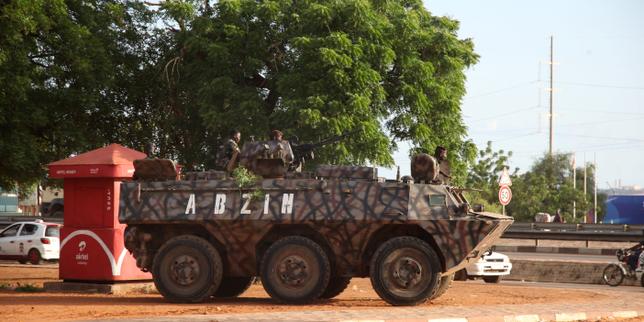
The architecture of military regimes relies fundamentally on the minimization of internal friction within the dominant command structure. When a governing junta faces a direct challenge from within its own armed apparatus, the survival of the executive depends on rapid structural recalibration, selective patronage redistribution, and the externalization of security guarantees. The events surrounding the internal challenges faced by General Abdourahamane Tiani's administration in Niger provide a clear case study in the mechanics of authoritarian regime preservation and command-line consolidation.
The Mechanics of Factional Friction
In any transition government born from a coup d'état, the ruling coalition is rarely monolithic. The power distribution inherently favors the specific branch of the military that executed the initial takeover—in Tiani's case, the Presidential Guard. This dynamic creates a structural fault line between elite praetorian units and regular front-line forces.
The primary vectors of internal military dissent are defined by three distinct variables:
- Resource Asymmetry: Preferential allocation of advanced logistics, protective equipment, and operational funding to elite inner-circle units while conventional units absorb disproportionate casualties on active counter-insurgency fronts.
- Command Stagnation: The concentration of political and military authority within a geriatric or entrenched leadership caste, blocking upward mobility for junior and mid-level operational officers.
- Operational Friction: Persistent security pressures from militant networks such as Jama'at al-Islam wal-Muslimin (JNIM) and Islamic State Sahel Province (ISSP), which expose the limits of state capacity despite inflated military expenditures.
When these variables intersect, the probability of internal mutiny or counter-coups rises significantly. The challenge to the Niamey regime demonstrated that the primary vulnerability had shifted away from civilian opposition toward internal military cohesion.
The Restructuring of Command Hierarchies
Faced with a fractured command chain, a regime cannot rely solely on ideological appeals or blanket calls for national unity. It must execute targeted administrative surgery to eliminate competing power centers.
The institutional response follows a predictable operational sequence:
- Executive Decapitation of Leadership: Immediate removal, detention, or house arrest of high-ranking military officials suspected of latent sympathy toward dissident factions. The sidelining of figures such as former Chief of Defence Staff General Moussa Salaou Barmou illustrates the speed required to neutralize institutional threats.
- Insertion of Operational Loyalists: Elevation of field commanders whose career trajectories are bound to the survival of the incumbent executive. The appointment of Brigadier General Mamane Sani Kiaou to key command positions emphasizes a shift toward officers tested in active operational zones like Tillabéry and Diffa, substituting bureaucratic generals with tactical loyalists.
- Subunit Disarticulation: Systematic purges, targeted arrests, and disarmament of specific dissident battalions or special operations units identified as nodes of conspiracy.
Externalized Security and the Rentier State
To offset internal unreliability within regular armed forces, weak military regimes frequently outsource core regime protection to external actors. This introduces an international dimension to domestic survival strategies.
The reliance on external paramilitary forces—such as Russia's Africa Corps—serves a precise function: it provides a specialized insurance policy against internal elite mutinies that domestic conscripts might refuse to suppress or might actively join. While conventional military units remain susceptible to shifting political loyalties, external security contractors operate outside local ethnic and institutional networks, rendering them immune to domestic factionalism.
However, this strategy introduces a long-term structural vulnerability. Rentier security models trade sovereignty for immediate survival. By depending on external technological and tactical support to maintain control over the capital, the central government binds its fiscal and resource extraction policies—particularly in strategic sectors like uranium and energy—to foreign geopolitical agendas.
Strategic Forecast
The stabilization achieved through purges and external security interventions is inherently fragile. Coercive consolidation suppresses symptoms of military discontent without addressing the underlying operational grievances of front-line troops. Unless the regime restructures resource allocation to alleviate the logistical and physical burdens borne by operational units, the structural preconditions for internal destabilization will persist. The longevity of the administration will be determined not by the scale of its internal purges, but by its capacity to insulate the broader military apparatus from the attrition of prolonged counter-insurgency warfare.
This RFI report on the Niger coup attempt provides additional context regarding the involvement of external actors in securing strategic sites during the crisis.