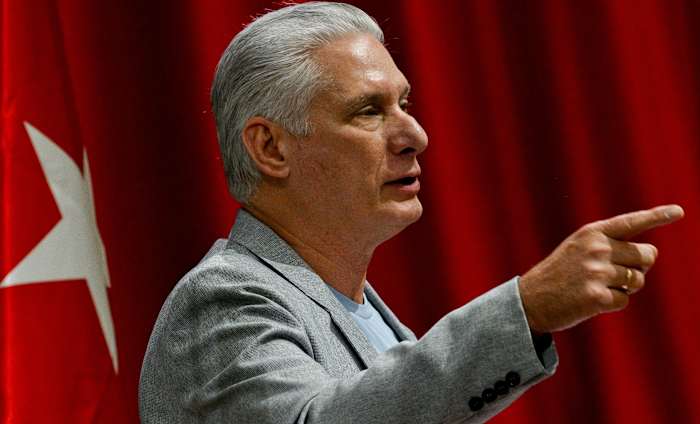
Miguel Díaz-Canel isn't going anywhere. In a recent sit-down with NBC News, the Cuban president flatly rejected the idea of stepping down, even as the island faces its worst economic crisis since the collapse of the Soviet Union. He looked the camera in the eye and signaled that the Communist Party’s grip remains firm. It’s a bold stance when you consider the reality on the ground. Cubans are dealing with 12-hour blackouts, food shortages, and a migration wave that has seen hundreds of thousands flee to the United States.
If you’re looking for a sign of a political transition in Havana, this wasn't it. Instead, Díaz-Canel doubled down on the "continuity" narrative he’s been pushing since taking over from Raúl Castro. He basically told the world that the system is functioning as intended, even if the people living under it would strongly disagree.
Why the Cuban president refuses to budge
Power in Cuba isn't just about one man. It’s about a massive institutional structure built over six decades. When Díaz-Canel tells a major American news outlet that he won’t resign, he’s speaking to two audiences. First, he’s talking to the Cuban people, trying to project an image of stability and strength. Second, he’s talking to Washington. He’s making it clear that if the U.S. wants to talk, they have to talk to him. He isn't interested in being a transitional figure who fades into the background.
The timing of this interview matters. Cuba is currently suffocating under a mix of internal mismanagement and external pressure. The tourism industry hasn't recovered from the pandemic. Sugar production is at historic lows. Inflation is making the Cuban peso almost worthless in the informal market. Most leaders would be looking for an exit strategy. Díaz-Canel is doing the opposite. He’s digging in.
The gap between Havana’s rhetoric and the street
Talking to NBC News is a calculated move. It allows Díaz-Canel to bypass state media and speak directly to a global audience. But his words don't match the desperation seen in cities like Santiago or Havana. Earlier this year, rare street protests broke out over the lack of food and electricity. People weren't just asking for bread; they were shouting for "freedom."
Díaz-Canel's response to those protests was predictable. He blamed the U.S. embargo. While the embargo—or "el bloqueo"—certainly limits Cuba’s ability to trade, it doesn't fully explain why the government can't keep the lights on or why agricultural production has cratered. The government’s own failed "Tarea Ordenamiento," a botched currency reform, did more damage to the average Cuban’s wallet than many of the sanctions did.
The shadow of the Castro legacy
You can’t understand Díaz-Canel without understanding the shadow of Fidel and Raúl Castro. He is the first person outside the Castro family to lead the country since 1959. That comes with an immense amount of pressure to prove he’s a true believer. He can’t afford to look weak. Any hint of stepping down or making massive concessions to "capitalist" demands would be seen as a betrayal of the revolution.
He’s stuck. If he opens the economy too much, he loses control. If he keeps it closed, the country continues to starve. He’s chosen a middle path that involves small, private businesses—known as MSMEs or mypimes—but these are heavily regulated and often owned by people with close ties to the regime.
What this means for U.S. relations
The Biden administration has kept Cuba on the State Sponsors of Terrorism list, a move that Díaz-Canel calls "absurd" and "unfair." Being on that list is a massive hurdle for Cuba. It blocks most international banking transactions and scares away foreign investors who don't want to get tangled in U.S. legal trouble.
By standing firm, Díaz-Canel is essentially saying that the "maximum pressure" campaign hasn't worked. He’s betting that he can outlast the sanctions. He’s looking toward allies like Russia and China for lifelines. We’ve seen Russian warships in Havana harbor recently. We’ve seen talks about Chinese electronic spying bases on the island. These are leverage points. He’s telling the U.S., "If you won't work with me, I have other friends who will."
The reality of the migration crisis
The most telling statistic about Cuba today isn't a GDP number. It’s the number of people leaving. Since 2022, more than 400,000 Cubans have arrived at the U.S. border. That is roughly 4% of the entire population. It’s a massive brain drain. The youngest, brightest, and most motivated people are giving up on the island.
When the president says he won’t step down, he’s ignoring the fact that his people are "voting with their feet." They don't want to wait for the system to fix itself. They don't believe his promises of a better tomorrow. For a 20-year-old in Havana, "continuity" sounds like a life sentence of poverty.
Survival is the only plan
There is no grand vision for a prosperous Cuba under the current leadership. The plan is survival. The government is focused on maintaining enough control to prevent a total collapse while hoping for a change in U.S. policy or a sudden windfall from an ally.
Díaz-Canel’s interview was an exercise in defiance. He wants the world to know that the Communist Party isn't going anywhere, even if the lights are out and the shelves are empty. It’s a grim reality for the millions of people who have to live through the consequences of that stubbornness.
Watch the policy shifts in Washington closely. If the U.S. decides to ease sanctions without demanding political changes, Díaz-Canel will claim victory. If the pressure stays on, expect more blackouts, more protests, and more people boarding makeshift rafts or flying to Nicaragua to start the long trek north.
The Cuban government is betting on your apathy. They hope the world gets tired of talking about Cuba so they can continue to rule in the dark. Don't let that happen. Keep an eye on the actual conditions of the people, not just the scripted defiance of their leaders. If you’re following this, look for independent reporting from journalists on the ground in Cuba who risk their safety to tell the real story. They provide the context that a presidential interview never will.
Pay attention to the upcoming sessions of the National Assembly. That’s where the actual policy shifts—or the lack thereof—will be codified. The rhetoric is for the cameras, but the legislation tells you how much more the government thinks the people can endure.


