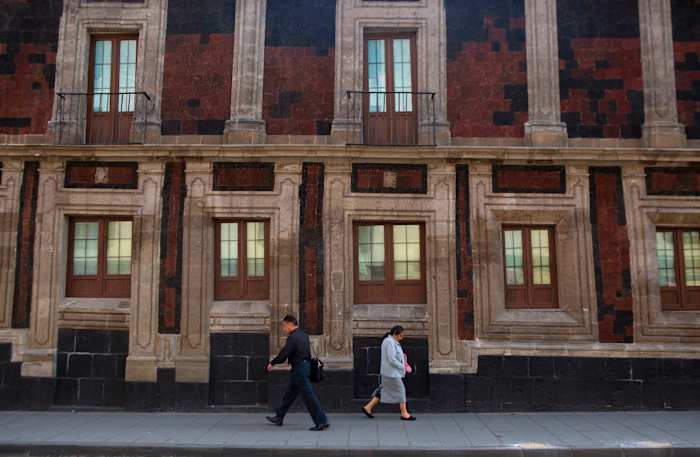
Mexico City is vanishing into the earth. While headlines frequently fixate on the dramatic satellite imagery showing the city’s descent from orbit, the reality on the ground is a slow-motion architectural massacre. This is not a uniform decline. The city is sinking at a rate of up to 50 centimeters per year in certain sectors, a pace that makes most other "sinking" global hubs look stationary. It is a mathematical certainty that parts of the metropolitan area will drop by 30 meters over the next century. This isn't just about cracked pavement. It is a terminal collision between 16th-century colonial planning and 21st-century hydrological mismanagement.
The fundamental crisis is not the sinking itself, but the irreversible compaction of the lacustrine clays beneath the streets. When you pump water out of the aquifer to thirsty residents, the clay layers collapse. Once they collapse, they can never be reinflated. Mexico City is effectively a giant sponge being squeezed dry, and as the pores of that sponge vanish, the ground above loses its structural integrity.
The Engineering Nightmare of Differential Subsidence
Gravity is a cruel landlord in the Valley of Mexico. The most pressing danger isn't that the whole city is going down, but that it is going down at different speeds. This phenomenon, known as differential subsidence, is what turns skyscrapers into leaning towers and snaps subway lines like dry twigs.
Imagine a massive concrete slab. If the entire slab sinks six inches evenly, the building on top remains functional. However, in Mexico City, the north end of a city block might sink four inches while the south end sinks ten. This creates a shearing force that no amount of steel reinforcement can withstand. We see this most clearly in the historic center. The Metropolitan Cathedral, a massive stone behemoth, has spent decades being literally pulled apart because its various wings rest on soil of varying densities.
Engineers have attempted "under-excavation" to level these ancient structures, essentially removing soil from the high side to force the building to tilt back into balance. It is a desperate game of architectural whack-a-mole. You fix the tilt today, and five years later, a new seismic shift or a change in local water extraction rates restarts the process.
The Aquifer Extortion
The city’s thirst is its own undoing. Roughly 70% of the drinking water for the 22 million people in the greater metropolitan area comes from the underground aquifer. This is a closed-loop disaster. As the city grows, it paves over the very ground that used to allow rainwater to recharge the underground reserves.
The water that does fall—often in torrential, flood-inducing bursts—cannot penetrate the asphalt. Instead, it mixes with sewage and is pumped out of the valley through massive drainage tunnels. We are throwing away the very resource that could stabilize the ground, then spending billions to pump fresh water uphill from the Cutzamala System, hundreds of kilometers away and over a thousand meters in elevation.
This energy-intensive process is one of the most expensive plumbing jobs on the planet. It is also failing. The Cutzamala System is frequently hit by droughts, and the infrastructure is aging. When the pipes break, the city turns back to the ground, drilling deeper wells, extracting more water, and accelerating the collapse.
Gravity and the Sewage Crisis
The most terrifying consequence of the sinking is the death of the sewage system. Modern plumbing relies on the simple principle that water flows downhill. For centuries, Mexico City’s drainage pipes were tilted slightly downward to lead waste out of the valley.
That tilt is gone.
Because the center of the city is sinking faster than the outskirts where the drainage tunnels exit, the slope has actually reversed in many areas. The "downhill" is now pointed back toward the city center. To prevent the city from literally drowning in its own waste, the government has had to install massive pumping stations to force sewage "uphill" against gravity. If those pumps fail during a heavy rainstorm, the result isn't just a puddle; it is a public health catastrophe.
The Eastern Discharge Tunnel (TEO), a massive engineering feat designed to alleviate this pressure, took over a decade to complete and cost billions. It is a band-aid on a gunshot wound. As the ground continues to settle, even the TEO will eventually face the same geometric challenges that killed its predecessors.
The Satellite Perspective is a Warning Not a Spectacle
When scientists analyze Interferometric Synthetic Aperture Radar (InSAR) data, they see a city of ripples. The data reveals that the sinking is no longer confined to the historic lakebed. It is spreading to the slopes and the surrounding hillsides.
These maps are often treated as curiosities by the international press, but for local urban planners, they are blueprints for a coming evacuation. The "sinking seen from space" narrative ignores the human cost of social displacement. It is the poorest neighborhoods, often built on the softest soils with the least infrastructure, that vanish first. Their homes crack, their water lines snap, and their streets become permanent flood zones.
Rich neighborhoods can afford to re-level their foundations or dig deeper private wells. The marginalized are simply swallowed.
The Myth of the Quick Fix
There is a frequent suggestion that we can simply "inject" water back into the ground to stop the sinking. In most geological contexts, this is possible. In Mexico City, it is a fantasy.
The volcanic clays under the city have a unique molecular structure. Once the water is removed and the weight of the city above crushes the clay particles together, they undergo a permanent physical change. They lose their elasticity. You can pour as much water as you want into those layers, but they will never expand back to their original volume. The height we have lost is gone forever.
Any viable solution requires a total overhaul of the city’s relationship with water. This means:
- Massive rainwater harvesting at a decentralized, household level.
- Permeable pavement across the entire valley to allow the earth to breathe and drink.
- Reclaiming the ancient lakes to act as natural reservoirs and pressure stabilizers.
The Political Inertia
The reason this hasn't happened is political, not technical. Water management is a long-term game, and political cycles in Mexico are short. Building a massive, invisible underground rainwater capture system doesn't win as many votes as building a shiny new highway overpass.
There is also the "sunk cost" fallacy. The city has invested so much in its current, failing infrastructure that the idea of abandoning it for a "sponge city" model seems financially impossible. But the cost of doing nothing is higher. Every centimeter the city drops adds to the future bill for broken gas lines, derailed trains, and collapsed schools.
Mexico City is a testament to human stubbornness. We built a megacity on a swamp, in a seismic zone, in a closed basin with no natural outlet. We are now seeing the limits of that stubbornness. The earth is reclaiming the space, and it doesn't care about our historical monuments or our sophisticated engineering.
The buildings will continue to tilt. The pipes will continue to burst. The city will continue its quiet, vertical retreat. The only question remaining is whether the inhabitants will adapt their philosophy of water before the ground moves so far that the pumps can no longer keep the flood at bay. Stop looking at the satellite photos as a marvel of science and start looking at them as a countdown. The clock isn't ticking; the ground is falling.
Every liter of water pumped from the deep today is a brick removed from the city's foundation tomorrow.