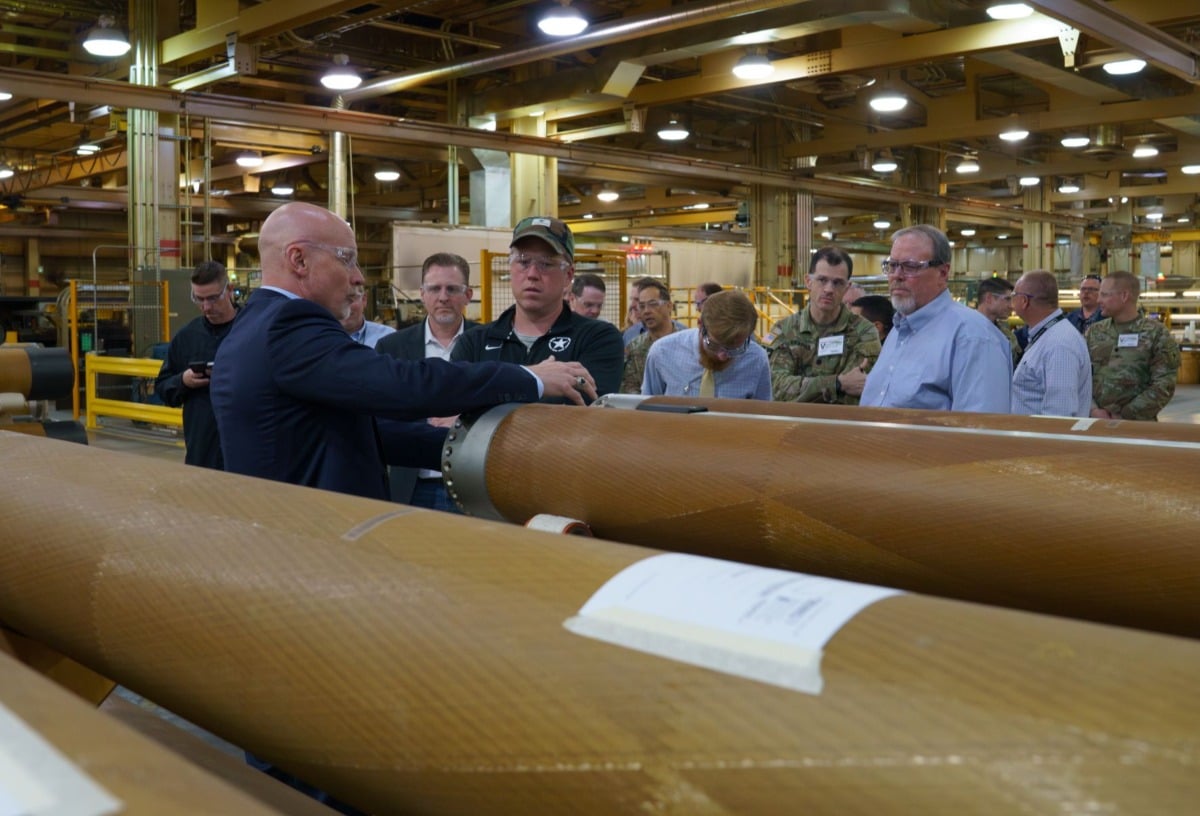
The floor of a modern munitions plant does not sound like a battlefield. It sounds like a giant, rhythmic clock. Click. Whir. Thump.
Every few seconds, a gleaming steel shell casing rolls off a line in Radford, Virginia, or Middletown, Iowa. It is cold to the touch. It is empty. But to the men and women watching it pass under the sterile glare of LED factory lights, that hollow piece of metal represents the thin line between a nation’s survival and its collapse. Also making waves lately: The Billion Dollar Microgravity Myth Why Space Based Semiconductor Subsidies Are a Total Farce.
For decades, the American public forgot about these rooms. We fell in love with the romance of Silicon Valley. We celebrated the invisible wizardry of software, stealth, and cyber warfare. The prevailing wisdom whispered that the wars of the future would be won by clicks, not cordite.
Then history woke up. Additional details regarding the matter are detailed by Wired.
When the artillery duels in Ukraine began consuming shells at a rate not seen since the Second World War, the Pentagon realized something terrifying. The digital empire was built on a foundation of physical industrial capacity, and that foundation had been allowed to rust. The factories were too slow. The supply chains were too brittle. The forge was cold.
The Weight of an Empty Shell
To understand the panic that gripped defense officials over the last few years, you have to stand where the metal meets the machine.
Army Secretary Christine Wormuth recently walked through the roaring belly of Northrop Grumman’s production facilities. What she was looking at wasn’t just a corporate briefing or a showcase of shiny new prototypes. She was looking at the sheer, brutal math of industrial warfare.
Consider a single 155mm artillery shell. To a casual observer, it looks like an oversized bullet. In reality, it is a masterpiece of metallurgical stress management. It must withstand pressures that would liquefy a normal engine block. It must fly true across twenty miles of sky.
If you don't have enough of them, nothing else matters. You can have the most advanced satellite constellation in the cosmos. You can have stealth fighters that fade from radar like ghosts. But if your partner nations are firing thousands of rounds a day to hold back a land invasion, and your factories can only produce a fraction of that number each month, your strategy is an illusion.
The math became a crisis. The United States was drawing down its own stockpiles to keep an ally alive, watching the numbers dip into the red zone. The defense industrial base, consolidated and streamlined for thirty years of peacetime efficiency, suddenly faced a sudden, staggering demand.
They needed more. They needed it years ago.
Rewiring the Monster
How do you accelerate an industry that measures its setup times in years?
You don't just hire more workers. You change the way the factory thinks.
During Wormuth’s tour of the Northrop Grumman footprint, the conversation centered on a massive, systemic overhaul. The company is pouring capital into expanding its production lines for ammunition, rocket motors, and the complex energetic materials that make things blow up. We are talking about facilities like the Radford Army Ammunition Plant and the Allegany Ballistics Laboratory—places that have suddenly become the center of the geopolitical universe.
But increasing capacity is a logistical nightmare.
Imagine trying to widen a highway while traffic is still moving at eighty miles an hour. You cannot simply stop production to install new machinery. Every hour a line is down is an hour where the stockpile shrinks. Instead, engineers are using advanced automation and digital modeling to squeeze every millimeter of efficiency out of existing square footage.
They are replacing manual inspections with high-speed optical scanning. Where a human inspector once used calipers to measure a casing, a bank of lasers now checks tolerances to the fraction of a millimeter in the blink of an eye. Robots handle the heavy lifting of volatile compounds, keeping human flesh far away from the dangerous business of mixing explosives.
The goal is staggering: push production numbers up by multiples, not percentages. The Army wants to hit a production rate of 100,000 shells a month across the entire industry. That requires an industrial mobilization the likes of which we haven’t witnessed since the Cold War.
The Ghosts in the Supply Chain
Yet, the biggest bottleneck isn't the assembly line itself. It is the invisible web of dependencies that feeds it.
Every weapon system is a mosaic of rare inputs. A specific chemical from a single supplier in the Midwest. A particular grade of steel forged in a handful of foundries. Specialized electronics that must survive the unimaginable G-forces of being shot out of a cannon.
If one link snaps, the entire machine grinds to a halt.
During the post-Cold War era, the defense industry adopted the "just-in-time" manufacturing philosophy popularized by commercial carmakers. It made sense on a balance sheet. Why pay to store millions of tons of raw materials if you don't need them today? Warehouse space costs money. Idle inventory is dead capital.
But war is not a commercial market. War is "just-in-case."
When the crisis hit, the just-in-time model broke. Northrop Grumman and the Army are now forced to rebuild the entire ecosystem from scratch. They are qualifying new suppliers, onshoreing the production of critical chemicals, and buying up vast reserves of raw ingredients to ensure the lines never run dry again. It is a massive financial gamble. It requires the government to guarantee long-term contracts so that businesses can afford to build new factories without fearing that the demand will evaporate the moment a ceasefire is signed.
It is a delicate dance between public policy and corporate risk. The Secretary's visit was less about clapping for achievements and more about validating that these massive capital investments are actually turning into physical, lethal inventory.
The Human Element at the Line
Behind the corporate press releases and the high-level political visits are the people who actually wear the safety glasses.
In towns across America, generations of families have worked these lines. It is demanding, precise work. There is no room for a bad day. A mistake in a software update might crash an app; a mistake in an explosives mixing bay can vaporize a building.
These workers know exactly what they are making. They watch the news. They see the footage of mud-slicked trenches halfway across the world. They know that a crate of ammunition rolling off their line today could be the deciding factor in whether a foreign town survives next month.
That knowledge brings a quiet, heavy intensity to the factory floor. The speed-up isn't just an abstract corporate metric dictated by a board of directors in Washington. It is a race against time that everyone feels in their bones. The shift workers, the logistics coordinators, the quality control technicians—they have been thrust onto the front lines of a global conflict without ever leaving their zip codes.
The Price of Peace
We are learning a hard, ancient lesson all over again. Deterrence is not a slogan. It is a mountain of iron.
The ability to prevent a war depends entirely on your opponent's belief that you can win a long one. If your adversary looks at your factories and sees that you will run out of bullets in three months, your diplomatic leverage vanishes. Industrial capacity is diplomacy. A thriving, roaring munitions line is just as powerful as a treaty.
The U.S. Army’s push to revitalize its ammunition infrastructure is an admission of past complacency. It is an acknowledgment that the world remains a stubborn, violent place where physical mass matters.
The transformation is happening, block by block, factory by factory. The cold rooms are getting hotter. The machines are turning faster. The silence of the peacetime era has been replaced by the relentless, deafening rhythm of a superpower remembering how to build.
As the sun sets over the Radford facility, the lights inside stay bright. The shift changes. Another group of workers steps up to the line. The metal keeps moving, clinking into crates, waiting for a future everyone hopes will never come, but for which they must be entirely prepared.