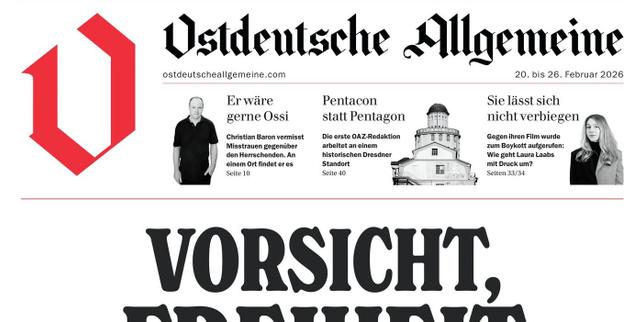
The launch of a new weekly publication dedicated to the East German narrative—specifically the Diesseits project—represents a calculated attempt to capture a specific demographic surplus: the gap between the lived experience of sixteen million people and the editorial focus of the Federal Republic's legacy media. This is not a charitable endeavor to "save" a culture; it is a strategic entry into a high-affinity, low-competition market segment. The success of such a venture depends on its ability to navigate the tension between regional identity and the structural economic realities of a post-reunification media market dominated by Western conglomerates.
The Structural Deficit of the East German Media Market
To understand the necessity of a new weekly, one must first quantify the consolidation of the German media landscape. Following 1990, the East German press underwent a rapid "West-integration" where the Treuhandanstalt facilitated the acquisition of regional dailies by Western giants like Axel Springer, Bauer, and Burda. This created a homogenization of editorial perspectives. Also making news in related news: The Cuban Oil Gambit Why Trump’s Private Sector Green Light is a Death Sentence for Havana’s Old Guard.
The current market is defined by three primary friction points:
- Ownership Concentration: Over 90% of regional daily circulation in the former GDR is controlled by Western German publishing houses. This creates a vertical misalignment where the decision-makers (owners) do not share the socio-economic history of the consumer base.
- The "West-Reflex" in National Media: National weeklies like Die Zeit or Der Spiegel frequently treat East Germany as an anthropological subject rather than a core constituency. This creates a "Representation Gap" where East German readers consume content that describes them as an "other."
- Demographic Wealth Transfer: Advertising revenue follows purchasing power. Because the median net worth in the East remains significantly lower than in the West, legacy media has historically under-invested in specialized content for these regions, favoring the high-value "A-cities" of the West.
The Three Pillars of Narrative Arbitrage
The new weekly operates on a strategy of narrative arbitrage—buying the "undervalued" stories of the East and selling them back to a population hungry for recognition. This strategy rests on three pillars: Further insights on this are explored by The Wall Street Journal.
Historical Continuity vs. Rupture
Legacy media often portrays 1989 as a "Year Zero." For the population, however, life is a continuum. A publication that treats the GDR years not just as a prelude to democracy, but as a valid era of professional and personal development, secures an immediate psychological moat. This is the "Biographical Validation" function.
Economic Specificity
The East German economy is characterized by a "Small and Medium Enterprise" (SME) structure with fewer DAX-listed headquarters. The cost function of living in the East—lower rents but also lower wages—creates a different consumer psychology. A weekly that addresses the specific investment, labor, and infrastructure challenges of the neue Bundesländer provides utility that a Frankfurt-based financial paper cannot.
Political De-stigmatization
The current political discourse often simplifies East German voting patterns into a binary of "pro-democracy" vs. "extremist." This ignores the nuanced skepticism toward centralized institutions that stems from having survived a collapsed state. The publication serves as a laboratory for "Skeptical Liberalism," providing a space for critique that doesn't automatically trigger the defensive mechanisms of the Berlin-Mitte elite.
The Cost Function of Regional Credibility
Launching a print-first or print-heavy product in 2024-2026 is an exercise in high-stakes capital allocation. The "East German Narrative" is a potent brand, but the unit economics of print are brutal.
- Production Costs: Paper and energy prices in Germany have remained volatile since 2022. For a startup weekly, the "Breakeven Circulation" is significantly higher than it was a decade ago.
- Distribution Bottlenecks: The German press distribution system (Presse-Grosso) is efficient but expensive. To reach rural Saxony or Mecklenburg-Vorpommern, the logistics costs per copy can erode the entire margin of the cover price.
- Digital Conversion: The target demographic—older East Germans who remember the transition—prefers print. However, the long-term viability requires a digital subscription model that appeals to the "Nachwendekinder" (those born after the wall fell). These younger cohorts have a "Hybrid Identity"; they are culturally East German but digitally global.
The Mechanism of Identity-Driven Growth
Success for a publication like this is not measured by total German reach, but by "Density of Influence" within the five eastern states. The growth mechanism follows a specific sequence:
- Trust Acquisition: By hiring journalists with East German roots, the publication bypasses the "Parachute Journalist" stigma. This is the "In-Group Signal."
- Controversial Differentiation: The weekly must take editorial stances that the "West-Press" avoids—for example, questioning the speed of the Energiewende (energy transition) or the specifics of German-Russian diplomatic history. This creates "Talkability."
- Community Compounding: As the publication becomes a staple in local political circles, it becomes an "Authority Node." Politicians and business leaders in the East begin to use it as their primary vehicle for communication, forcing the Western media to quote it.
Risks of Narrative Over-Correction
There is a significant danger in becoming an "Echo Chamber of Grievance." If the publication focuses exclusively on what the East lacks or how it has been wronged, it limits its upside.
- The Victimhood Trap: Constant focus on the "Unfairness of the 90s" can alienate the ambitious younger generation who want to build, not just remember.
- The Extremism Magnet: In a polarized climate, a platform for "East German voices" can be co-opted by radical elements. Maintaining a "Rigorous Center" is the hardest editorial task in this segment. If the paper loses its intellectual rigor to appease populism, it loses its ability to influence the broader German policy debate.
The Competitive Response
Western German publishing houses will not ignore a successful niche player. We can expect a "Fast-Follower" strategy where established brands like ZEIT or FAZ launch dedicated "East Supplements" or digital verticals.
However, these legacy players face the "Incumbent's Dilemma." They cannot fully embrace the East German perspective without alienating their core Western subscriber base, which often views East German demands as subsidization. This "Structural Incompatibility" gives a dedicated startup like Diesseits a temporary monopoly on authentic regional advocacy.
Strategic Execution Framework
To move from a niche project to a sustainable media institution, the editors must execute on three fronts:
- Aggressive Talent Poaching: They must secure the "Star Columnists" of the East—intellectuals who are currently underutilized as "tokens" in Western newsrooms.
- B2B Integration: The publication should position itself as the "Trade Journal of the East German Economy," attracting B2B advertising from regional energy providers, construction firms, and mid-sized manufacturers.
- Physical Presence: In a digital age, trust is built through "Physical Proxies." Monthly town halls in cities like Chemnitz, Magdeburg, and Rostock will serve as both content generation engines and subscriber acquisition channels.
The market for East German identity is currently in a state of "Under-Supply." While the political landscape is crowded, the intellectual and cultural landscape remains thin. The goal is not to "rescue" a narrative, but to professionalize it. The publication that successfully moves East Germany from a "Problem Zone" to a "Profit Center of Ideas" will own the most loyal audience in the Federal Republic.
The strategic play is to leverage the regional vacuum to build a high-density, high-trust platform that eventually forces a re-negotiation of the national consensus. This is not just journalism; it is the construction of a new intellectual infrastructure. The focus should now shift toward securing long-term institutional capital that is decoupled from the immediate volatility of newsstand sales, prioritizing a multi-channel "Membership Model" over a simple "Subscription Model."