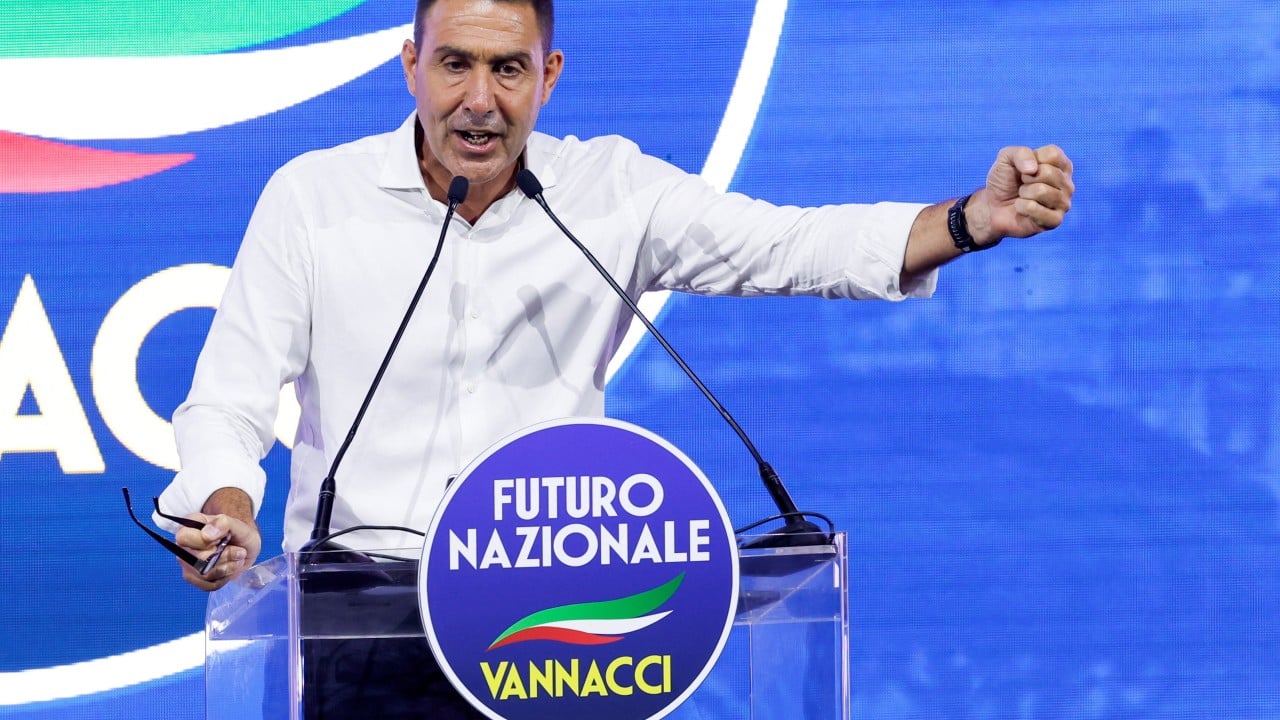
The mainstream political press loves a predictable script. When Roberto Vannacci—the controversial former Italian general—announced his intention to spin his personal movement, "The World Upside Down," into a fully fledged political party, the headlines practically wrote themselves. The lazy consensus locked in immediately: an existential threat to Prime Minister Giorgia Meloni, a mortal danger to the European Union, and the inevitable rise of a new far-right juggernaut.
It is a neat, terrifying, and utterly wrong narrative.
Mainstream commentators are analyzing 21st-century populism using a 20th-century playbook. They see a man in a crisp uniform with hardline views on migration, identity, and sovereignty, and they assume he is building a traditional political machine designed to seize legislative power.
He isn't. Vannacci is doing something far more dangerous, and far more sophisticated, than launching a redundant nationalist party. He is weaponizing a personal brand to cannibalize the existing right from the inside out, operating not as a traditional statesman, but as a high-yield political grifter. The establishment is panicking about an electoral coup when they should be worrying about an ideological hostile takeover.
The Illusion of the Meloni Challenger
Let's dismantle the primary premise dominating the news cycle: that Vannacci represents a viable electoral alternative to Giorgia Meloni's Brothers of Italy.
Political analysts look at Vannacci’s massive haul of over half a million preference votes in the European Parliament elections and see a launching pad for a new party. This ignores the foundational mechanics of modern Italian coalition politics. Italy’s electoral system heavily penalizes fragmentation. Starting a boutique radical party does not dilute the mainstream center-right; it isolates the radical fringe.
Meloni understands power structures. She spent years positioning Brothers of Italy to absorb the remnants of Silvio Berlusconi’s Forza Italia and Matteo Salvini’s Lega. She transitioned from a fiery agitator to a pragmatic institutionalist because that is the only way to govern Italy without the coalition collapsing in six months.
Vannacci’s movement lacks the structural infrastructure required to mount a serious legislative challenge. It has no regional headquarters, no deep-pocketed corporate backing, and no network of seasoned local mayors and counselors who actually deliver votes during non-presidential cycles.
"In politics, passion fills halls, but infrastructure fills ballot boxes."
I have spent years watching political insurgencies flame out because they confused viral book sales with sustainable grassroots mobilization. Vannacci is a symptom of Meloni’s pragmatic pivot to the center, not a cure for it. He exists because Meloni chose to play the game of global statecraft, leaving a vacuum of raw, unvarnished anger. But filling a vacuum with rhetoric is vastly different from building a governing coalition.
The Salvini Parasite: The Real Target
To understand what Vannacci is actually doing, look at Matteo Salvini and the Lega. This is where the lazy consensus completely misses the mark. Vannacci isn't attacking Meloni; he is cannibalizing Salvini.
Salvini took a massive gamble by placing Vannacci on the Lega’s ticket for the European elections. It was a desperate move by a leader whose party had plummeted from 34% of the vote in 2019 to single digits. Salvini thought he could use the general's notoriety to prop up his own failing brand.
Instead, the parasite has effectively consumed the host.
Vannacci did not just win votes; he exposed the utter ideological bankruptcy of the modern Lega. By operating his cultural movement in tandem with his role as an MEP, Vannacci has created a party-within-a-party. The moment "The World Upside Down" becomes an official political party, it won't pull voters from Meloni's institutional base. It will pull the remaining hardliners away from Salvini, dealing a death blow to a legacy party.
This is not a grand ideological realignment. It is a liquidation sale of the populist right's most radical assets. Vannacci is simply the smartest liquidator in the room.
The Euro-Skepticism Boogeyman
The international media is hyperventilating over Vannacci’s anti-EU rhetoric, framing his new political venture as a bomb thrown into the heart of Brussels. This displays a fundamental misunderstanding of how the European Parliament actually functions.
A politician can deliver all the fiery, anti-globalist speeches they want on TikTok, but inside the European Parliament, influence is dictated by European political groups. Vannacci sits with the Patriots for Europe group. This bloc, while vocal, is systematically sidelined by the "cordon sanitaire"—the informal alliance of centrist, center-right, and center-left parties that locks radical factions out of key committee chairmanships and legislative rapporteur roles.
Vannacci’s anti-EU stance is entirely performative. It is designed for domestic consumption, not continental disruption. It serves to maintain his outsider status while he collects a robust European salary and enjoys immunity. He has no path to altering EU policy because he has no interest in the grueling, boring work of legislative negotiation. The media treats him like a systemic threat to the Union, when in reality, he is using Brussels as a highly subsidized megaphone to fund his domestic brand building.
The Grift of the "Cultural Combatant"
The real danger Vannacci poses has nothing to do with passing laws or winning prime ministerships. The danger is the permanent degradation of political discourse for profit.
Vannacci’s playbook is lifted directly from the American alt-right ecosystem. You don't build a party to govern; you build a party to create a perpetual grievance machine. A political party allows for tax-exempt donations, official campaign funding, and structured book tours masquerading as political rallies.
Consider the financial trajectory. His self-published book sold hundreds of thousands of copies not because it offered a coherent policy framework for Italy's economic stagnation, but because it provoked a reaction. The outrage is the business model. Every time a center-left politician condemns him, his stock goes up. Every time a media outlet runs a panicked profile, his donation page sees a spike.
By turning his movement into a formal party, Vannacci ensures that this commercial enterprise is institutionalized. He transforms from an eccentric retired general into a protected political commodity.
The downside to this contrarian view? It requires admitting that our political systems are no longer vulnerable to ideological coups, but rather to cultural grifts. It means acknowledging that the threat isn't a return to 1930s authoritarianism, but a descent into an era where political parties are merely content creation houses designed to monetize polarization.
Dismantling the Premises
The public frequently asks the wrong questions about this political shift. Here is the unvarnished reality behind the most common assumptions.
Will Vannacci force Meloni to move further right?
No. Meloni’s primary objective is survival, which requires maintaining the confidence of international markets, European central bankers, and Washington. She cannot afford to chase Vannacci into the ideological wilderness. She will let him occupy the extreme fringe because it makes her look like the only adult in the room to global leaders. Vannacci is the best foil Meloni could have asked for.
Is Italy on the verge of electing a military strongman?
This is a comical misunderstanding of the Italian electorate. Italy has a profound, historically coded skepticism toward military figures in civilian politics. Vannacci’s uniform gives him a temporary novelty factor, but the moment he enters the mud-slinging arena of a formal party leader, that mystique vanishes. He becomes just another politician fighting over airtime, subject to the same scandals, flip-flops, and backstabbing that destroys every Italian political project within three years.
Can a new right-wing party fix Italy’s systemic issues?
Absolutely not. Italy's core challenges are structural, demographic, and economic: an aging population, a stagnant productivity rate, and a crushing public debt load that hovers around 140% of GDP. Neither Meloni, Salvini, nor Vannacci has an actionable solution for these realities. Vannacci’s platform offers cultural grievances—identity, gender roles, migration—because addressing structural economics requires making unpopular choices that alienate voters. It is far easier to complain about the "upside-down world" than it is to reform a broken judicial system or update a bloated bureaucracy.
The New Political Currency
The media continues to measure political power in terms of seat counts, polling averages, and legislative agendas. They are tracking outdated metrics.
In the current ecosystem, attention is the only currency that matters. Vannacci does not need to win an election to win the game. If he can command the news cycle, dictate the parameters of what is considered acceptable discourse, and force mainstream politicians to react to his provocations, he already holds the power.
By treating his new party as a traditional political threat, the press is validating his strategy. They are giving an attention-merchant exactly what he needs to scale his business. He is not building a party to rule Italy. He is building a party to ensure he never has to stop talking, and that we never stop listening.
Stop looking for the ghost of old regimes in a tailored suit. The new political reality isn't a march on Rome; it's a subscription model for outrage, and the general just launched his IPO.