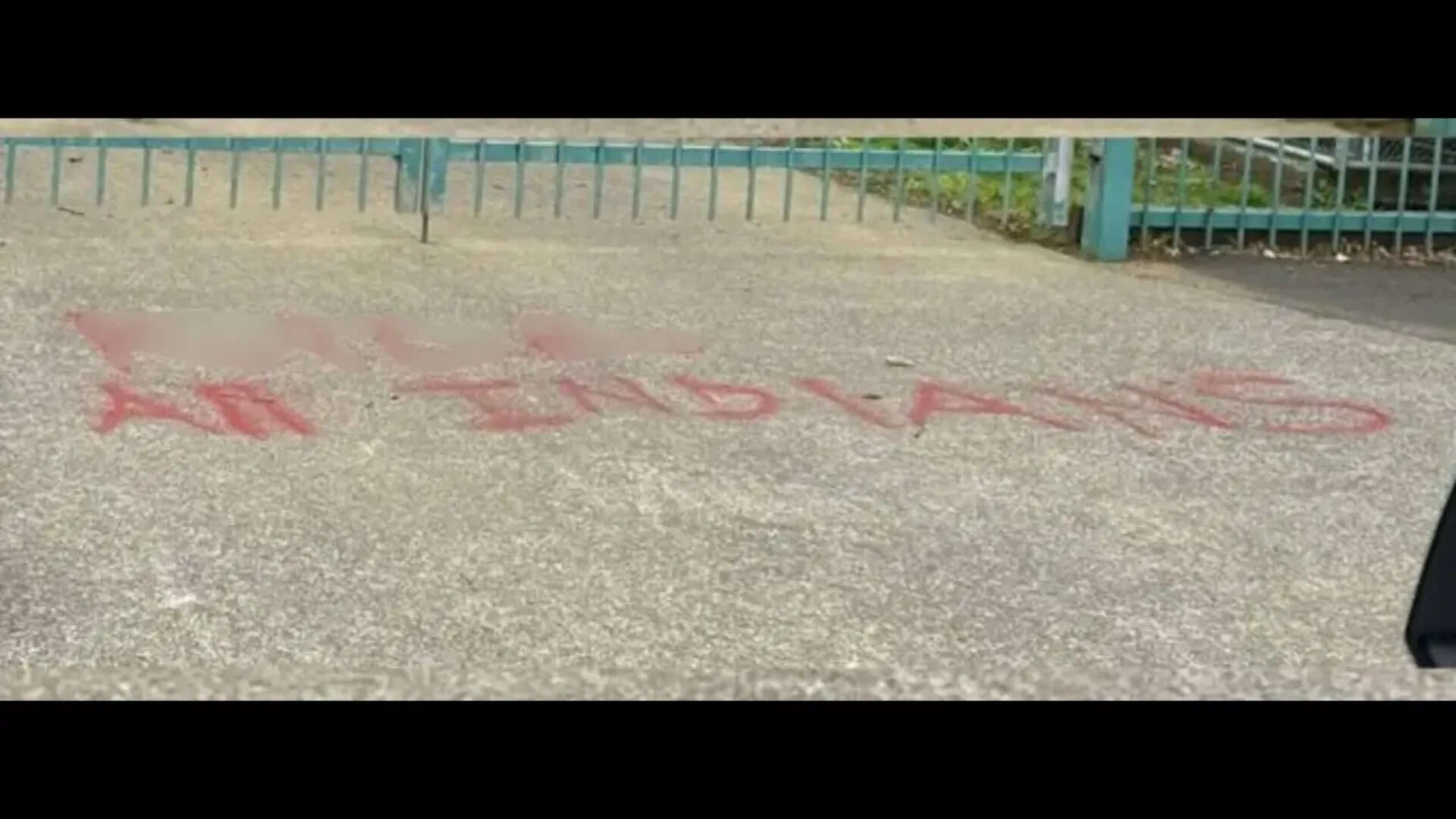
Geopolitical tensions are no longer contained by physical borders; they are increasingly outsourced to diaspora populations through low-cost, high-visibility actions known as "fringe signal amplification." The discovery of anti-Indian graffiti outside a New Zealand educational institution represents a tactical shift in psychological operations, moving from digital echo chambers into the physical infrastructure of neutral third-party nations. This phenomenon functions as a stress test for domestic social cohesion, forcing host governments to navigate the thin line between protecting free speech and mitigating hate-motivated property damage.
The Architecture of Identity-Based Vandalism
To understand the impact of the graffiti in New Zealand, one must deconstruct the event through the lens of Signal Theory. Vandalism of this nature serves three primary functions that extend far beyond the physical act of defacing a wall. You might also find this similar story useful: The Tourism Crisis in Cuba is Not a Sanctions Problem.
- Territorial Marking: By placing messaging near a school, the actors target the foundational institutions of a community. This implies that the targeted demographic—in this case, the Indian diaspora—is being monitored in their most vulnerable daily routines.
- Reaction Mining: The success of fringe vandalism is measured by the seniority of the reaction it triggers. When a high-ranking official, such as a Member of Parliament, labels the act "vile and cowardly," the perpetrators achieve a maximum return on investment. The low cost of a spray-can is traded for a high-value national and international news cycle.
- Algorithmic Feedback Loops: Physical graffiti is designed to be photographed and uploaded. Once digitized, it re-enters the global information stream, reinforcing narratives of persecution or dominance in the home countries of the diaspora involved.
Structural Incentives for Diaspora Friction
The escalation of these incidents suggests a breakdown in the traditional "buffer" role that host nations provide. Several structural drivers contribute to why New Zealand has become a theater for these displays.
The Portability of Grievance
Digital connectivity allows political grievances from the Indian subcontinent to remain "live" for migrants. Historical assimilation models assumed a gradual decoupling from home-country politics; however, current data-consumption patterns show that diaspora members often remain more engaged with the political friction of their origin than with the local governance of their current residence. This creates a "dual-citizen psyche" where local walls become canvases for distant wars. As extensively documented in latest reports by USA Today, the results are significant.
The Low-Risk Asymmetry
Engaging in political violence in high-surveillance or authoritarian environments carries extreme personal risk. Conversely, New Zealand’s legal framework, which prioritizes civil liberties and treats non-violent property damage as a secondary offense, offers a low-risk environment for radical expression. The cost-benefit analysis for a bad actor favors these "hit and run" tactics because the likelihood of severe prosecution is statistically low, while the social media clout generated is substantial.
Quantifying the Social Erosion Cost
While the physical cost of removing graffiti is negligible, the Social Erosion Coefficient—the measurable decline in trust between ethnic enclaves and the state—is significant. This cost manifests in three distinct phases.
Phase One: The Security Tax
When educational institutions become sites of political messaging, the immediate response is a redirection of capital toward security infrastructure. Schools are forced to spend budgets on high-definition CCTV, perimeter fencing, and private patrols. This "security tax" is a direct diversion of resources away from pedagogical outcomes.
Phase Two: The Communal Withdrawal
Targeted messaging creates a "chilling effect" on public participation. If the Indian community perceives that public spaces are becoming hostile, there is a measurable shift toward insular social behavior. This reduces the frequency of cross-cultural interaction, which is the primary mechanism for long-term social stability in multicultural democracies.
Phase Three: The Diplomatic Friction Point
The response of Indian officials to events in New Zealand creates a diplomatic feedback loop. When a foreign government feels compelled to comment on the safety of its diaspora, it places the host nation’s law enforcement under external scrutiny. This turns a local police matter into a bilateral diplomatic variable, complicating trade, visa, and security negotiations.
The Failure of Current Mitigation Strategies
Most municipal responses to political graffiti rely on "Rapid Removal" policies. While effective at reducing visual blight, rapid removal fails to address the underlying incentive structures.
- The Erasure Paradox: Cleaning the wall does not erase the digital footprint of the image. In many cases, the act of cleaning is itself filmed and used as further content by radical groups to show "state suppression" of their message.
- The Categorization Gap: Law enforcement often classifies these incidents as "vandalism" rather than "hate-motivated signaling." This misclassification prevents the deployment of higher-level intelligence resources that could track the organizational links behind the actors.
Logic Framework for Institutional Response
To de-escalate these tensions, institutions must shift from a reactive posture to a Resilience-Based Framework. This requires a departure from simple condemnation toward a more clinical, data-driven isolation of the actors.
Intelligence Integration
Police units must treat "fringe signal" graffiti as a data point in a larger trend of transnational repression. Mapping the frequency, location, and specific terminology used in the New Zealand graffiti allows analysts to determine if the act was an isolated impulse or part of a coordinated campaign.
Strategic Silence vs. Targeted Condemnation
There is a tactical tension between ignoring an act to starve it of oxygen and condemning it to reassure the public. A superior strategy involves "de-platforming the deed." This means removing the graffiti immediately but restricting high-level political commentary unless there is a credible threat of physical escalation. Constant high-level outrage feeds the "Reaction Mining" mentioned earlier.
Tactical Realignment for Educational Boards
School boards and local councils must view their physical assets as potential flashpoints in a global information war. The following protocols offer a more robust defense than simple surveillance:
- Contextual Monitoring: Security teams should be briefed on the specific political calendars of the major diaspora groups in their area. High-risk windows often coincide with national holidays, election cycles, or anniversaries of historical conflicts in the home country.
- Diaspora Leadership Engagement: Rather than relying on police to bridge the gap, schools should maintain direct lines to community elders and secular diaspora organizations. These leaders are better positioned to provide counter-narratives that delegitimize the vandals within their own community.
- Defined Reporting Standards: Standardizing how these incidents are reported—ensuring they are tagged as "bias-motivated" in official databases—creates the necessary data trail for national security agencies to justify the allocation of protective resources.
The incident in New Zealand is a symptom of a larger, systemic shift where the "local" is permanently tethered to the "global." In this environment, the wall of a school is no longer just brick and mortar; it is a node in a global network of grievance.
The strategic imperative for the New Zealand government and its allies is to move beyond the language of "cowardice" and toward the language of "operational deterrence." This involves hardening soft targets through environmental design and ensuring that the legal consequences for transnational signaling outweigh the digital rewards. Failure to treat these acts as sophisticated psychological operations will only lead to an increase in their frequency and a further fracturing of the social contract within multicultural urban centers.
State agencies must prioritize the identification of the financial or organizational hubs that encourage these "low-level" disruptions. By treating the graffiti not as an end in itself, but as the visible edge of a much deeper radicalization funnel, authorities can begin to disrupt the supply chain of grievance before it reaches the school gates. The goal is to make the cost of participation so high, and the social reward so low, that the tactic becomes obsolete.