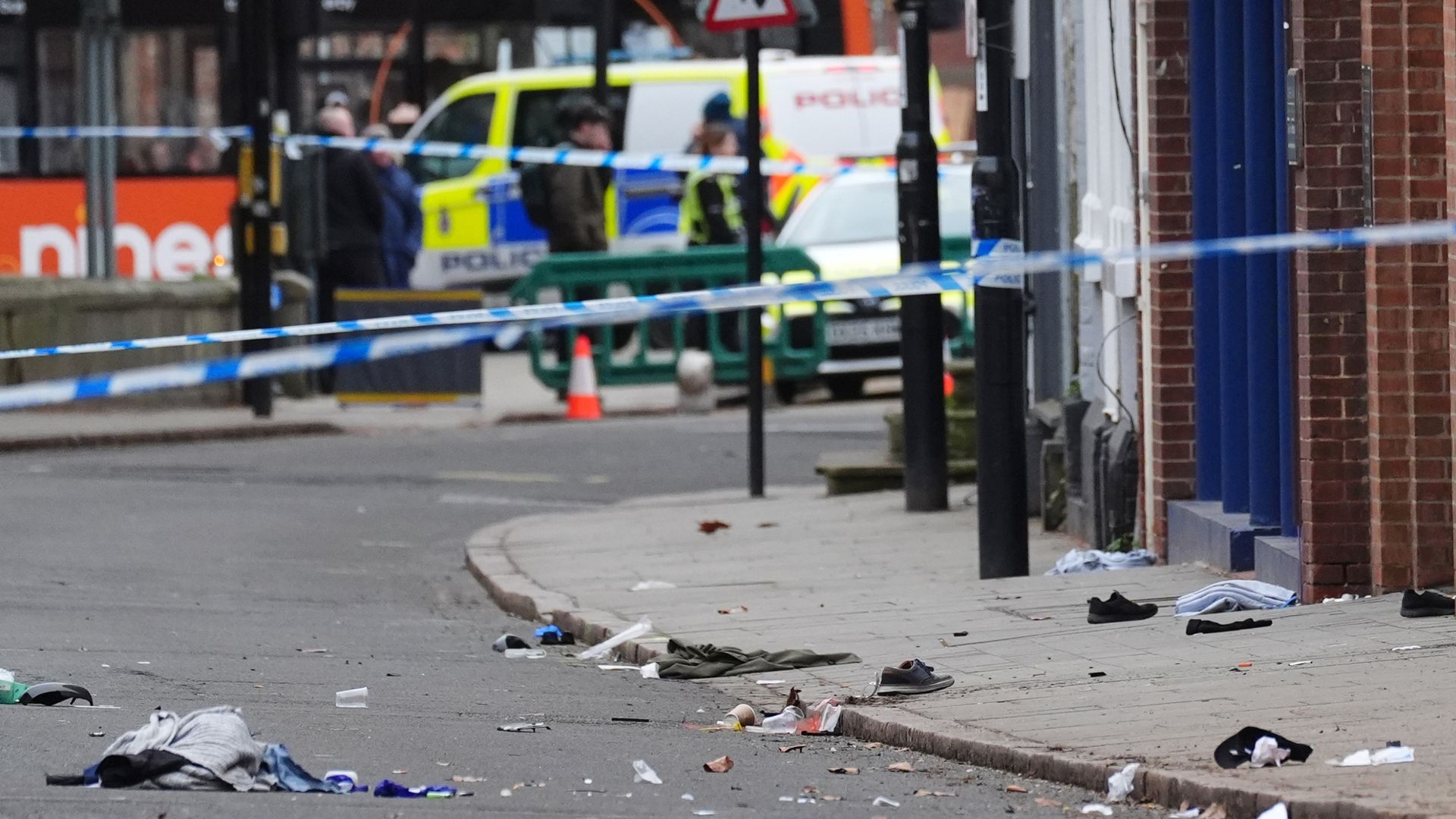
The deployment of a vehicle as a weapon in urban environments represents a critical failure of public space safety protocols and a high-velocity challenge to emergency response synchronization. When a car strikes multiple pedestrians, as occurred recently in Derby, the incident shifts from a traffic transgression to a suspected criminal act of attempted murder, necessitating a transition from standard accident investigation to a forensic criminal inquiry. This transition is governed by the immediate assessment of intent, the spatial distribution of victims, and the kinetic variables involved in the impact.
The Kinematics of Vehicular Impact on Pedestrian Clusters
Analyzing the severity of an incident where pedestrians are struck requires an understanding of the energy transfer involved. The lethality of a vehicular strike is a function of velocity, mass, and the lack of structural protection for the pedestrian.
- Velocity and Survival Probability: The relationship between impact speed and pedestrian fatality is non-linear. At 20 mph, survival rates are high, but they drop precipitously as speeds exceed 30 mph.
- Impact Vectors: In a deliberate or suspected intentional strike, the driver often maintains or increases acceleration through the point of contact, rather than braking. This eliminates the "pre-impact braking" phase that typically reduces kinetic energy in accidental collisions.
- The Displacement Factor: Multiple victims spread across a specific area suggest either a loss of control over a sustained distance or a conscious steering toward human targets.
In the Derby case, the arrest on suspicion of attempted murder indicates that the preliminary evidence—likely CCTV footage, witness statements, or vehicle telemetry—suggests the driver’s actions were not the result of mechanical failure or a medical episode, but rather a directed application of force.
Jurisdictional Transition and Investigative Frameworks
The moment a collision is reclassified from an "accident" to a "crime scene," the operational priorities of the Derbyshire Constabulary shift. This is not merely a semantic change; it dictates the allocation of resources and the methodology of evidence collection.
Forensic Scene Management
The physical environment is treated as a repository of data. Investigators utilize 3D laser scanning to map the "debris field"—the distribution of glass, plastic, and personal effects—which allows for the reconstruction of the vehicle's trajectory.
- Tire Mark Analysis: Scuff marks and "yaw" marks reveal the vehicle's path and whether the driver attempted to steer into or away from the victims.
- Digital Forensics: Modern vehicles contain Event Data Recorders (EDRs) that capture throttle position, braking status, and speed in the seconds leading up to an impact. This data is the primary tool for proving or disproving intent.
The Threshold of Attempted Murder
For a charge of attempted murder to hold in the UK legal system, the prosecution must prove a "specific intent to kill." This is a significantly higher burden of proof than "dangerously driving" or even "causing grievous bodily harm with intent." The investigation must find evidence that the suspect did not just intend to injure, but intended to end life. This intent is often inferred from the speed of the vehicle, the repeated nature of the strikes, or the targeting of vulnerable areas of the body.
Systemic Vulnerabilities in Urban Pedestrian Infrastructure
The incident in Derby highlights a persistent vulnerability in modern urban design: the proximity of high-mass vehicles to unprotected human traffic. This creates a high-risk interface that can be exploited with minimal preparation.
The Permeability of Public Spaces
Most city centers rely on "soft" security measures—curbs, bollards, and signage—that are designed to manage flow rather than resist deliberate kinetic force.
- Static Defenses: Fixed bollards provide protection but limit accessibility for emergency vehicles and logistics.
- Active Defenses: Retractable barriers are effective but costly to maintain and require human or sensor-based activation, which may be too slow in a high-speed assault.
Psychological and Social Variables
While the physical mechanism of the crime is the vehicle, the root cause is the human operator. Law enforcement must determine if the motivation was personal, spontaneous (road rage), or ideological. The suspect in Derby, being held on suspicion of attempted murder, suggests a focused investigation into their prior relationship with the victims or their mental state at the time of the event.
Medical Response and Triage Dynamics
In the immediate aftermath of a multi-pedestrian strike, the medical response follows a "METHANE" protocol (Major incident, Exact location, Type of incident, Hazards, Access, Number of casualties, Emergency services).
- Catastrophic Hemorrhage Control: The primary cause of death in vehicular strikes is rapid blood loss from limb trauma or internal organ rupture.
- Blast-like Trauma: The impact of a 1.5-ton vehicle at speed mimics the effects of primary blast injuries, causing blunt force trauma that may not be immediately visible, such as tension pneumothorax or traumatic brain injury.
- Distribution of Care: Victims must be distributed across regional trauma centers to prevent any single facility's surgical capacity from being overwhelmed.
Strategic Mitigation of Vehicular Risk
To reduce the frequency and impact of such incidents, urban planning must move beyond reactive policing and toward proactive structural engineering.
- Zonal Segregation: Implementing "pedestrian-only" windows in high-traffic areas during peak hours.
- Infrastructure Hardening: Replacing standard street furniture with crash-rated alternatives that can absorb the energy of a vehicle impact without fragmenting.
- Telematics Integration: Future-facing strategies involve the use of geofencing and remote "kill switches" in vehicles, allowing law enforcement to disable a car that enters a restricted pedestrian zone or exhibits erratic behavior.
The investigation in Derby will continue to focus on the suspect's digital footprint and the vehicle's internal data. The outcome of this case will likely hinge on the ability of the Crown Prosecution Service to link the physical dynamics of the crash to a documented intent to kill. The strategic priority for the city must now shift to a comprehensive audit of pedestrian-vehicle interfaces to identify and harden "soft" targets against future incursions.
Local authorities should immediately initiate a spatial risk assessment of the Derby city center, identifying corridors where vehicle speeds and pedestrian density create the highest "risk-product" value. Prioritizing the installation of reinforced planters or energy-absorbing bollards in these specific zones offers a measurable increase in public safety without significantly impeding the flow of commerce.