The United States Men’s National Team’s 3-0 victory over Paraguay highlights a fundamental principle in modern football: structural efficiency beats chaotic defensive volume. While mainstream match reports focus heavily on Folarin Balogun's individual brace, a technical breakdown reveals that his goals were the downstream effects of a deliberate tactical overload. The United States systematically exploited Paraguay’s defensive transition defects, transforming structural advantages into high-probability scoring opportunities.
By analyzing the match through the lens of spatial control, transition velocity, and qualitative superiorities, we can isolate the exact mechanisms that dictated this outcome.
The Three Pillars of the US Tactical Blueprint
The United States' dominance was not a product of random sequence; it relied on three distinct tactical mechanisms designed to destabilize Paraguay's low block.
1. Vertical Directness in Transitional Phases
Paraguay’s defensive strategy relied on a mid-block that compressed space horizontally. To counter this, the United States avoided slow, horizontal circulation that would allow Paraguay to shift their defensive block. Instead, the central midfielders prioritized immediate vertical progression upon regaining possession. By bypassing the secondary line of press with rapid, forward-facing passes, the US forced Paraguay’s center-backs into disorganized retreat, preventing them from establishing a set defensive line.
2. Isolation of the Left Half-Space
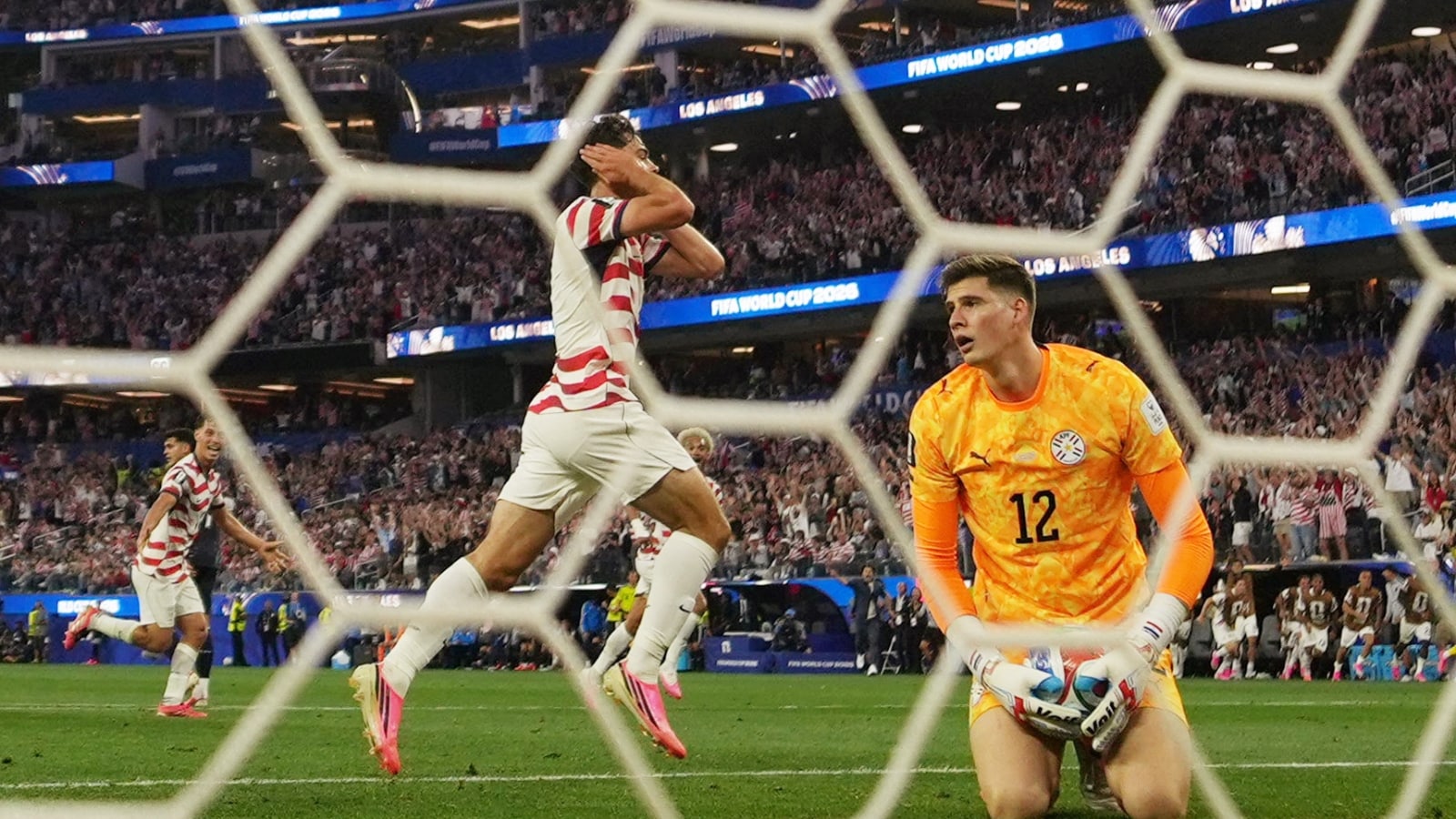
Folarin Balogun’s effectiveness relied directly on the deliberate creation of isolation patterns in the left half-space. The US winger pinned the Paraguayan right-back wide, while an overlapping run from the fullback dragged the covering midfielder out of position. This sequence isolated Balogun against a single, backpedaling center-back. His opening goal—a striking sequence utilizing a sharp left-footed finish—was the direct result of this spatial creation. He did not merely beat his marker; the system systematically stripped the marker of any defensive cover.
3. Asymmetric Flank Overloads
The United States operated with an asymmetric attacking structure. The right flank served as the retention zone, drawing Paraguay’s defensive focus and forcing their midfield to shift across the pitch. Once Paraguay tilted its defensive shape toward the ball, the US executed rapid, long-range switches to the isolated left flank. This constant shifting created physical fatigue and mental lapses in the Paraguayan defensive unit, directly leading to the breakdown that facilitated the second and third goals.
Paraguay Defensive Compactness -> USA Right Flank Overload -> Rapid Switch to Left Half-Space -> Balogun Isolation (1v1) -> High-Probability Shot
Deconstructing the Paraguayan Defensive Breakdown
A 3-0 scoreline indicates a systemic failure rather than isolated individual errors. Paraguay’s defensive structure collapsed across two specific failure points.
The Delayed Recovery Press
When possession was lost in the attacking third, Paraguay failed to execute an effective counter-press. Instead of pressure on the ball carrier, Paraguayan midfielders dropped off, attempting to protect space behind them. This passive defensive posture gave the US deep-lying playmakers time and space to measure line-breaking passes. Without immediate pressure on the ball, a defensive line cannot successfully maintain a high or mid-block without exposing massive space behind.
Positional Disconnection in the Penalty Box
During sustained defensive sequences, Paraguay suffered from severe lapses in structural discipline inside their own 18-yard box. Rather than defending zonally and tracking late runners, defenders became ball-watchers. The second goal of the match exposed this flaw perfectly. As the ball moved into the wide area, the Paraguayan central defenders dropped deep toward their own goal line, completely severing their connection with the midfield line. This created a vacant pocket of space around the penalty spot, which US attackers exploited without resistance.
The Cost Function of Balogun's Role
Evaluating Balogun solely on his goals obscures his broader structural utility within this tactical framework. His presence alters the opponent's defensive calculus through two measurable behaviors.
- Fixing the Center-Backs: By consistently occupying the shoulders of both central defenders, Balogun prevents them from stepping up to challenge interior midfielders. This creates a spatial cushion for creative players operating in the attacking midfield pocket.
- Decoy Criss-Cross Runs: On wide deliveries, Balogun's diagonal runs toward the near post drag the primary marker with him. This movement vacates the central corridor for inverted wingers or late-arriving central midfielders to exploit.
The trade-off for this high-ceiling attacking output is a reduced defensive workload during the initial phases of opposition build-up. The US system accepts this deficiency by utilizing a highly energetic midfield trio to cover the central pressing lanes, ensuring the team remains compact even when the primary striker sits out of the initial press.
Analytical Limitations and Uncertainties
While a 3-0 victory provides validation for the strategic approach, rigorous analysis requires acknowledging data limitations and alternative hypotheses.
First, Paraguay played a significant portion of the match under acute game-state pressure after conceding early. This forced them to abandon their preferred compact shape and commit bodies forward, which artificially inflated the number of transition opportunities available to the United States in the second half. It remains unproven whether this specific vertical blueprint would yield identical efficiency against an elite low-block side that refuses to break structure, even when trailing.
Second, the data set from a single international match possesses high variance. The clinical nature of the finishes—specifically Balogun’s sharp-angled strikes—outperformed standard Expected Goals (xG) models for those specific shooting locations. Sustaining a 3-0 output over a longer tournament trajectory requires creating higher-quality, central chances rather than relying on low-probability, high-skill executions from wide angles.
Strategic Recommendation
The United States must institutionalize this asymmetric attacking model as their primary tactical identity heading into high-stakes tournament play. Rather than reverting to a balanced, symmetrical 4-3-3 that allows opponents to predict defensive rotations, coaching staff should continue to weaponize the right-side overload to isolate elite individual talent on the left.
To maximize this strategy against tier-one opponents, the next developmental iteration must focus on tightening the rest-defense structure. The fullbacks must transition into inverted midfield positions during possession phases, creating a mid-pitch blockade that stops counter-attacks before they start. This structural adjustment will allow the United States to sustain attacking pressure, isolate their clinical forwards, and starve opponents of transition opportunities entirely.