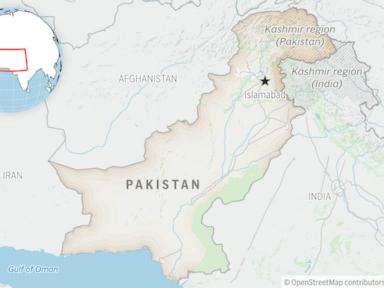
The arrest of 72 political activists linked to the Joint Awami Action Committee in Pakistan-administered Kashmir—historically designated as Azad Jammu and Kashmir—exposes the structural friction between local economic grievances and state-level security imperatives. Ostensibly executed to preserve public order ahead of regional legislative elections, the state's enforcement mechanism relies on a calculated strategy of preemptive suppression. By analyzing this crackdown through the lens of asymmetric political leverage and systemic state control, the underlying objective becomes clear: decoupling localized economic discontent from broader systemic challenges to administrative authority.
When regional governments encounter grassroots mobilization, they typically operate under a binary enforcement framework: reactive containment or preemptive disruption. The recent actions by the regional police apparatus represent a textbook execution of preemptive disruption. This strategy minimizes the operational capacity of dissident networks before they can scale their mobilization efforts to an unmanageable volume.
The Operational Mechanics of Preemptive Suppression
Preemptive disruption relies heavily on three core tactics designed to break down a movement's ability to coordinate effectively.
- Asymmetric Leadership Attrition: Rather than engaging with the rank-and-file demonstrators during active protests, law enforcement targets organizers and operational node-holders within networks like the Joint Awami Action Committee. Removing these key individuals creates an immediate coordination deficit, severing the link between organizational strategy and grassroots execution.
- Information Interdiction via Communication Blackouts: A critical component of this preventive strategy involves the targeted suspension of cellular and digital data services. In modern civil resistance, real-time communications function as the primary logistics layer. Shutting down localized networks forces organizers back to slower, less secure communication channels. This friction point slows down mobilization and allows state forces to gain a tactical time advantage.
- Narrative Deprecation through Legal Frameworks: To justify the use of force and preventative detentions to the broader public, the state relies on specific legal labeling. Categorizing civic advocacy organizations as "banned protest groups" or "threats to public order" changes the legal status of attendees from aggrieved citizens to national security liabilities. This shift reduces public sympathy and provides a solid legal basis for long-term detention without immediate trial.
The Economic Triggers and the Cost Function of Dissent
The friction in the region cannot be evaluated solely as an ideological confrontation. Instead, it is deeply rooted in structural economic asymmetries. The mobilization observed over the past years stems directly from escalating cost-of-living metrics, specifically the inflation of staple goods like wheat flour and rising utility pricing structures.
$$C_{dissent} = P_{legal} + P_{physical} + P_{economic} - G_{expected}$$
The structural equation above models the decision-making framework of regional demonstrators. A citizen chooses to participate in public dissent only when the expected utility gain ($G_{expected}$, such as subsidized wheat or reduced electricity tariffs) outweighs the total calculated cost of participation ($C_{dissent}$). This total cost is a function of legal penalties ($P_{legal}$), physical risks during crackdowns ($P_{physical}$), and immediate economic losses from missing work or facing fines ($P_{economic}$).
When the state introduces a massive capital infusion—such as the 23 billion PKR grant delivered by the federal government during previous unrest—it artificially lowers the necessity for immediate mobilization by temporarily fulfilling the utility demand ($G_{expected}$). However, when macroeconomic pressures cause inflation to outpace these temporary subsidies, the equation shifts back. The perceived cost of remaining passive becomes higher than the risks associated with public demonstration.
Legislative Transition Windows as Risk Multipliers
The timing of the current security clampdown is directly linked to the upcoming legislative elections in the territory. Democratic or semi-democratic transition windows inherently lower the barriers to entry for political mobilization. During these periods, political factions use existing public grievances to build leverage and secure institutional power.
For the administrative state, an election cycle introduces significant systemic risk. If a banned or unsanctioned political network successfully aligns its goals with widespread economic frustration during a vote, it can permanently undermine the credibility of the state-backed legislative process. The state’s preventative arrests are designed to separate these economic grievances from the electoral machinery. By removing active organizers from the environment weeks before voting begins, the state ensures that the economic dissatisfaction remains unorganized and cannot be channeled into an organized political challenge.
Structural Vulnerabilities of Preemptive Stabilization
While preemptive crackdowns are highly effective at suppressing immediate street actions, they introduce long-term systemic vulnerabilities that can undermine future stability.
The primary limitation of this approach is its reliance on a false stability loop. Forcing a movement underground through arrests and communications blackouts creates a temporary veneer of order. However, because the underlying drivers of unrest—such as structural economic deficits and inflation—remain unaddressed, the state merely delays the next cycle of escalation.
Furthermore, relying heavily on preemptive legal charges reduces the state's long-term tactical flexibility. When peaceful advocacy groups are subjected to the same level of legal and physical suppression as violent insurgent factions, the incentive for moderate elements to remain within legal boundaries disappears. This can inadvertently accelerate the radicalization of the remaining underground leadership nodes.
The regional administration's immediate path forward depends on its ability to maintain this strict security posture while simultaneously managing local economic pain points. If the state fails to deploy targeted economic relief alongside its security measures, the current enforcement model will eventually break down. Law enforcement can disrupt organizational networks in the short term, but suppressing a decentralized population facing systemic economic strain requires a continuous expenditure of political and financial resources that the state cannot sustain indefinitely. The current equilibrium is highly unstable; any future macroeconomic shock will likely overcome the state's containment mechanisms and trigger renewed unrest.