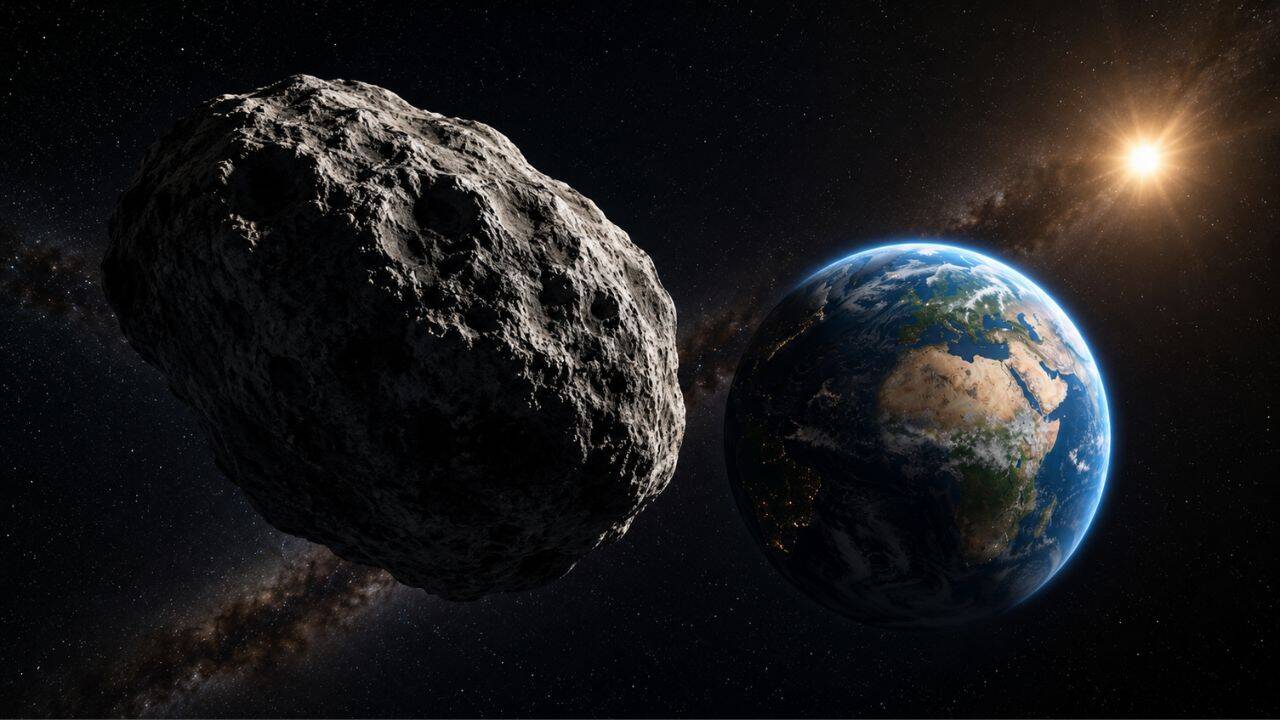
The flyby of asteroid (152637) 1997 NC1 on June 27, 2026, presents a stark contrast between media sensationalism and planetary dynamics. Popular narratives frame the event as a dramatic, near-miss spectacle using arbitrary terrestrial benchmarks like the Eiffel Tower. In reality, the encounter serves as a case study in the mathematics of orbital mechanics, the limitations of optical photometry, and the structured framework used by space agencies to manage planetary risk.
Evaluating the flyby requires stripping away non-technical hyperbole and analyzing the three foundational variables that define near-Earth object encounters: structural magnitude, spatial trajectory, and observational mechanics.
The Structural Variable: Albedo and Size Uncertainty
A persistent flaw in baseline reporting is the treatment of asteroid diameter as a fixed, verified metric. For 1997 NC1, the European Space Agency establishes a wide dimensional range between 750 meters and 1,650 meters. This variation represents a significant mathematical spread, meaning the upper estimate yields an object with more than ten times the volume and mass of the lower estimate.
This tracking volatility stems from the reliance on absolute optical magnitude ($H$) to deduce size. Astronomers measure the sunlight reflected off the asteroid, but the total reflected light is a function of two distinct variables: cross-sectional area and albedo (the surface reflectivity coefficient).
$$\text{Reflected Light} \propto \text{Area} \times \text{Albedo}$$
Because the composition of 1997 NC1 cannot be directly sampled, its albedo must be inferred based on taxonomic models of similar Aten-class asteroids. If the surface consists of dark carbonaceous chondrites, it possesses a low albedo (near 0.05), requiring a massive physical diameter to generate the observed brightness. If the surface is rich in silicates, the albedo is high (near 0.25), pointing to a much smaller physical footprint.
The cause-and-effect relationship missed by casual reporting is that dimensional uncertainty directly impacts mass and kinetic energy calculations. Assuming an average density of 2.6 grams per cubic centimeter, the kinetic energy variance scales cubically with the radius. This means the analytical community must treat the asteroid not as a uniform object, but as a broad probability distribution of potential kinetic payloads.
Spatial Trajectory and the Potentially Hazardous Designation
On June 27, 2026, at 11:14 UTC, 1997 NC1 reaches its perihelion proximity at 2.56 million kilometers from the terrestrial surface. This distance corresponds to approximately 6.66 lunar distances ($LD$). The public frequently misinterprets the asteroid’s formal classification as a Potentially Hazardous Asteroid (PHA) as an indicator of an imminent threat. The designation is dictated by two rigid, non-negotiable metric thresholds established by the Minor Planet Center:
- Minimum Orbit Intersection Distance (MOID): The minimum distance between the osculating orbits of the asteroid and Earth must be less than 0.05 astronomical units ($AU$), which translates to roughly 7.5 million kilometers.
- Absolute Magnitude ($H$): The object must possess an absolute magnitude of 22.0 or brighter, which serves as a proxy for a diameter greater than 140 meters.
Asteroid 1997 NC1 clears both bars easily. Its absolute magnitude sits well above the threshold, and its path crosses Earth’s orbital plane. It belongs to the Aten group, a class of Earth-crossing asteroids characterized by semi-major axes smaller than one astronomical unit. Because their orbital periods are less than one Earth year, these bodies spend the majority of their duration inside Earth's orbit, rendering them difficult to track against solar glare.
The planetary defense community uses these baselines to filter objects requiring long-term tracking from benign space debris. The designation indicates a long-term orbital intersection probability over centuries, not a short-term impact forecast. Current tracking arrays confirm zero probability of a terrestrial impact from 1997 NC1 for at least the next 100 years.
The Observational Bottleneck: Photometric Limits and Sky Dynamics
Media guides suggesting that casual observers can readily view the flyby ignore the physics of astronomical instrumentation. At its closest approach, 1997 NC1 peaks at an apparent visual magnitude of approximately 10. This scale is logarithmic; every step down represents a $2.512$-times decrease in brightness. A magnitude 10 object is roughly 40 times fainter than the human eye's absolute physiological threshold under perfect, unpolluted night skies.
Observing the object requires structured optical intervention. The baseline instrument required is a telescope with an aperture diameter of at least 6 inches (150 mm). The optical system must collect enough photons to distinguish the target from background stellar noise. Furthermore, the observational window is heavily constrained by timing and local atmospheric conditions.
The first major impediment is diurnal timing. The absolute closest approach occurs during broad daylight across major longitudes in Western Europe, rendering direct visual capture impossible at peak proximity. Observational strategies must target the flanking night windows of June 26 and June 28.
The second impediment is celestial positioning and lunar interference. The path of 1997 NC1 places it between the Moon and the star Antares in the Scorpius constellation. The proximity to a bright, waxingly gibbous lunar disc introduces profound sky-glow pollution. This scattered light floods the telescope's field of view, lowering contrast and effectively raising the detection floor above magnitude 10 for low-aperture optics.
Unlike meteors, which incinerate in the upper atmosphere at high angular velocities, 1997 NC1 moves at an orbital velocity of 8.9 kilometers per second relative to Earth. Given its multi-million kilometer distance, its apparent motion across the sky is measured in arcminutes per hour. To the observer, it does not streak; it drifts. Detecting movement requires tracking the object's position relative to fixed background stars over intervals of 5 to 10 minutes.
Systematic Limits of Ground-Based Tracking Infrastructure
The observation of 1997 NC1 highlights the operational constraints of the global Near-Earth Object Tracking system. Discovered in 1997 by the automated NEAT program at Haleakala, Hawaii, the object has a tracking history spanning nearly three decades. This extensive observation arc eliminates orbital tracking errors, reducing the position uncertainty covariance matrix to near zero for this century.
However, the architecture relies heavily on ground-based asset deployment, which presents systematic challenges:
- Hemispheric Dependency: The geometry of the June 2026 exit trajectory causes the asteroid to transition rapidly into the southern celestial hemisphere, shifting the data acquisition burden exclusively to southern observatories.
- Albedo Resolution Deficit: Optical sensors remain incapable of resolving the surface details or true geometric bounds of the asteroid, leaving the 750-to-1,650-meter diameter variance unresolved until radar imaging assets or space-based infrared platforms can be deployed.
For the broader public, digital tracking networks provide a viable alternative to physical optics. The Virtual Telescope Project leverages automated, high-aperture instruments located in optimal, low-light geographic sectors to stream live charge-coupled device (CCD) captures. These feeds use automated sidereal tracking to lock onto the asteroid's precise coordinate path, providing a real-time view of its positional shift against the background star field without the atmospheric and equipment limitations facing independent observers.
The optimal strategy for analyzing near-Earth flybys requires abandoning sensationalist frameworks and focusing instead on refining albedo estimation techniques and expanding space-based infrared observation arrays. These improvements are necessary to narrow structural uncertainties and enhance our long-term planetary defense models.