Maritime disasters within semi-enclosed coastal basins are rarely the result of a single isolated anomaly. They are the consequence of compounding variables where environmental dynamics, vessel design, and passenger payload interact critically. The capsizing and subsequent sinking of the Volare—a 49-foot cabin cruiser originating from Stockton, California—near Alcatraz Island serves as a case study in these structural failures. The incident resulted in two confirmed fatalities, including 58-year-old Tondra Madruga and 79-year-old Clifford Joseph Boisa, while two individuals remain missing within a search envelope that expanded to 950 square nautical miles.
Deconstructing this event requires an examination of the hydrodynamics of the San Francisco Bay, the stability metrics of cabin cruisers under concentrated passenger loads, and the physics governing sub-surface containment and structural recovery. Discover more on a related issue: this related article.
The Hydrodynamic Bottleneck of the Central Bay
The location of the incident, near Alcatraz Island, represents one of the most hydrodynamically volatile zones within the San Francisco Bay system. The geography of the Golden Gate creates a classic venture effect, forcing immense tidal volumes through a narrow constriction. This creates a highly complex wave-current interaction, particularly during an ebb tide when outflowing water meets incoming ocean swells.
When a localized wave hits a vessel broadside or obliquely in these conditions, the mechanical forces applied to the hull scale exponentially. The Volare was reportedly struck by a wave during a memorial service, causing an immediate loss of equilibrium. In a compressed waterway like the Central Bay, waves are characterized by shorter wavelengths and steeper faces compared to open-ocean swells. These "choppy" conditions reduce the reaction time of both the vessel's hull and its operator, accelerating the transition from a stable state to catastrophic capsizing. Additional journalism by NBC News explores related views on the subject.
Stability Metrics and Passenger Payload Dynamics
The Volare was configured as a 49-foot cabin cruiser carrying 20 adult passengers. To evaluate the stability failure of the vessel, two primary factors must be analyzed: the vertical center of gravity ($KG$) and the freeboard clearance.
Cabin cruisers are architecturally distinct due to their high superstructure, which naturally elevates the baseline $KG$. This high profile increases the vessel’s susceptibility to aerodynamic forces (wind heel) and hydrodynamic forces (wave impact). When a vessel carries 20 adults, the spatial distribution of that live load alters its stability characteristics.
- The Freeboard Reduction Mechanism: The cumulative weight of 20 adult passengers—estimating a conservative mean weight of 80 kilograms per person—adds approximately 1,600 kilograms of localized displacement. This additional mass forces the hull lower into the water column, systematically reducing the vessel’s freeboard (the distance from the waterline to the upper deck). Lower freeboard drastically decreases the reserve buoyancy of the vessel, making it highly vulnerable to taking on water when struck by an external wave.
- The Free-Surface Effect and Passenger Movement: In a memorial configuration, passengers frequently congregate on one side or on elevated decks to observe activities such as the scattering of ashes. This concentration causes an initial static heel angle. If the vessel is then struck by a wave on the high side, the abrupt rolling motion forces passengers to slide or shift toward the low side. This dynamic load shift exacerbates the inclining moment, overriding the vessel's righting energy and causing a complete roll-over.
The Micro-Environment of Sub-Surface Trapping
Initial survivor testimonies indicated that individuals inside the cabin cruiser were attempting to break through windows as the vessel inverted. This highlights a critical survival bottleneck inherent to cabin cruiser designs during rapid capsizing: interior containment.
When a vessel with a prominent superstructure capsizes, it frequently traps air pockets within the inverted hull. However, the structural layout of a cabin cruiser—characterized by narrow companionways, bulkheads, and limited escape hatches—creates an immediate physical barrier for passengers inside. As the vessel transitions from inversion to negative buoyancy, the influx of water creates high-velocity localized currents inside the cabins, pinning occupants against bulkheads or furniture.
The physiological toll is accelerated by the thermal profile of the San Francisco Bay, where water temperatures routinely range between 10°C and 13°C. At these temperatures, the human body experiences immediate cold shock, leading to involuntary hyperventilation, rapid loss of motor coordination, and a severe reduction in useful consciousness time. This explains why individuals unable to exit the superstructure immediately face a near-total barrier to egress, leading to the Coast Guard’s assessment of a high probability of structural entrapment.
Sub-Surface Search Mechanics and Recovery Protocols
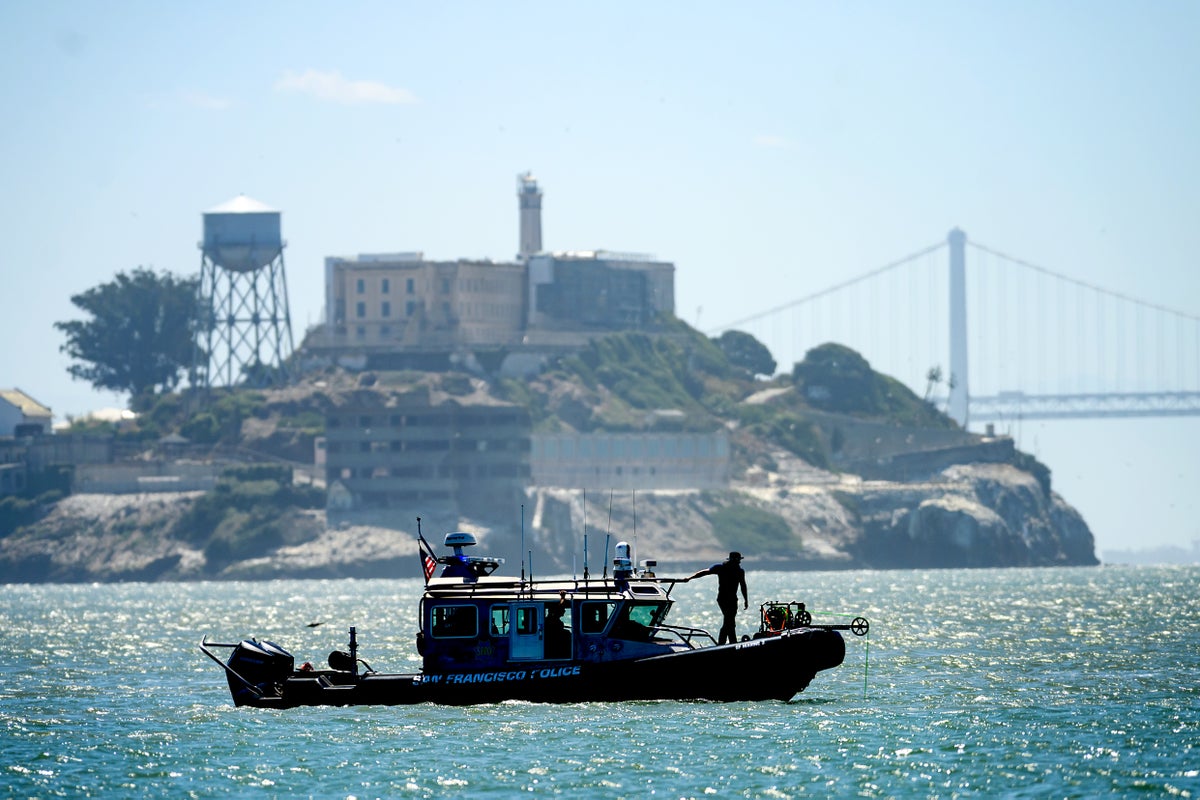
Following the suspension of the surface search by the U.S. Coast Guard after sweeping 950 square nautical miles, the operation transitioned from a rescue model to a localized sub-surface recovery framework managed by the San Francisco Police Department’s Marine Unit.
The physical recovery of Tondra Madruga’s body near Treasure Island highlights the transport mechanics of the bay. The strong, bidirectional tidal currents can displace buoyant or semi-buoyant objects miles from the initial point of capsizing within a single diurnal tide cycle. Conversely, the vessel itself settled on a rocky seabed at a depth of approximately 120 feet (36 meters).
Locating and assessing a wreck at this depth involves a multi-tiered technological framework:
- Side-Scan and Hull-Mounted Sonar: High-frequency acoustic imaging is deployed to map the topography of the seabed, identifying anomalies that match the dimensions of the 49-foot hull against the irregular profile of the rocky bottom.
- Remotely Operated Vehicles (ROVs): Due to the extreme currents and depth limitations for human divers, tethered ROVs equipped with high-definition optical cameras and scanning sonar are deployed. The ROV assesses the structural integrity of the inverted vessel, identifies entry points, and determines if the hull is stable enough to permit safe physical recovery operations without collapsing or shifting under tidal pressure.
Operating a recovery at 120 feet under heavy current constraints presents severe operational boundaries. The risk of umbilical entanglement for ROVs or secondary structural failure of the vessel dictates a highly deliberate, slow-velocity extraction strategy.
Strategic Operational Directives for Commercial and Private Cruisers
To mitigate the recurrence of stability failures within high-current estuary systems, vessel operators must implement rigid pre-departure load verifications that move beyond nominal passenger counts. Commercial and private operators utilizing vessels with elevated superstructures must calculate dynamic stability margins based on real-time weather and tide interactions. Passengers must be structurally distributed across the lower decks during transits through high-energy choke points like the central bay, ensuring the vertical center of gravity remains low enough to withstand sudden transverse wave impacts.