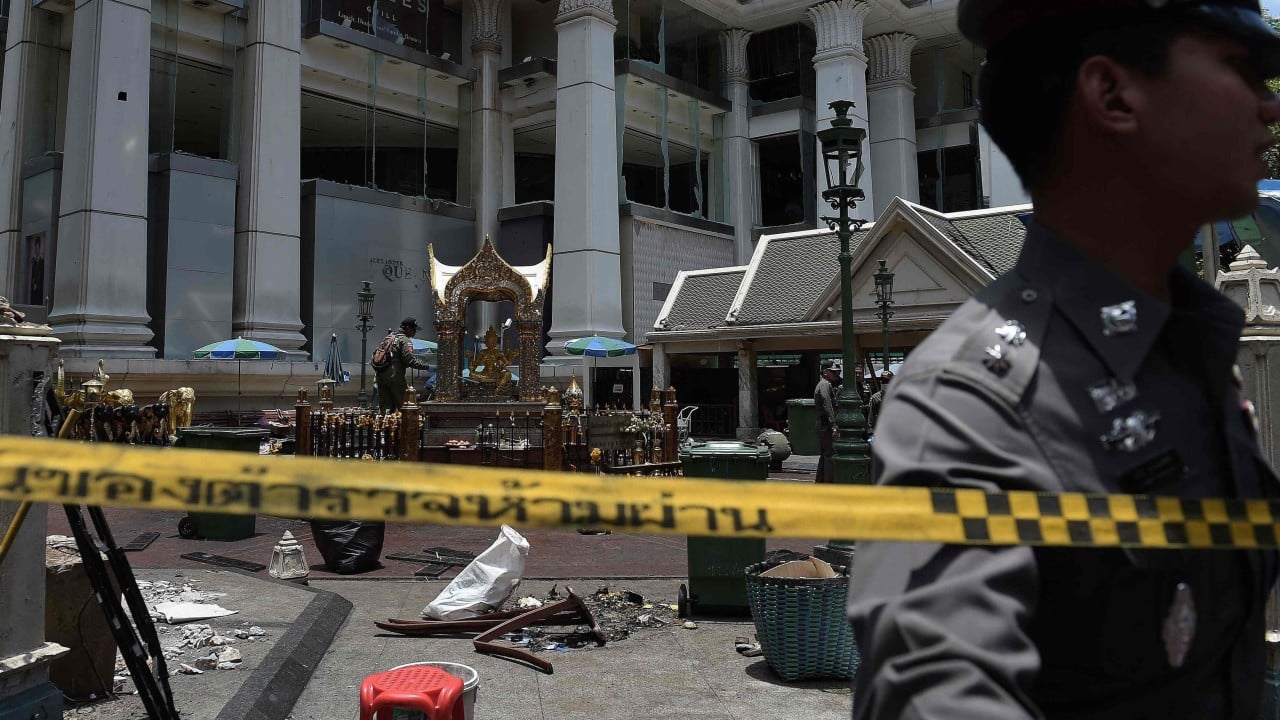
The sentencing of two Chinese Uyghur nationals to death by a Thai military court for the 2015 Erawan Shrine bombing represents more than a delayed judicial conclusion; it is a case study in the intersection of transnational terrorism, migration diplomacy, and proxy litigation. The attack, which killed 20 people and injured over 120 in the heart of Bangkok, highlights the operational friction that occurs when a domestic legal system handles a case tied to complex international geopolitical alignments.
An analysis of the decade-long judicial process reveals three distinct structural pillars that defined the case: tactical execution errors by the perpetrators, acute diplomatic pressures exerted by external state actors, and severe procedural bottlenecks within the Thai military tribunal system. Examining these components clarifies why the trial faced chronic delays and illustrates how Southeast Asian nations manage cross-border security crises without destabilizing critical economic partnerships.
The Operational Architecture of the Attack
The Erawan Shrine bombing was not an isolated act of domestic grievance, but a calculated strike aimed at a high-density transit and tourism hub. To understand the strategic choices behind the target and timing, the event must be broken down into its core operational variables.
Target Selection and Economic Sabotage
The choice of the Erawan Shrine at the Ratchaprasong intersection was dictated by maximize-casualty metrics and economic sensitivity. The shrine is highly popular among East Asian tourists, particularly mainland Chinese visitors. By striking this specific node, the perpetrators achieved two distinct outcomes:
- Asymmetric Casualty Yield: The open-air, high-traffic nature of the shrine meant a relatively small improvised explosive device (IED) could achieve a high lethality radius.
- Macroeconomic Disruption: Tourism accounted for roughly 10% of Thailand's GDP at the time. Targeting Chinese nationals directly threatened Thailand’s primary source of foreign tourism revenue, weaponizing economic anxiety against the ruling military junta.
The Network Disruption Cascade
The perpetrators, Bilal Mohammad (also known as Adem Karadag) and Yusufu Mieraili, operated as part of a larger, decentralized human smuggling and militant network. The immediate catalyst for the attack was a classic enforcement-retaliation loop.
Weeks prior to the bombing, the Thai government forcibly repatriated 109 Uyghur asylum seekers back to China. This action disrupted a lucrative and highly organized human smuggling pipeline running from western China through Southeast Asia to Turkey. The bombing functioned as a retaliatory strike designed to punish the Thai state, signaling that compliance with Beijing's security demands would carry a severe domestic cost.
The Three Pillars of the Thai Judicial Bottleneck
The gap between the 2015 attack and the 2024 death sentences spans nearly nine years. This prolonged timeline was not a product of investigative incompetence, but rather a structural consequence of the legal and political environment in which the trial took place.
+-------------------------------------------------------------------+
|               THE THAI JUDICIAL BOTTLENECK LAYER                  |
+-----------------------------------+-------------------------------+
| 1. Military Jurisdiction          | Trial under martial law;      |
|                                   | limited rights of appeal.     |
+-----------------------------------+-------------------------------+
| 2. Linguistic Asymmetry           | Chronic shortage of certified |
|                                   | Uyghur-Thai translators.      |
+-----------------------------------+-------------------------------+
| 3. Evidence Degradation           | Nine-year delay compromised   |
|                                   | witness memory & forensics.   |
+-----------------------------------+-------------------------------+
1. Military vs. Civilian Jurisdiction
Following the 2014 coup d'état, Thailand operated under a military junta that transferred national security cases to military courts. Mohammad and Mieraili were indicted in a military tribunal where standard civilian legal protections were altered.
Military courts prioritize state security over procedural velocity. The lack of independent judicial oversight meant that pre-trial motions, discovery, and evidentiary challenges were subjected to prolonged bureaucratic review, slowing the trial's momentum from the outset. Even when the case was eventually transferred back to a civilian court as the country transitioned out of formal junta rule, the legal baggage and accumulated delays carried over.
2. Linguistic Asymmetry and Translation Failures
The primary operational bottleneck in the courtroom was the chronic shortage of qualified, neutral interpreters. The defendants spoke Uyghur and limited Turkish; the court operated in Thai.
Finding an interpreter who possessed the necessary technical legal vocabulary, held no political bias, and was willing to participate in a high-profile terrorism trial proved nearly impossible. Multiple interpreters fled the country, citing intimidation, or were rejected by the defense due to ties to Chinese state agencies. Every substitution forced the court to review months of recorded testimony, effectively resetting the procedural clock multiple times.
3. Evidence Degradation Across Time
A nine-year gap between arrest and sentencing introduces a steep decay curve for evidentiary reliability.
- Physical Evidence: Forensic data, closed-circuit television (CCTV) tracking arrays, and chemical residue analyses lose their persuasive edge over a decade of storage and chain-of-custody handoffs.
- Testimonial Reliability: Witness memories fade, and cross-examinations conducted in 2023 regarding events in 2015 are inherently vulnerable to inconsistencies, which the defense aggressively leveraged.
The prosecution overcame this degradation by anchoring their case to immutable digital forensic footprints: financial transfers tracking the purchase of bomb-making materials and biometric matches from CCTV footage near the Ratchaprasong intersection.
The Diplomatic Cost Function
Thailand's handling of the trial reflects a delicate hedging strategy designed to balance its security relationship with Western nations against its deep economic dependence on China.
The Dilemma of External Classification
Throughout the investigation and trial, Thai authorities steadfastly refused to classify the bombing as an act of international Islamic terrorism. Instead, they maintained a strict narrative that the attack was the work of a "human trafficking gang" disgruntled by a crackdown on their illicit business.
This semantic distinction was a deliberate strategy to mitigate risk. Classifying the attack as international terrorism would have triggered immediate travel advisories from Western embassies, causing a catastrophic drop in tourism numbers. Furthermore, explicitly linking the attack to Uyghur militancy would have forced a public acknowledgment of the plight of the Uyghur minority in Xinjiang—a diplomatic red line for Beijing.
Asymmetric Pressure and Sovereign Compromise
The trial took place under the shadow of asymmetric bilateral relations. China demanded swift, decisive punishment for the individuals who targeted its citizens and disrupted its regional prestige. Conversely, international human rights organizations monitored the trial for violations of due process, pointing to allegations that the defendants' initial confessions were obtained under duress and torture.
Thailand navigated this by executing a slow-rolling judicial process that allowed international scrutiny to wane over time. By delivering the death penalty long after the public intensity of the 2015 event had dissipated, the Thai state satisfied Beijing's demand for retributive justice while minimizing the immediate blowback from Western human rights apparatuses.
Tactical Foresight for Regional Security Operations
The resolution of the Bangkok shrine bombing case provides a clear blueprint for how transit hubs in Southeast Asia must restructure their counter-terrorism and judicial frameworks. Relying on retrofitted military courts and ad-hoc translation infrastructure creates systemic vulnerabilities that delay justice and compromise national credibility.
Governments in the region must establish permanent, multi-lingual legal task forces capable of handling transnational defendants without generating years of procedural friction. Concurrently, security agencies must decouple their counter-trafficking operations from political asylum determinations. When human smuggling networks are dismantled without regard for the geopolitical identity of the cargo, it creates an unpredictable security vacuum that routinely manifests as asymmetric retaliatory violence. Protecting high-value economic zones requires anticipating these retaliatory loops before the first deportation order is signed.