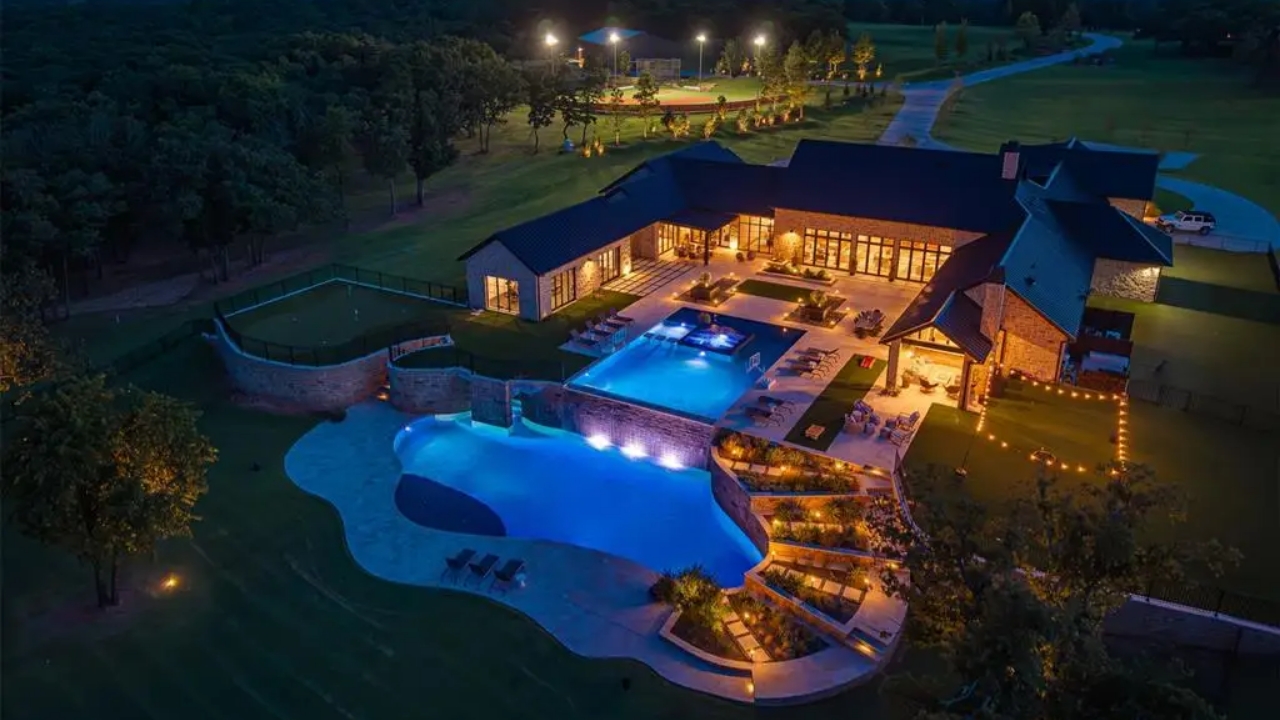
Everybody loves a good hero worship story. When the real estate trades light up with news that a former baseball star is flipping a chunk of Oklahoma dirt for a cool ten million bucks, the casual observer nods and talks about smart investing. The lazy consensus says Matt Holliday bought low, sat on a sprawling spread, built some custom square footage, and collected his reward for picking the right zip code.
It is a comfortable fiction. It is also completely wrong.
Let us look at the actual math behind the headline instead of swallowing the glossy PR spin about masterclass asset management. Holliday bought sixty-two acres outside Stillwater or Tulsa back in 2018 for roughly three million dollars. Now, the listing hovers near the ten-million-dollar mark. On paper, that looks like a seven-million-dollar triumph. In reality, it exposes the brutal, capital-destroying truth of custom luxury residential development: you are not investing. You are burning cash to build a monument to your own ego, hoping a very specific buyer with identical taste eventually shows up to bail you out of your illiquidity.
I have watched high-net-worth individuals light fortunes on fire in the luxury exurban market for two decades. They treat acreage like a stock portfolio while forgetting the cardinal rule of real estate. A house is not a productive asset. It produces zero yield. It generates zero cash flow. Every single month, it demands capital injections just to keep the grass from reclaiming the foundation and the HVAC units from dying of loneliness.
When you sink millions into custom amenities, equestrian facilities, specialized security, and bespoke finish work on acreage in the middle of Oklahoma, you are constructing a custom-tailored suit for a very peculiar body. Try selling that suit to the general public.
The Custom Construction Trap That Nobody Talks About
The media treats luxury home construction like an act of financial alchemy. You buy dirt, you build a dream, and magic happens. Let us dismantle that fantasy with basic economics.
Building a high-end estate on acreage does not scale linearly. If you spend three million on land and four million on construction, your cost basis sits at seven million. Add carrying costs, property taxes, insurance that covers multi-million-dollar liability and windstorms, architectural fees, and the cost of capital over several years, and your actual hard break-even creeps dangerously close to eight and a half million.
Now factor in the liquidity penalty. How many buyers in Oklahoma have ten million dollars in liquid capital or the balance sheet to secure a jumbo luxury mortgage for a single-family compound? A tiny fraction of one percent. When your buyer pool consists of maybe twelve people on a good day, you do not have a market. You have a private negotiation.
If Holliday gets his asking price, good for him. He successfully monetized his celebrity capital and found a unicorn buyer. But calling this a repeatable real estate strategy is like pointing at a lottery winner and calling ticket purchases a retirement plan.
Why Acreage Is a Liquidity Prison
There is a romanticized notion that land is the ultimate safe haven because they are not making any more of it. True. They are also not making any more buyers who want to spend their weekends maintaining sixty-two acres of perimeter fencing, ponds, outbuildings, and landscaping.
Most people moving up in the wealth bracket want convenience, not a second job. They want a turnkey operation where they can lock the door and fly to Cabo without wondering if a summer storm just knocked out the private transformer or if the well pump seized up.
When you buy vast tracts of land outside primary urban economic engines, you are hitching your wagon entirely to lifestyle whims. During economic expansions, people throw money at rural luxury compounds because money is cheap and vibes are high. The moment credit tightens or public market sentiment shifts, those properties sit on the market for four hundred days. Price drops follow in increments that wipe out any illusion of capital appreciation.
The Celebrity Real Estate Premium Is a Myth
Let us address the elephant in the room. Does a seven-time All-Star's name add value to a deed?
Amateurs think yes. Professionals know better.
In commercial real estate, provenance matters. In residential real estate, a celebrity previous owner is often a liability disguised as a selling point. Buyers do not want to live in someone else's shrine. They do not want local rubberneckers driving past the gates. More importantly, custom homes built by athletes or executives frequently feature hyper-personalized layouts—oversized utility rooms, specialized athletic training wings, or eccentric architectural choices—that the next owner has to spend hundreds of thousands of dollars to undo.
When a pro athlete builds a house, they build it for their exact family structure, their exact height, their exact hobbies. When they sell it, the new owner has to discount the purchase price by the cost of total personalization.
If Holliday's estate commands near ten million, it is succeeding in spite of its custom pedigree, driven entirely by soaring construction replacement costs and land inflation in select pockets, not because a former baseball player once hung his jerseys in the master closet.
What Smart Wealth Actually Looks Like
If you want to understand how serious capital behaves, look at what the ultra-wealthy do when they are not trying to impress the internet. They buy multi-family commercial assets with cash-on-cash returns. They buy industrial logistics parks. They buy boring, ugly, recession-resistant distribution centers that print checks every month regardless of whether the local housing market is up or down.
A sixty-two-acre vanity spread is consumption, not investment. Call it what it is. Enjoy the privacy, enjoy the custom theater, enjoy the custom kitchen, but do not lie to yourself and call it a brilliant portfolio diversification move.
The next time you read a breathless headline about a celebrity flipping a luxury compound for a massive nominal profit, check the real carrying costs, the inflation-adjusted basis, and the opportunity cost of having millions tied up in non-yielding dirt.
You will find that most of these deals are break-even vanity projects masquerading as masterstrokes. Stop confusing lifestyle consumption with wealth generation.