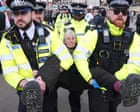
The arrest of more than 200 activists in Central London marks a violent escalation in the tactical standoff between Palestine Action and the British state. This was not a standard protest that spilled over the pavement. It was a calculated attempt to paralyze the logistical heart of a global arms network, met by a police force now operating under significantly sharpened legal powers. While the headlines focus on the sheer volume of detainees, the real story lies in the shifting mechanics of British dissent and the increasingly aggressive strategies used to silence it.
Metropolitan Police units moved with uncharacteristic speed to intercept the group before they could reach their primary targets. By the time the dust settled near the Department for Business and Trade, the scale of the police operation had become clear. This was a pre-emptive strike. The authorities are no longer content to manage the optics of a march; they are now focused on dismantling the operational capacity of groups that target the defense supply chain.
The Logic of Direct Action
Palestine Action does not play by the rules of traditional advocacy. They don't write letters to MPs or hold vigils. Their philosophy is rooted in "material disruption." The goal is simple: make it financially and logistically impossible for companies like Elbit Systems to operate on British soil.
By targeting offices, factories, and government buildings, they aim to break the links in the chain that facilitate the export of military technology. This isn't about winning hearts and minds in the general public. It is about creating a "friction tax" on the arms industry. Every day a factory is closed, every window smashed, and every server room doused in red paint adds to the overhead of being a defense contractor in the UK.
The 200 arrests represent a massive blow to the group’s boots-on-the-ground numbers, but in the world of radical activism, these numbers are often viewed as a badge of honor. To the activists, the police are not just maintaining order; they are acting as the private security force for multinational corporations. This perspective fuels the cycle of escalation.
The New Policing Reality
We are witnessing the full deployment of the Public Order Act 2023. This legislation was designed specifically to tackle the "guerrilla" tactics used by groups like Palestine Action and Just Stop Oil.
Under these laws, the definition of "serious disruption" has been broadened to the point where almost any effective protest can be deemed illegal. The police now have the power to stop and search without suspicion if they believe a protest is imminent. They can also use "locking on" offenses to snag anyone who attaches themselves to a building or another person.
The mass arrests in London were a laboratory for these powers. The police didn't wait for the windows to break. They utilized Section 12 and Section 14 orders to clear the streets with a level of aggression that would have been legally questionable five years ago.
The Cost of Enforcement
The financial burden of these operations is staggering. Policing a single high-stakes direct action event costs the taxpayer millions in overtime and specialized equipment.
- Surveillance: Intelligence gathering on activist cells starts months in advance.
- Deployment: Specialized units, including the Territorial Support Group (TSG), are brought in to handle heavy lifting and forced entries.
- Processing: Managing 200 arrests requires an enormous amount of administrative labor, clogging up custody suites across the capital.
The government justifies this expenditure as the price of protecting "essential trade." However, critics argue that the state is effectively subsidizing the security costs of private weapons manufacturers.
The Corporate Target Under Siege
Elbit Systems, Israel's largest private defense contractor, remains the primary focal point of this movement. They produce everything from tactical drones to precision-guided munitions. For Palestine Action, Elbit is the physical manifestation of the conflict they are fighting against.
The company has historically maintained a low profile in the UK, but that has become impossible. Their sites in Oldham and Tamworth were eventually closed after sustained pressure, which the activists claim as a total victory. This creates a dangerous precedent for the industry. If a small group of determined individuals can force a multi-billion dollar company to shutter its doors, the entire sector starts to look vulnerable.
Industry analysts are watching this closely. The concern is not just about physical damage, but about "investor flight." If the UK becomes a jurisdiction where defense firms cannot guarantee the safety of their staff or the continuity of their operations, they will move elsewhere. This puts the British government in a precarious position. They want to maintain the UK's status as a global hub for defense technology, but they are doing so against a rising tide of domestic hostility.
The Evolution of Protest Tactics
Palestine Action has moved beyond the simple "sit-in." They now utilize sophisticated reconnaissance and decentralized command structures. During the London incident, groups were split into small, mobile cells to avoid being "kettled" by the police.
They use encrypted communication apps to coordinate movements in real-time, often outmaneuvering police commanders who are tied to rigid radio protocols. The police response has had to evolve in kind, leading to the "snatch squad" tactics seen during the arrests, where officers target perceived leaders to cause the crowd to fragment.
It is a cat-and-mouse game played with high stakes. On one side, you have young activists willing to face years in prison for a cause they believe is existential. On the other, you have a state apparatus that views them as a threat to national security and economic stability.
A Legal System at the Breaking Point
The British courts are the next theater of war. The Crown Prosecution Service (CPS) is currently handling an unprecedented volume of protest-related cases.
There is a growing tension between the government's desire for harsh sentencing and the fundamental right to protest. Some juries have shown a surprising willingness to acquit activists on the basis of "proportionality" or "necessity." This has infuriated the Home Office, leading to calls for stricter guidance on what defenses can be used in court.
When a jury hears that an activist broke a window to prevent a greater harm—in this case, the use of weapons in a conflict zone—they sometimes agree. This "jury equity" is the last line of defense for activists, and it is a line the government is actively trying to erase.
Why the London Arrests Matter Now
This isn't just about the 200 people currently sitting in cells. It's about the signal this sends to the rest of the world.
London is a global stage. By launching a mass action in the heart of the city, Palestine Action is forcing the international community to look at the UK's role in the global arms trade. The arrests provide the optics of a state under pressure. Every image of an activist being dragged away by four police officers serves as a recruiting tool for the movement.
The government's heavy-handedness may backfire. History shows that when you close all legal avenues for dissent, you don't stop the dissent; you simply drive it underground, where it becomes more radical and harder to predict.
The Long Road of Attrition
This is a war of attrition. Palestine Action believes they can outlast the political will of the government. They gamble on the idea that the public will eventually tire of seeing their tax money spent on protecting arms factories.
Conversely, the state is banking on the idea that long prison sentences and heavy fines will eventually break the movement's morale. The 200 arrests in London are a massive gamble for both sides. If the activists are successfully prosecuted and hit with deterrent sentences, the movement may falter. If they are seen as martyrs or if the cases collapse in court, the momentum will shift toward the streets.
The standoff near the Department for Business and Trade was a microcosm of a much larger struggle. It was a collision between a globalized industry and a localized, militant opposition. The arrests are a temporary fix for a systemic problem that shows no signs of dissolving.
The state has drawn its line in the sand. The activists have shown they are willing to cross it. This ensures that the streets of London will remain a primary battleground for the foreseeable future, as the definition of "lawful protest" continues to shrink under the weight of geopolitical interests.
The next move won't come from a courtroom or a parliamentary chamber. It will come from the next group of people willing to risk their freedom for a cause that the law no longer recognizes as valid.
Observe the court dockets over the coming months. That is where the true impact of this day will be measured. If the convictions stick, the state wins. If they don't, the 200 arrests will be remembered as the moment the authorities lost control of the narrative.



