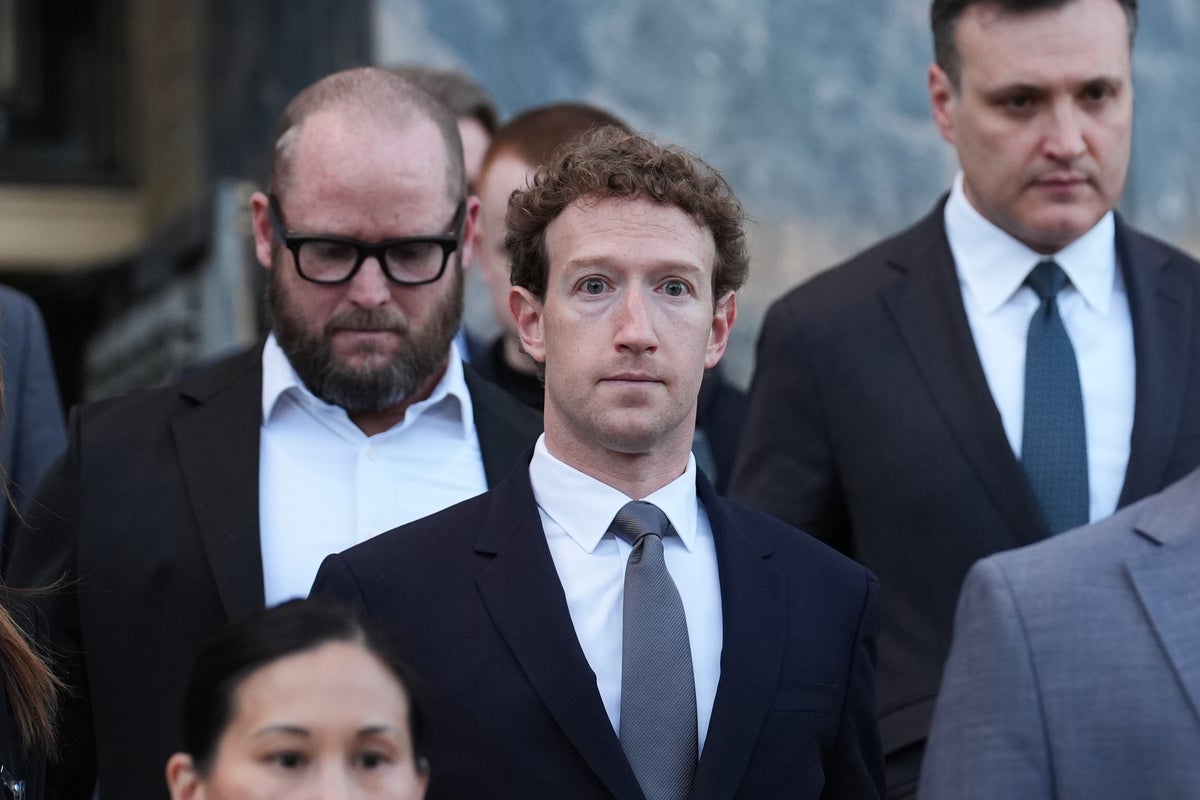
Mark Zuckerberg walked into a courtroom and told a story. It was a story about a principled founder standing as a bulwark against government overreach, a man who "resisted" the urge to silence users even when the pressure was high. The mainstream press swallowed it whole, framing it as a battle for the soul of the First Amendment.
They are wrong.
This wasn't a defense of free speech. It was a masterclass in liability hedging. When Zuckerberg claims he resisted censorship, he isn't talking about ideology; he is talking about the bottom line. The "resistance" he describes is actually the friction of a massive corporation trying to avoid the legal responsibility that comes with being an editor rather than a conduit.
The Myth of the Reluctant Censor
The current narrative suggests there is a binary choice: either Meta censors too much, or it doesn't censor enough. This premise is fundamentally flawed. Meta doesn't care about the content of your speech; it cares about the cost of your speech.
Every time a government official "suggests" a content takedown, Meta’s legal team runs a mental $P \times L$ calculation—the Probability of a fine multiplied by the Loss of user engagement. Zuckerberg’s "resistance" is simply the time it takes for those two variables to balance out.
If he complies too quickly, he loses the "neutral platform" protections offered by Section 230 of the Communications Decency Act. If he ignores it entirely, he faces regulatory hell in the EU and congressional subpoenas in the US. What the media calls "principled resistance" is actually just bureaucratic drag. I have seen tech giants burn through $50 million in legal fees not to protect a user's right to speak, but to ensure they don't set a legal precedent that forces them to hire 10,000 more moderators.
The Algorithmic Shadow Cabinet
The trial focuses on what was removed. This is the wrong question. We should be asking what was buried.
Zuckerberg can truthfully say he didn't "censor" certain topics because he didn't need to delete the posts. He has something much more effective: the "Downrank." In the world of social media architecture, visibility is the only currency that matters. If a post is technically "live" but its reach is throttled by $99%$, is it still speech?
- The Deletion: Triggers a notification, an appeal process, and a potential PR nightmare.
- The Shadow-ban: Triggers nothing. The user shouts into a void, assuming their audience is just bored.
By focusing on "censorship" in the courtroom, Zuckerberg is redirecting the gaze toward the binary (on/off) and away from the gradient (the algorithm). The "resistance" he mentions is a shell game. He resists the crude tool of deletion so he can maintain the absolute power of the recommendation engine.
Why Transparency is a Trap
People ask: "Why can't we just have a transparent set of rules for what gets flagged?"
Because transparency is the enemy of a pivoting business model. If Meta defines its rules with surgical precision, it loses the "flexibility" to change them when the political wind shifts. Zuckerberg's testimony relies on vague terms like "community standards" because ambiguity is a shield.
Imagine a scenario where the rules are hard-coded and public. If a new political movement emerges that threatens Meta’s ad revenue, they would have to publicly update their manifesto to suppress it. By keeping the rules "evolving" and "subject to context," they can suppress whoever they want under the guise of "safety" without ever admitting to a policy shift.
The Revenue of Friction
Let’s look at the data. Meta’s most engaged users are often the ones pushing the boundaries of these "censored" topics. Total censorship is a suicide pact for an engagement-based economy.
Zuckerberg "resists" because every deleted post is a lost data point and a decrease in time-on-site. His true genius lies in convincing the public that his desire for maximum ad inventory is actually a noble commitment to the marketplace of ideas. He isn't protecting your right to post; he’s protecting his right to monetize your outrage.
The False Choice of Consumer Protection
The trial pretends to be about "protecting" consumers from misinformation or harmful content. This is a distraction. The real "harm" to the consumer isn't a spicy take on a political event; it’s the fact that a single entity controls the visibility of information for three billion people.
When Zuckerberg says he resisted the government, he is asserting that he, not the elected state, should be the ultimate arbiter of truth. That isn't a win for freedom. It's a transfer of sovereignty from a public institution to a private monopoly.
The Technical Reality of Content Moderation
Let's get precise about the engineering. Content moderation at Meta’s scale is a problem of $O(n)$ complexity that they are trying to solve with $O(1)$ effort.
- Human moderators are a rounding error in the total system. They are there for the optics of "human oversight."
- AI classifiers are trained on biased datasets that reflect the panic of the previous week, not a consistent moral philosophy.
- Legal frameworks like the Digital Services Act (DSA) in Europe are already making Zuckerberg’s "resistance" a relic of the past.
If you believe Zuckerberg is the last man standing between you and government-mandated thought-policing, you’ve been played. He is simply negotiating the price of his cooperation.
Stop asking if he should have censored more or less. Start asking why one man has the power to "resist" or "comply" with the flow of global information in the first place. The "resistance" isn't a virtue; it's a symptom of a power imbalance that a courtroom isn't equipped to fix.
The next time you hear a billionaire talk about his "principles" under oath, check his balance sheet. The truth isn't in his testimony; it's in the code that determines who gets to be heard and who is silenced by the quiet hum of a server rack.
Quit looking for heroes in a boardroom.