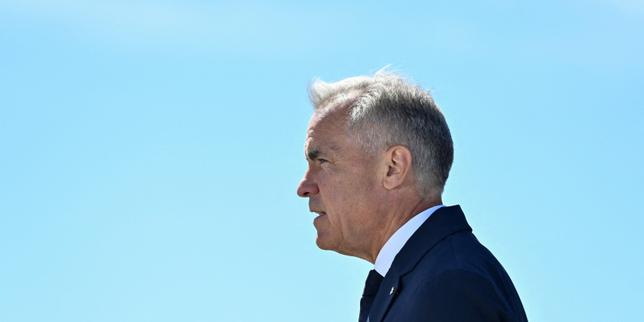
The lazy consensus in international media loves a neat narrative. Watch Mark Carney, former central banker, current political heavyweight, adjust his tone on Donald Trump, and the headlines write themselves. The mainstream press claims he is softening his stance, practicing diplomacy, and putting pragmatism over provocation. They think he is blinking.
They are wrong.
Carney is not moderating his views out of sudden admiration for the rhetoric coming out of Mar a Lago. He is executing a calculated repositioning. When you look past the polite diplomacy of the commentary, a different reality emerges. Carney understands economic gravity better than almost any politician currently breathing. If you think his recent statements signal a retreat, you do not understand how institutional power operates when the rules of global trade are being shredded.
The Consensus Trap
Let us dismantle the prevailing media myth. The standard line is that Canadian leaders must choose between groveling to a protectionist American administration or standing on a moral soapbox and inviting an economic embargo. This is a false binary designed for television segments, not for actual governance.
Carney has spent decades in the machinery of global finance. I watched financial institutions blow millions ignoring structural shifts while fixating on daily headlines during the 2008 crisis and subsequent European sovereign debt turmoil. The press focuses on the tweet of the week. Carney focuses on supply chain dependency, energy corridors, and monetary velocity.
When he tempers his public rhetoric regarding Trump, it is not a concession. It is strategic indirection. In high stakes economic negotiations, public chest-beating achieves nothing except forcing your opponent into a corner where they must double down to save face. Carney knows that Trump responds to leverage, not lectures. By dropping the moralizing tone, Carney strips away the pretext for retaliatory tariffs while quietly fortifying Canada’s independent economic defenses.
The Economic Realities Everyone Ignores
To understand why Carney is pivoting his public posture, you have to look at the structural vulnerabilities of the Canadian economy. For decades, Canada treated the United States market as an infinite, frictionless sink for its resources. That era is dead. The rebirth of American industrial policy, marked by domestic subsidies and aggressive protectionism, means the US does not need Canadian raw materials in the same way, or at least, they believe they do not.
People ask: Can Canada simply diversify its trade away from the United States?
The answer is a brutal no in the short term, and a qualified maybe over twenty years. Infrastructure pipelines point south. Rail lines point south. Power grids point south. You cannot simply flip a switch and redirect billions of barrels of oil and millions of metric tons of timber across oceans overnight. Carney knows this math. When he speaks about Trump now, he is acknowledging geographic and economic inertia. You do not pick a trade war with your primary customer when your ports are constrained and your productivity growth is lagging behind a parked car.
Instead of fighting the current administration with empty rhetoric, Carney’s approach points toward building domestic resilience. That means ruthlessly cutting internal trade barriers within Canada—barriers that are entirely self-inflicted and do more damage to our GDP than any foreign tariff ever could.
The Misunderstood Pragmatism
Critics on both the left and right misread this shift. The left thinks he is abandoning climate and institutional values. The right thinks he is just another technocrat bending the knee to foreign muscle. Both perspectives miss the underlying mechanics of modern statecraft.
Pragmatism in the face of populism is not surrender. It is containment.
Imagine a scenario where a Canadian politician spends every press conference denouncing American trade policy. What happens? Markets react with anxiety, the Canadian dollar takes a beating, foreign direct investment flees to safer tax havens, and Washington slaps a punitive tariff on aluminum just to prove a point. You get moral satisfaction and economic ruin.
Carney is choosing economic survival over performative outrage. His background running the Bank of Canada and the Bank of England taught him one immutable lesson: markets punish emotion faster than they punish bad policy. When central bankers pivot their tone, they are reacting to data models that show high sensitivity to volatility.
The Uncomfortable Truth About Canadian Leverage
We love to pretend Canada holds all the cards because of our critical minerals and energy exports. Let us look at the actual data. The United States accounts for roughly three-quarters of Canadian exports. Canada accounts for a smaller, though significant, share of total US imports. In a pure power contest, asymmetrical interdependence favors the larger economy every single time.
Carney understands asymmetric power dynamics. He is not trying to beat Trump at a rally. He is trying to insulate Canadian banking, energy, and tech sectors from the collateral damage of a total breakdown in cross-border commerce. His refined tone is the velvet glove over an iron fist of institutional preparation.
If you want to know what Carney is actually planning, stop listening to what he says about Trump’s personality and start watching where he directs capital investment, how he structures public-private partnerships, and how aggressively he pushes for internal economic reform.
The media wants a soap opera of heroes and villains. Carney is offering a masterclass in survival economics. Stop looking for the apology and start looking at the balance sheet.


