A single sentence can weigh more than a mountain.
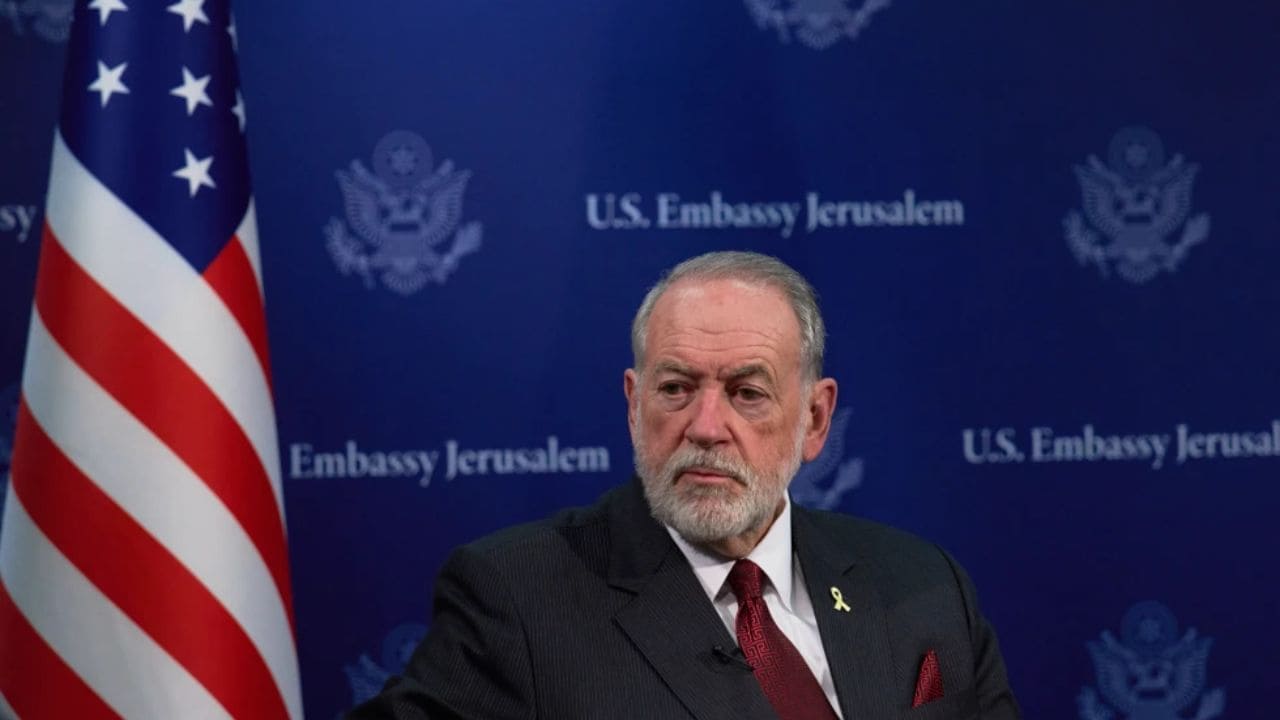
When Mike Huckabee, the newly designated American ambassador to Israel, spoke the words "take it all" in reference to the West Bank, he wasn't just offering a political opinion. He was dropping a match into a valley filled with dry brush. To a diplomat in a climate-controlled office in D.C., it might have sounded like a bold stance. To a family in Riyadh, a shopkeeper in Amman, or a student in Cairo, it sounded like a map being redrawn while they were still standing on the grass.
The reaction from the Saudi-led bloc wasn’t just a "slam" or a "rebuke" in the way cable news likes to frame it. It was a visceral, collective intake of breath. The Arab world, specifically the heavyweights within the Gulf Cooperation Council and their allies, viewed this not as a change in policy, but as an existential erasure.
Consider a man named Omar. He lives in a neighborhood where the history of the soil is whispered in the shade of olive trees. For Omar, "expansionist rhetoric" isn't a phrase from a textbook. It is the sound of a bulldozer. It is the sight of a fence moving ten feet closer to his front door overnight. When an incoming official from the world’s most powerful superpower uses language that suggests a total takeover, Omar doesn’t see a "strategic shift." He sees the end of a dream. He sees the permanent disappearance of the two-state solution, a concept that—however battered and bruised—has been the only fragile bridge toward a future where his children might walk without looking over their shoulders.
The Weight of a Word
The "take it all" comment acted as a lightning rod for a region already vibrating with tension. The Saudi Ministry of Foreign Affairs didn't just issue a press release; they articulated a fundamental breach of international trust. When the Saudi-led bloc calls something "dangerous," they aren't being hyperbolic. They are describing a breakdown of the rules-based order that has, however imperfectly, prevented the entire region from sliding into a perpetual, borderless war.
The core of the fury lies in the term annexation. In the dry halls of international law, annexation is the forcible transition of territory from one state to another. In the reality of the Middle East, it is a tectonic shift. For decades, the Saudi-led Arab Peace Initiative has sat on the table like a peace offering that no one quite has the courage to pick up. It promises full normalization of relations in exchange for a Palestinian state based on the 1967 borders.
Huckabee’s rhetoric doesn’t just ignore that table. It flips it over.
By suggesting that Israel should "take it all," the message sent to Riyadh and Abu Dhabi is clear: your initiatives don't matter. Your vision for a stable, integrated Middle East is secondary to a specific, hardline ideological agenda. This creates a massive problem for leaders in the Gulf who have been trying to balance a desire for modernization and Western partnership with the deep, spiritual, and cultural demands of their own populations who remain fiercely committed to the Palestinian cause.
The Invisible Stakes
We often talk about geopolitics as if it’s a game of chess played with wooden pieces. It isn't. It’s a game played with nerves, blood, and the collective memory of generations.
The invisible stake here is the concept of legitimacy. If the United States, acting as the traditional mediator, signals that international law is optional, the guardrails vanish. The Saudi-led bloc knows that if the West Bank is absorbed entirely, the "Two-State Solution" moves from the ICU to the graveyard.
What happens then?
Without a path to a state, millions of people find themselves in a permanent limbo. Imagine living in a house where you pay the bills, sweep the floors, and raise your children, but the deed is held by someone who says you don't actually exist. That is the psychological landscape of the West Bank under the threat of total annexation. It creates a vacuum. And in the Middle East, vacuums are never filled by peace. They are filled by the loudest, most violent voices available.
The Saudi response was a warning to the West: do not mistake our pursuit of economic "Vision 2030" goals for a lack of resolve on this issue. They are signaling that the price of regional cooperation is a baseline of respect for existing borders. You cannot build a "New Middle East" of high-tech cities and trade corridors on a foundation of disappearing maps.
The Human Echo
Think of a hypothetical diplomat, let's call her Sarah, working in an embassy in the region. Her job is to build bridges. She spends her days talking about water rights, tech transfers, and educational exchanges. Then, a comment like "take it all" hits the airwaves.
Suddenly, Sarah’s phone goes silent. Her counterparts in the local government can’t be seen shaking her hand. The progress of six months is erased in six seconds. The rhetoric creates a "cold front" that freezes everyday cooperation. This is the human cost of expansionist talk. It makes the moderates look like fools and the radicals look like prophets.
The Saudi-led bloc’s "fury" is grounded in the reality that they are the ones who have to manage the fallout. They are the ones who will deal with the protests in the streets. They are the ones who will have to explain to their youth why the international community’s rules only seem to apply to some people and not others.
A Fragile Equilibrium
The Middle East is currently a place of extreme contradictions. You have the shimmering glass towers of Dubai and the ancient, dust-covered stones of Hebron. You have the desire for a post-oil future clashing with the oldest grievances on earth.
The Saudi-led bloc is trying to navigate a path toward the former, but comments that endorse a "take it all" mentality pull them back into the latter. It forces them to pivot away from trade and back toward defense. It forces them to harden their stance to maintain credibility with their own people.
It is easy to sit in a television studio and use bold, sweeping language about "expansion." It is much harder to live in the shadow of that language. The fury sparked by Huckabee isn't about one man's opinion; it's about the fear that the last remaining exit ramp toward peace is being paved over.
The stakes aren't just about who owns which hill or who controls which valley. The stakes are about whether or not we still believe in the possibility of a shared future. When you tell one side to "take it all," you are telling the other side they have nothing left to lose. And there is nothing more dangerous in this world than a person, or a nation, with nothing left to lose.
The map is being tugged from both ends. If it tears, it won't just be a line on a page that breaks. It will be the lives of millions of people who just want to know that the ground beneath their feet is theirs to keep.
The match has been dropped. The question is whether there is enough breath left in the room to blow it out before the brush catches fire.
A map is a promise. A match is an end. You cannot use one to build the other.


