The coffee wasn’t even real. It was a prop, probably lukewarm, sitting in a sterile London studio while the rain beat against the glass outside. But in 1987, millions of people stared at their television screens and forgot about the rain. They forgot about their own lives for precisely forty-five seconds because of a look. A glance. A slow, deliberate tilt of a chin.
Anthony Head stood in that doorway, playing a character known simply as "The Man." He wasn't a household name yet. He was just an actor looking for a gig, standing opposite Sharon Maughan in a commercial for Nescafé Gold Blend. It was supposed to be a standard advertising campaign. Instead, it became a national obsession.
We watch television to escape, but we also watch it to find the things we lack in our own quiet, ordinary rooms. That commercial sequence wasn’t about freeze-dried coffee granules. It was a serialized soap opera masquerading as marketing, a slow-burn romance that stretched across thirty installments and five long years. It gave a fractured Britain something to agree on. Every time Anthony appeared on screen, he carried the weight of an unspoken question: Will they, or won't they?
The stakes were completely invisible, yet entirely monumental to the viewer at home. Head understood something fundamental about the human condition early on. He knew that the space between two people is far more interesting than the moment they finally collide.
The Weight of the Wooden Stake
An actor can get trapped in a gold-plated cage. After the coffee commercials ended, Head could have spent the rest of his days playing the sophisticated, suave gentleman in British sitcoms. The industry loves a neat box. It makes casting easy. It makes marketing predictable.
Instead, he packed a suitcase and flew to Los Angeles, a city notorious for chewing up British talent and spitting out the bones.
When he landed the role of Rupert Giles in Buffy the Vampire Slayer in 1997, the casting choice raised eyebrows across the Atlantic. To the British public, he was the smooth-talking romance man. To Joss Whedon and the American executives, he was the essential anchor for a absurd premise. Think about the sheer ridiculousness of the show on paper: a blonde high school cheerleader fights the undead in a town built on a literal mouth of hell.
Without Giles, the whole tower of cards collapses.
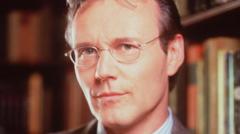
Head became the watcher. He wore the tweed jackets, the wire-rimmed glasses, and the weary expression of a man who had read too many ancient texts and slept too few hours. But he didn't play Giles as a caricature of British stuffiness. He played him with a profound, aching humanity.
Consider the quiet brilliance of his performance in the season five episode, "The Body." The main character’s mother has died of utterly natural causes—a brain aneurysm. No vampires. No magic. No monsters to fight. The scene where Giles discovers the body is a masterclass in unspoken grief. There are no grand monologues. There is only a sharp intake of breath, a sudden, clumsy fumbling with his glasses, and a desperate, fragile attempt to maintain order while the world shatters around him.
That is the lived experience of loss. It isn't cinematic tears; it is the absolute failure of your hands to do what you tell them to do. Head brought that truth to a show about monsters, and in doing so, he elevated a cult teen drama into art.
The Mutation of Authority
As the years pressed on, the lines on Head’s face deepened, and his screen presence shifted. The dependable mentor began to curdle into something far more dangerous.
In the BBC’s Merlin, he took on the mantle of Uther Pendragon. This wasn't the benevolent king of Arthurian myth. This Uther was a tyrant driven mad by grief, a man who banned magic because it had cost him his wife, blind to the fact that his obsession was destroying his son.
Watch his posture change across these decades. In the coffee ads, he leaned against doorframes, loose and inviting. As Giles, he hunched over old books, shielding his eyes from the horrors of the world. As Uther, he stood rigid, a spine of pure iron, his chin thrust forward as if daring the universe to strike him down.
It is terrifying to watch a good actor grow old on screen, not because of the physical aging, but because you watch their capacity for darkness expand. Head tapped into a very specific British archetype: the institutional man whose righteousness has gone rotten. We see these people in our boardrooms, our governments, our schools. The men who believe so deeply in their own rules that they will burn the village to save it.
He made Uther tragic because, even when the king was executing innocent people, you could see the ghost of the loving husband hiding behind his eyes. You didn't hate him. You pitied him. And that made him infinitely more frightening.
The Richmond Revolution
Then came Ted Lasso.
When Ted Lasso debuted during the dark, uncertain months of 2020, the world was bleeding. We were isolated, trapped in our homes, desperate for kindness. The show offered a warm hug in the form of an optimistic American football coach trying to run a British soccer team.
But a story cannot exist on sugar alone. Every great fairytale requires a dragon.
Anthony Head entered the frame as Rupert Mannion, the billionaire former owner of AFC Richmond. He was the ex-husband of Rebecca Welton, the man who treated people like trading cards and loyalty like a joke.
It was a stroke of casting genius. Head utilized every ounce of the charm he had cultivated thirty years prior in those Nescafé commercials, but he weaponized it. When Rupert Mannion smiles, your skin crawls. He doesn't raise his voice. He doesn't offer cartoonish threats. He simply walks into a room, oozing wealth and effortless charisma, and buys the loyalty of everyone present with a casual wave of his hand.
The real problem with men like Rupert isn't that they are monsters; it’s that they are incredibly fun to be around until they decide you no longer exist.
There is a pivotal scene in the third season where Rupert invites the young, naive coach Nate into his inner sanctum—a dark, wood-paneled club filled with beautiful women and expensive whiskey. Rupert offers him a glass, smiles that familiar, warm smile, and attempts to corrupt the young man's soul under the guise of mentorship. It is a mirror image of Rupert Giles and Buffy, twisted into a horrific shape. The mentor is no longer saving the child; he is devouring him.
Head played that role with an absolute lack of vanity. He allowed himself to be the symbol of everything cynical, everything cruel, and everything broken in modern culture. He became the perfect foil for Ted Lasso’s optimism.
The Final Portrait
If you look at the trajectory of Anthony Head's career through a series of photographs, you aren't just looking at the resume of a successful working actor. You are looking at a map of shifting masculinity over forty years.
We began with the romantic ideal of the late eighties: the mysterious, affluent man who offered connection over a warm beverage. We moved into the nineties with the protective, vulnerable father figure who carried the weight of the world on his sloping shoulders. We endured the harsh, uncompromising patriarch of the 2000s, before finally arriving at the smooth, corporate villain of the modern era.
He has played them all, not by changing his face with heavy prosthetics, but by changing the way he occupies the space around him.
The dry facts of his biography tell you he was born in Camden, that his brother is also famous, that he lives in Somerset. But those details are just the frame. The actual picture is found in the quiet moments between the dialogue. It’s the way his eyes soften when he looks at a fictional student, or the way his mouth hardens when he faces a fictional rival.
Anthony Head remains the master of the unspoken. He understands that the audience is always smarter than the script, that we are always looking past the words to find the truth hiding in the shadows. He invites us into those shadows, time and time after time, and we follow him willingly, even when we know there are monsters waiting in the dark.