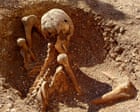
The dirt in Cassis is not like the soft, dark loam of a backyard garden. It is a stubborn mix of limestone and clay, baked by the Provençal sun and cooled by the mistral winds that howl off the Mediterranean. It resists the shovel. It guards its secrets. But a few months ago, while workers were clearing ground for a new construction project in this seaside French town, the earth finally gave way to reveal something that stopped the machinery cold.
A face. Or rather, the hollowed-out sockets where a face used to be.
Most skeletons found by archaeologists tell a story of surrender. They are laid flat, limbs extended or perhaps tucked into a fetal curl, surrendering their weight to the gravity of the grave. But the man found in Cassis was different. He was sitting up.
He sat with his spine curved slightly, his legs crossed or tucked beneath him, and his head positioned as if he were still watching the horizon. He had been sitting that way for somewhere between 6,000 and 7,000 years.
The Defiant Posture of the Neolithic
When we talk about "seated burials," we are entering a strange, quiet mystery of the Stone Age. Standard archaeological reports will tell you that this find is significant because it adds to a growing map of similar "upright" burials across Europe. They will mention carbon dating, soil stratigraphy, and the lack of grave goods. But they often miss the visceral reality of what it takes to bury a person this way.
To bury someone sitting up is an act of intense labor. It requires a deeper, narrower shaft—a vertical challenge to the earth. It requires the living to interact with the dead in a way that is intimate and perhaps even unsettling.
Imagine the scene six millennia ago. The community didn't just toss a body into a hole. They had to support him. They had to ensure the walls of the grave were tight enough to hold him in his posture, or perhaps they bound him in linens that have long since rotted away. While most of his peers were being laid to rest in the horizontal "sleep" we recognize today, this man was kept in a position of action.
Why?
In the Neolithic mind, the boundary between life and death wasn't a shuttered door; it was a beaded curtain. A person sitting up is a person who is still present. He is a sentinel. He is a witness.
The Geography of a Soul
Archaeologists from the French National Institute for Preventive Archaeological Research (INRAP) have been meticulous. They noted that the skeleton showed no signs of violent trauma. This wasn't a victim of a frantic, makeshift execution. This was a deliberate, ceremonial choice.
The site in Cassis sits near the coast, a place where the land ends and the infinite blue of the sea begins. For a community 6,500 years ago, this was the edge of the known world. By placing a member of their tribe in a seated position, they were perhaps creating a permanent inhabitant for that edge.
Consider the "invisible stakes" of such a burial. In a world without written history, your ancestors were your library. They were your legal system. They were your connection to the gods. If you lay an ancestor flat, you are returning them to the earth. If you sit them up, you are keeping them in the room. You are asking them to keep watch over the fishing grounds, the hunt, and the children who will eventually take their place.
This isn't the first time France has yielded such a ghost. Similar seated burials have appeared in the Auvergne region and further north. Each time, they disrupt our comfortable narrative that ancient people were simple or uniform in their grief. They were as complicated as we are. They had rebels, and they had rituals that we are only now beginning to decode.
The Physicality of the Past
When you look at the photos of the excavation, the most striking thing isn't the age of the bones—it’s the proximity. The archaeologists are crouched in the dirt, mere inches from the skull, using fine brushes to whisk away centuries of grit.
The man from Cassis was likely in his late twenties or thirties. In the Neolithic, that was middle age. He would have known the ache of a long day's trek and the sharp relief of a fire at night. His teeth show the wear of a coarse diet. His joints show the stress of a life lived entirely outdoors.
There is a profound loneliness in seeing him there, surrounded by plastic yellow tape and the hum of modern traffic nearby. He was a person who was loved enough to be buried with extreme care, yet he has spent six thousand years in total silence, his vigil unobserved until a backhoe accidentally grazed his sanctuary.
The Mirror of the Grave
We often look at these finds as "specimens." We categorize them by the length of their femur or the shape of their pelvis. But that is a way of distancing ourselves from the truth. The truth is that the man in Cassis represents a choice.
Every society decides how it wants to remember its dead. Today, we often choose invisibility. We hide death behind hospital curtains and polished mahogany. We want it to be "seamless" and "efficient." We want the dead to go quietly.
The people of the Neolithic were braver. They sat their dead up. They looked them in the eye. They lived alongside them, knowing that the soil beneath their feet was crowded with the watchful spirits of those who came before.
This discovery doesn't just change our understanding of ancient French burial customs; it challenges our modern detachment. It asks us what we are watching for, and who will be left to hold us up when we can no longer stand on our own.
The man from Cassis is now in a laboratory. He will be measured. He will be tested for DNA. He will be turned into data points on a spreadsheet. But for a brief moment, when the sun hit his skull for the first time in sixty centuries, he was something more. He was a reminder that even in the face of the ultimate end, some of us choose to remain upright.
He is still there, in the mind’s eye, sitting in the dark of the French soil, waiting for a dawn he was never supposed to see.