The paper was thin, weathered, and smelled of decades-old dust. Shigeaki Mori held it with the kind of reverence usually reserved for a holy relic. For most of the world, August 6, 1945, is a date in a textbook, a black-and-white flash followed by a mushroom cloud. For Mori, it was the day the sky fell, and for the seventy-seven years that followed, it was a debt he spent every waking hour trying to repay.
He was eight years old when the world ended. He was standing on a bridge in Hiroshima. The flash didn't just blind; it erased. When he crawled out of the wreckage of that morning, he found himself in a landscape of charcoal and silence. He lived. That was his primary burden.
Survival is rarely a gift in the aftermath of an atomic blast. It is a haunting. While the rest of Japan rebuilt with concrete and neon, Mori began a solitary, quiet crusade. He didn't seek the spotlight. He didn't want to be a political symbol. He just wanted to find the names of the boys who had been forgotten in the fire.
Specifically, he was looking for the Americans.
The Invisible Prisoners
Imagine being a young man from a small town in the United States, perhaps a farm boy from Iowa or a student from Michigan, sent across the Pacific to fight a war you barely understood. You are captured. You are held in a civilian police station in the heart of Hiroshima. Then, your own country drops a sun on your head.
History is often written by the victors, and the victors didn't particularly want to talk about the twelve American Prisoners of War who died at Ground Zero. Their families back home were told they were "missing in action." No details. No closure. Just a void where a son or a brother used to be.
Shigeaki Mori couldn't sleep knowing those souls were wandering the streets of his city without a headstone. He spent thirty-five years—three and a half decades of painstaking research—tracking down their identities. He used his own money. He spent his weekends in dusty archives. He made international calls when long-distance was a luxury. He knocked on doors in rural America, speaking through translators, telling mothers and sisters that he knew where their boys had spent their final moments.
He wasn't doing it for his country. He was doing it for theirs.
The Moment the World Watched
In 2016, the narrative of the war shifted. Barack Obama became the first sitting American president to visit Hiroshima. The air was thick with the weight of expectation. Would he apologize? Would he stay distant?
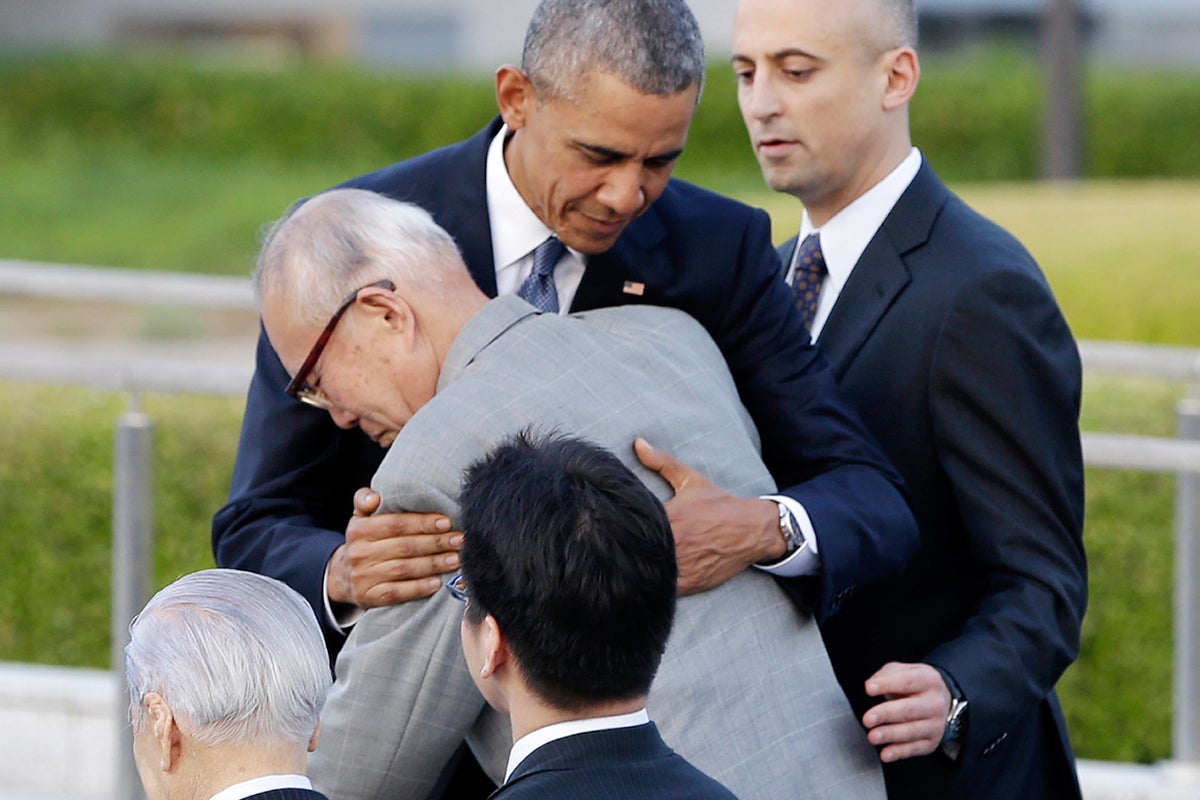
Mori was there, a small, bespectacled man in his late seventies, sitting in the front row. When the President finished his speech, he walked toward Mori. The cameras zoomed in. The world held its breath.
Mori began to weep. It wasn't the weeping of a victim; it was the release of a man who had carried the weight of twelve dead strangers on his back for half a lifetime. President Obama didn't shake his hand. He embraced him.
That hug lasted only a few seconds, but it bridged an ocean of resentment. It was a silent acknowledgment that the fire had burned everyone equally. In that moment, Mori wasn't a survivor of an enemy nation. He was a human being who had recognized the humanity in his enemies.
The Cost of Memory
Doing this kind of work takes a toll. It isn't just about cold data or military records. To find a person’s story, you have to inhabit their tragedy. Mori had to visualize the planes, the impact, and the screams. He had to face the reality that the very people who had bombed his home were also victims of the machinery of war.
He faced criticism, too. There were those who felt his energy should be spent only on Japanese victims. They argued that the "enemy" didn't deserve his tears. Mori ignored them. He understood a fundamental truth that many of us forget: grief has no nationality.
He eventually succeeded in getting the names of those twelve Americans added to the official list of atomic bomb victims held at the Hiroshima Peace Memorial Museum. It was a clerical victory that carried the weight of a mountain. It meant that, officially, they existed. They weren't just "collateral damage." They were people with names like Normand Brissette and Ralph Neal.
A Legacy of Quiet Persistence
Shigeaki Mori passed away recently at the age of 88. He died in a world that is once again rattling its sabers, where the threat of nuclear fire feels less like a memory and more like a looming shadow.
His life was a counter-narrative to the noise of modern conflict. He didn't have a social media following. He didn't give "TED Talks" on peace. He just did the work. He sat in the archives. He wrote the letters. He remembered the people that both governments would have preferred to forget.
There is a specific kind of courage required to look at the person who hurt you and decide that their pain matters as much as your own. Mori possessed that courage in abundance. He didn't just survive the bomb; he spent the rest of his life making sure the bomb didn't have the last word.
The bridge where he stood as an eight-year-old boy is still there, or at least a version of it is. The city is vibrant now, full of life and commerce. But if you walk through the Peace Park and see the names etched in stone, you are looking at Mori’s life’s work.
He understood that when we stop naming the dead, we make it easier to kill the living.
The archives are a little quieter now. The man who spent forty years talking to ghosts has finally joined them. One can only hope that when he arrived, he was met not by the fire of 1945, but by the twelve young men he spent his life bringing home.
He leaves behind a world that is still learning how to forgive, standing as a reminder that the smallest voice, if it speaks the truth long enough, can eventually be heard over the roar of an explosion.


.jpg?width=1200&auto=webp&trim=0%2C0%2C0%2C0)