The courtroom smells of old wood and anxiety. It is a sterile place where human tragedies are distilled into legal precedents, but today, the air feels heavier. In the center of the room stands a man who has become a symbol before he has even had the chance to be a person. To the public, he is the face of a nightmare—the individual linked to the deaths of two Edmonton Police Service officers. To his defense, he is something else entirely. He is a scapegoat.
When a community loses its protectors, the grief is not just deep; it is volatile. It demands a name. It demands a face. In the wake of such a profound loss, the collective psyche of a city seeks a focal point for its rage. The legal system is designed to provide justice, but sometimes, in the rush to heal a gaping wound, it risks providing a sacrifice instead. This is the friction at the heart of the trial, a tension between the need for accountability and the fundamental right to a fair shake.
Consider the weight of the charges. Manslaughter. It is a word that carries the thud of a closing cell door. But the defense argues that the prosecution’s case is built on the crumbling foundation of convenience. They suggest that the authorities, desperate to provide an answer to a grieving public, have ignored the complexities of the night in question. They point to a narrative that has been smoothed over, polished until it shines with the simplicity of a villain and a hero, leaving no room for the messy, gray reality of what actually occurred.
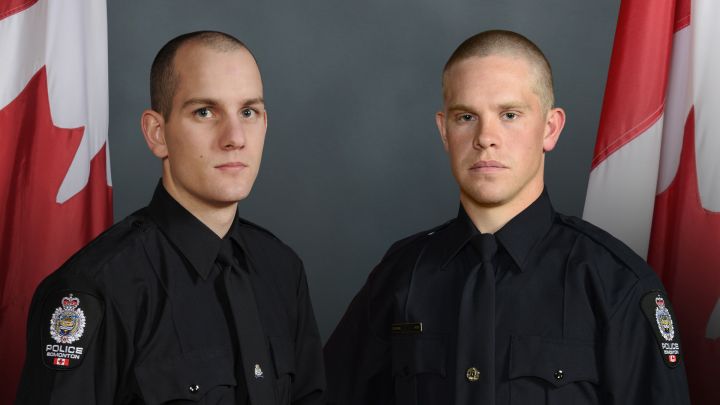
The officers, Constables Travis Jordan and Brett Ryan, were more than just uniforms. They were sons, husbands, and colleagues. Their deaths left a void that ripples through the precinct and across kitchen tables in every corner of the city. When the news broke, the collective breath of Edmonton hitched. We want someone to pay because the alternative—that life is chaotic, that tragedy can strike without a single, clear architect of malice—is too terrifying to bear.
But justice is not a balm for grief. It is a cold, clinical examination of facts.
The defense’s strategy is not just about a legal technicality; it is an appeal to the very idea of the individual versus the institution. They argue that their client is being crushed under the institutional weight of the police force and the crown, two entities that need a conviction to restore a sense of order. If you can point to one man and say, "He did this," then the world feels slightly more manageable. If the truth is that a series of systemic failures, mental health crises, and split-second escalations led to the tragedy, then we all have to look at ourselves. That is much harder.
Think of a hypothetical scenario where a storm knocks down a tree, and the tree crushes a car. We look for the rot in the trunk. We look for the wind speed. But if a person was seen touching the tree an hour before, we find it much easier to blame the person than the wind. It gives us an illusion of control. The defense argues that their client was merely a witness to the storm, not the hand that guided the lightning.
The evidence presented so far is a mosaic of fragmented memories and digital footprints. There are body-worn camera videos that capture the frantic energy of the night—the shouting, the darkness, the sudden, sharp pops of gunfire. There are forensic reports that detail the trajectory of bullets and the chemical composition of blood. Yet, the defense insists that these pieces are being forced into a puzzle where they don’t quite fit. They argue that the prosecution is "cherry-picking" moments of the defendant's behavior to create a profile of culpability while ignoring the moments that suggest confusion, fear, or even attempts to de-escalate.
The stakes are invisible but massive. If the defense is right, then we are witnessing a secondary tragedy: the slow-motion destruction of a man’s life to satisfy a social debt. If the prosecution is right, then a man who contributed to the deaths of two public servants is trying to slip through the cracks of a complex legal system.
The courtroom isn't just deciding one man's fate. It is testing the integrity of the system itself.
One. Word. Accuracy.
That is what the defense is demanding. They are stripping away the emotional layers of the "fallen hero" narrative to look at the mechanics of the event. Who held the weapon? Whose intent was clear? In the chaotic seconds of an active shooting, can one man truly be held responsible for the actions of another, or for the environment that birthed the violence? These are the questions that keep juries awake at night. They are the questions that turn a "dry" news story into a visceral struggle for the truth.
The defendant sits quietly, his hands often folded, his eyes fixed on the floor or the back of a lawyer’s head. He is the eye of the storm. Around him, the lawyers trade barbs and the judge issues rulings, but the man himself seems to shrink as the trial progresses. He is being redefined by every witness. To some, he is a dangerous catalyst. To others, he is a confused bystander caught in a lethal crossfire.
The city waits. Outside the courthouse, life moves on, but for those inside, time has frozen in March of 2023. The memory of the funeral—the long line of blue uniforms, the riderless horse, the haunting sound of bagpipes—still lingers in the public consciousness. It is that memory that makes this trial so fraught. It is hard to be objective when you can still feel the lump in your throat from the day those men were buried.
However, the law does not operate on feelings. It operates on the burden of proof. The defense is betting that when the emotional dust settles, the prosecution will be left with nothing but shadows and suggestions. They are counting on the fact that "likely" or "probably" isn't enough to take away a man's freedom.
We often talk about the "thin blue line" as the barrier between order and chaos. In this courtroom, there is another line: the one between accountability and convenience.
Every witness who takes the stand adds a brushstroke to the portrait of that night. A neighbor who heard the screams. A dispatcher who took the call. An investigator who walked the blood-stained carpet. Each testimony is a thread, and the prosecution is trying to weave them into a noose. The defense is trying to show that the threads are frayed, mismatched, and ultimately incapable of holding the weight of a manslaughter conviction.
The tragedy of the officers’ deaths is absolute. Nothing can change the fact that two families are broken and a police force is scarred. But the defense’s argument reminds us that we cannot fix one injustice by potentially committing another. The label of "scapegoat" is a heavy one to throw around, but it serves as a necessary warning. It reminds us that in the heat of our collective mourning, we must not lose our sight.
The trial continues, a slow grind of testimony and cross-examination. It is a battle of narratives. On one side, a story of a man whose presence and actions created a deadly environment. On the other, a story of a man who is being blamed for a situation he couldn't control, simply because he was the only one left standing to face the music.
The truth likely sits somewhere in the uncomfortable middle, in the space where human error meets unforeseen circumstance. But the law doesn't like the middle. The law requires a verdict. It requires a "guilty" or a "not guilty."
As the sun sets over Edmonton, casting long shadows across the North Saskatchewan River, the city remains divided. There is a longing for closure, a desperate hope that this trial will finally put the ghosts of that night to rest. But closure is a myth. There is only the verdict, and the long, silent aftermath that follows.
A man’s life is on the line, but so is the credibility of our grief. If we convict the wrong man just because we need someone to blame, we haven't honored the fallen. We have only added to the wreckage. The gavel will eventually fall, and the sound will echo far beyond the courtroom walls, a final note in a song that no one wanted to hear.
The weight of the badge is heavy, but the weight of the handcuffs is heavier still when the hands inside them might be innocent of the crime they are accused of. We watch. We wait. We hope that whatever the outcome, it is born of light, not just the heat of a city’s broken heart.