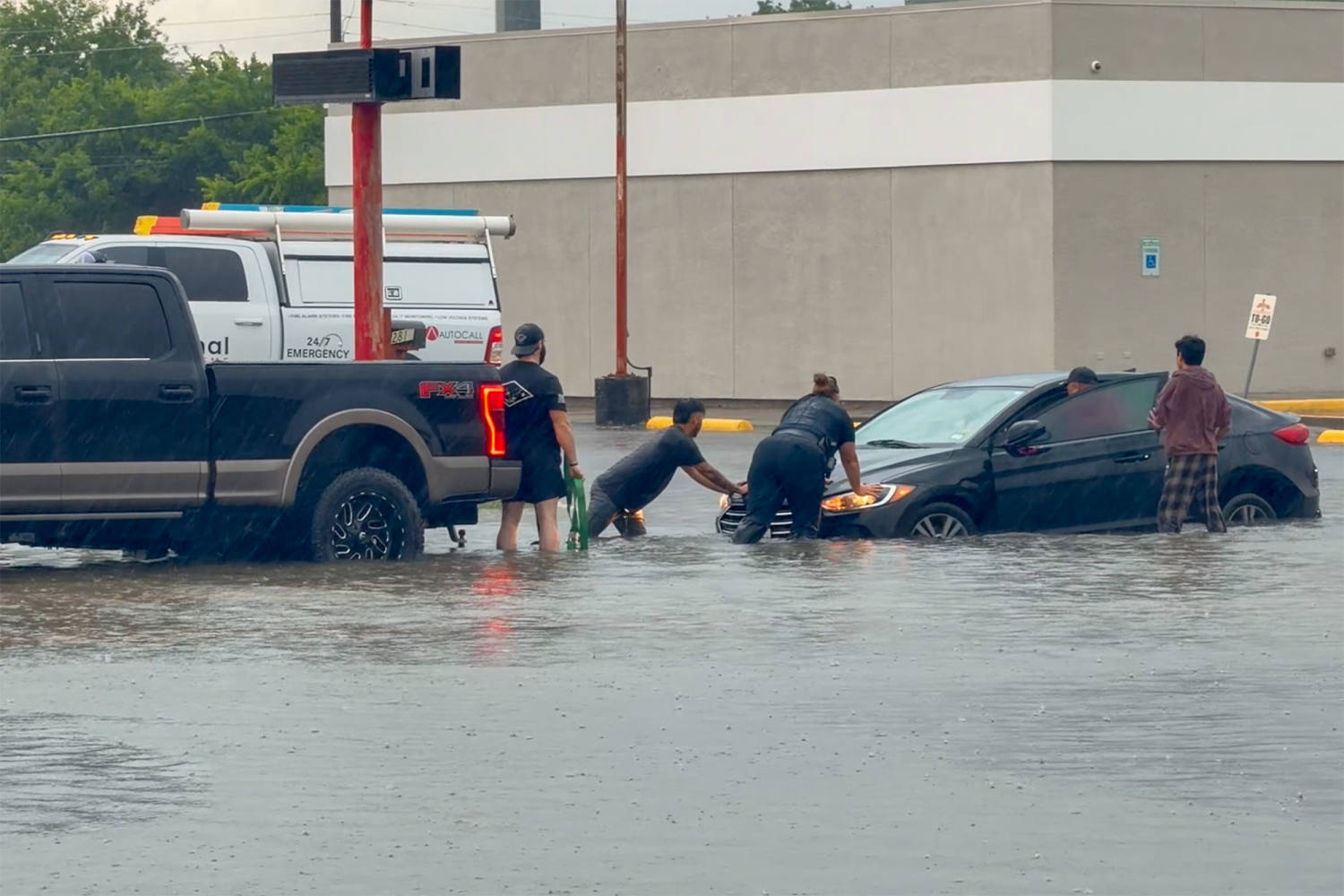
The standard weather alert narrative is broken. Every time a major storm front stalls over the American South, the media rolls out the exact same script: "Millions at Risk as Heavy Rains Threaten Historic Flooding."
They show you maps painted in alarming shades of crimson. They interview frantic local officials standing next to sandbags. They tell you to buy bottled water, hunker down, and pray the infrastructure holds.
It is a lazy, reactive consensus that treats natural weather cycles as unpredictable, apocalyptic anomalies.
The media focuses entirely on the sky, counting inches of rainfall as if the clouds are the structural failure. Rainfall is just a data point. The real crisis is an engineered vulnerability, masked by a multi-billion-dollar cycle of bad planning and misallocated federal funds.
By framing flooding as a sudden, dramatic act of God, standard reporting actively prevents communities from understanding why their streets are underwater. We do not have a rain problem. We have a systemic architecture problem disguised as a weather emergency.
The Disaster Capital Cycle
I have spent years analyzing municipal infrastructure budgets and risk management frameworks. I have watched cities blow tens of millions of dollars on post-disaster recovery, only to rebuild the exact same flawed drainage systems in the exact same floodplains.
It is a highly predictable cycle. The rain falls, the media panics, the federal government cuts a check via emergency declarations, and local contractors get paid to restore the status quo.
Mainstream coverage treats infrastructure as a static shield that simply failed because the storm was "unprecedented." This ignores the basic mechanics of hydrology.
When you cover thousands of acres of natural wetlands with asphalt, concrete, and strip malls, you fundamentally alter how water moves. In a natural ecosystem, the ground acts as a sponge. In a modernized southern metro area, that sponge is replaced by impervious surfaces.
Imagine a scenario where a city experiences a standard five-inch rainfall event. In 1950, 80% of that water absorbed directly into the water table. Today, because of unchecked suburban sprawl, 90% of that same rainfall becomes immediate surface runoff.
The water has nowhere to go but into the streets, backed-up storm sewers, and eventually, living rooms.
The media calls this a natural disaster. Hydrologists call it a predictable design outcome. We are not experiencing worse weather; we are experiencing the compounded interest of bad civil engineering.
Dismantling the 100-Year Flood Myth
If you want to understand how deep the misinformation goes, look no further than the phrase "100-year flood."
You hear this term thrown around by anchors every time a river breaks its banks. The public hears "100-year flood" and assumes it means an event that happens once a century. They think, Well, we had one this year, so we are safe for the next 99.
This is a dangerous misunderstanding of statistical probability, perpetuated by lazy reporting.
A "100-year flood" is a regulatory definition used by the Federal Emergency Management Agency (FEMA). It simply means an event that has a 1% chance of occurring in any given year.
- Year 1: 1% chance
- Year 2: 1% chance
- Year 3: 1% chance
The odds do not reset because you got hit last week. A home located within a designated 100-year floodplain has a 26% chance of being flooded over the course of a standard 30-year mortgage. That is a greater than one-in-four chance. Yet homebuyers are routinely blindsided because the terminology sounds like an extreme rarity rather than an ongoing probability.
Furthermore, the historical data used to calculate these percentages is frequently decades out of date.
Local governments rely on historical rainfall records from the mid-20th century to build their current stormwater systems. They are designing infrastructure for a climate and a landscape layout that no longer exists. When a storm inevitably overwhelms these antiquated metrics, the system does not just fail—it fails catastrophically.
The Counter-Intuitive Truth About Flood Insurance
People frequently ask: "If I buy a house outside the official flood zone, am I safe?"
The brutal, honest answer is no.
FEMA flood maps are political documents as much as they are scientific ones. Local politicians and real estate developers routinely lobby to keep areas designated as "Low Risk" to keep property values high and avoid mandatory flood insurance requirements.
When the heavy rains hit, water does not care about lines drawn on a municipal map.
According to data from the National Flood Insurance Program (NFIP), more than 20% of all flood insurance claims come from policyholders living outside of mapped high-risk flood zones. These are the people who watched the news, saw that their neighborhood was not highlighted in red, and assumed they had nothing to worry about.
The contrarian approach to property protection requires ignoring the official designation entirely. If your property sits at the bottom of a grade, if your local municipality has approved massive upstream commercial developments, or if your local storm drains are routinely clogged with debris, you are in a flood zone. It does not matter what your mortgage paperwork says.
Stop Buying Sandbags, Start Demanding Concrete Accountability
The actionable advice offered by traditional media outlets during a heavy rain event is almost comically useless. They tell you to stack sandbags around your doors.
Let us be realistic about the physics of fluid dynamics. Sandbags are a temporary, porous barrier designed to divert low-velocity surface water. They do not stop a rising water table, they do not prevent sewage from backing up through your drains, and they will not save a structure subjected to prolonged inundation.
Instead of focusing on reactive, individual survivalism during the storm, the real solution requires a radical shift in how we manage municipal development before the sky turns gray.
Implement True-Cost Development Fees
Developers who build massive subdivisions or commercial centers must be forced to pay fees that reflect the actual cost of the increased runoff they create. If a new parking lot adds 2 million gallons of runoff to the city's system during a major storm, that developer should foot the bill for the downstream retention ponds required to manage it. Currently, those costs are socialized onto the taxpayers in the form of emergency bond measures after the disaster occurs.
Transition to Permeable Infrastructure
We need to stop paving over the South with traditional concrete. Major European cities are already shifting toward permeable pavement, green roofs, and urban bioswales that mimic natural hydrology by allowing water to filter back into the ground where it falls. It is a proven mechanism that reduces peak runoff volumes by up to 60%.
[Traditional Infrastructure]
Rainfall -> Impervious Concrete -> 90% Immediate Runoff -> Overwhelmed Storm Sewers -> Urban Flooding

[Permeable Infrastructure]
Rainfall -> Porous Pavement/Bioswales -> 40% Runoff / 60% Ground Absorption -> Managed Flow -> Minimal Risk
Enforce Civil Liability for Infrastructure Neglect
When a storm drain backs up and floods a neighborhood, it is rarely because the rain was too heavy. It is usually because the city failed to clear debris, leaves, and silt from the drainage lines during the dry season. Citizens need to stop accepting "weather" as an excuse for administrative negligence. If a private company blocked a pipe and flooded your home, you would sue them. The same standard of accountability must apply to municipal public works departments.
The Downside of the Hard Truth
Admitting that flooding is a structural issue rather than a purely weather-driven event comes with an uncomfortable reality. It means acknowledging that some areas are currently un-fixable.
There are entire neighborhoods built in low-lying coastal plains and river basins across the South that should never have been approved for development. No amount of engineering, civil funding, or clever drainage manipulation will ever make them safe from heavy rainfall.
The ultimate solution for these areas is not rebuilding; it is managed retreat. It means using federal funds to buy out these properties permanently, demolishing the structures, and converting the land back into natural wetlands that can absorb the water safely.
But managed retreat is a political nightmare. It kills property tax revenues for local governments, drops real estate commissions to zero, and forces communities to admit defeat. So instead, politicians and developers prefer the media narrative. They prefer to blame the historic, unprecedented rain. It allows them to pretend the disaster was entirely unavoidable, right up until the next storm rolls in and the whole cycle starts over again.
Stop looking at the weather radar. Start looking at the zoning maps. Your local government is betting that you will keep blaming the clouds for the failures they engineered.