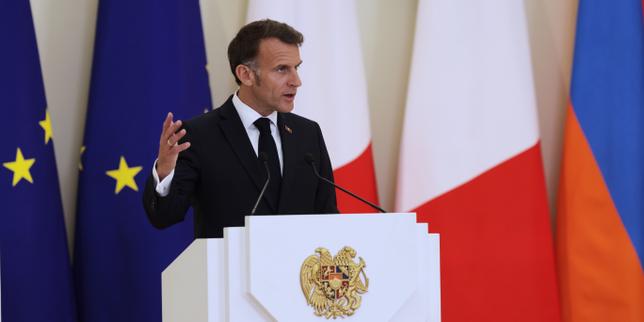
Emmanuel Macron isn't bluffing anymore. The French President just sent a massive shockwave through the halls of Brussels and Washington. If the United States follows through on its threat to slap heavy surtaxes on European vehicles, the EU is ready to hit back with everything in its legal arsenal. This isn't just typical political posturing or pre-election noise. We're looking at the potential activation of the EU’s "anti-coercion instrument," a specialized trade weapon designed to stop economic bullying in its tracks.
The stakes couldn't be higher for the European automotive industry. For years, manufacturers in Germany, France, and Italy have played by the rules while watching global trade tensions rise. Now, they're caught in the crosshairs of a protectionist shift in American policy that threatens to price European cars right out of the US market. Macron’s stance is simple. If the US shuts the door, Europe locks the gate.
The end of European passivity in global trade
For decades, the European Union acted like the world's most polite referee. It followed WTO guidelines to a fault while other superpowers used subsidies and tariffs like sledgehammers. Those days are gone. Macron’s latest comments reflect a fundamental shift in how Paris and Brussels view "strategic autonomy." They’ve realized that being the only ones following the old rulebook is a recipe for industrial suicide.
The specific "menace" here is a proposed US surtax that would target non-American vehicles, specifically hitting the European electric vehicle (EV) sector. It’s an aggressive move by Washington to force manufacturing onto US soil. Macron sees this as a direct violation of international norms. He's pushing the European Commission to stop "deliberating" and start preparing for a counter-strike.
You've probably heard this kind of talk before, but the legislative reality has changed. The Anti-Coercion Instrument (ACI), which became law recently, allows the EU to skip the years-long WTO arbitration process. It gives the bloc the power to impose retaliatory tariffs, restrict access to public procurement, or even limit intellectual property rights in record time. It’s the trade equivalent of a nuclear deterrent.
Why the US auto tariffs are a direct attack on the Green Deal
Europe has bet its entire industrial future on the transition to electric mobility. Billions of euros have flowed into battery plants and EV assembly lines from Wolfsburg to Lyon. If the US market—one of the largest in the world—suddenly becomes inaccessible due to a 25% or 30% tariff, those investments won't just stall. They’ll fail.
Washington argues these tariffs are necessary for national security and to protect local jobs. Honestly, it’s mostly about the upcoming election cycle. Both sides of the American political aisle are competing to see who can be more protectionist. But for Macron, this isn't about American domestic politics. It’s about the survival of the European middle class.
The European automotive sector employs nearly 13 million people directly and indirectly. It represents roughly 7% of the EU’s GDP. You don't just sit back and let a "partner" dismantle that kind of economic engine. Macron is signaling that if the US wants a trade war, Europe won't just show up—it’ll fight to win.
Understanding the Anti-Coercion Instrument in practice
How does this actually work? It isn't just about tit-for-tat tariffs on bourbon or Harley-Davidsons like we saw in the past. The ACI is much more sophisticated. It triggers when a third country tries to pressure the EU or a member state into a specific policy choice by using economic measures.
- Investigation: The Commission identifies the coercive measure.
- Consultation: A brief period where the EU asks the offending country to stop.
- Retaliation: If the country refuses, the EU hits back with a menu of options.
This isn't just about taxes at the border. The EU could theoretically block American tech companies from certain service sectors or tie up US financial firms in red tape. It’s designed to be painful enough that the other side decides the original tariff wasn't worth the trouble.
Critics say this will only lead to a spiral of protectionism that hurts consumers. They aren't wrong. Prices for cars will go up on both sides of the Atlantic. However, the alternative is letting European industry hollow out while the US and China subsidize their way to dominance. Macron is betting that a temporary trade fight is better than permanent industrial decline.
The German dilemma and the quest for EU unity
Getting all 27 EU members on board isn't easy. Germany, in particular, is usually terrified of trade wars. Their economy is so dependent on exports to the US and China that any retaliation usually results in a backfire. But even in Berlin, the mood is shifting. The realization has sunk in that "Wandel durch Handel" (change through trade) is dead.
Macron is leading the charge because he knows France has less to lose than Germany in terms of pure export volume to the US, giving him more room to be the "bad cop." But he's also doing the heavy lifting for the rest of the continent. By framing this as an EU-wide issue rather than just a French or German one, he’s forcing the Commission to take a harder line.
This isn't just about cars. It's about whether the EU will remain a global power or become a playground for the US and China. If the EU fails to act now, it sends a signal to every other trading partner that Europe is a soft target. Macron knows that's a legacy he can't afford.
What happens if the surtax goes live
If the "menace" becomes reality, expect the EU to move fast. We likely won't see a slow ramp-up. We'll see a massive list of retaliatory targets released within weeks. The goal will be to hit politically sensitive areas in the US to create internal pressure on Washington to negotiate.
You should keep a close eye on the negotiations over the next few months. If you’re an investor or work in the supply chain, start looking at diversification. The era of frictionless transatlantic trade is hitting a massive wall.
Companies need to prepare for a world where "Made in Europe" is a liability in America and "Made in USA" is a liability in Europe. It's an ugly scenario, but it’s the one we're currently heading toward. Macron’s bluntness is a service to the market—it’s a warning that the "old ways" of handling trade disputes are officially over.
Prepare for a volatile 2026. Review your contracts for force majeure clauses and look at localized production options if you're shipping across the pond. The trade map is being redrawn in real-time, and those who ignore Macron's warnings are going to get burned when the "instruments" finally get activated.