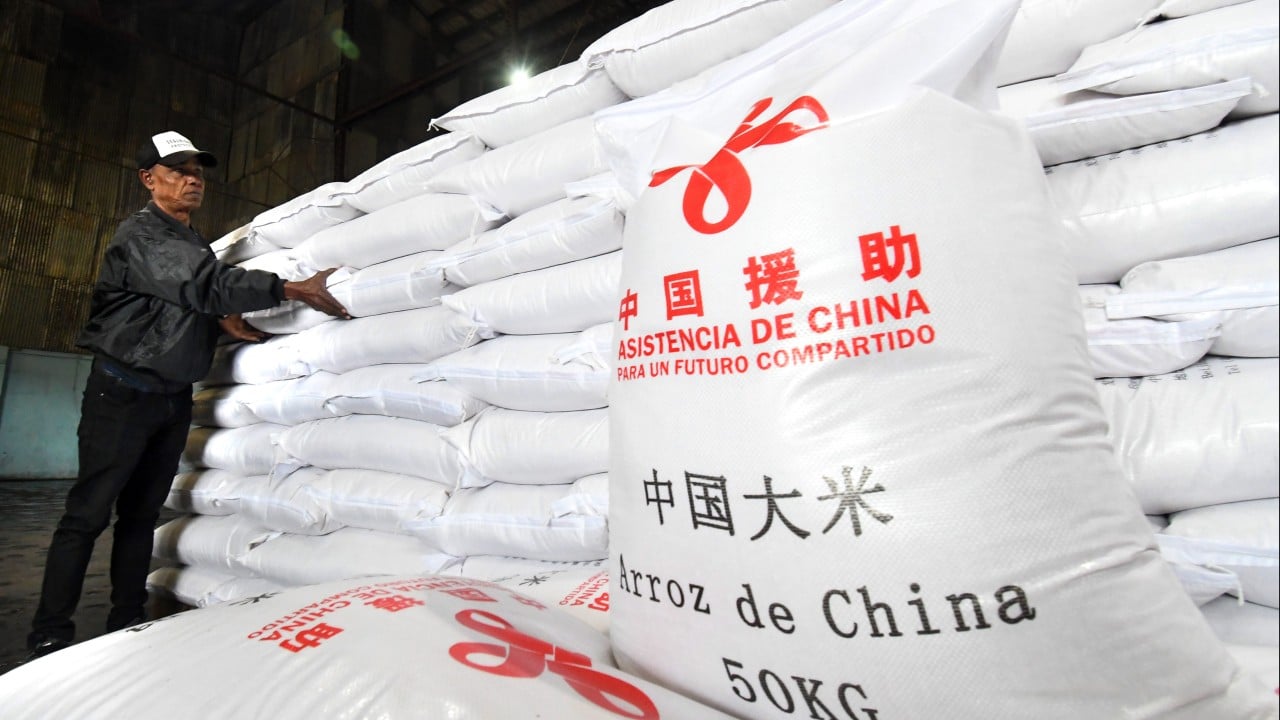
The arrival of a 15,000-tonne shipment of rice from China at the port of Havana reveals the structural realities of Cuba's state-directed food distribution model and the mechanics of bilateral crisis insulation. While public communications framing this transaction focus on political solidarity, a strict structural evaluation shows that these shipments operate as a critical macroeconomic subsidy. The delivery represents the initial tranche of a 60,000-tonne emergency food package, augmented by an 80 million USD financial aid allocation authorized by Beijing.
Evaluating this transaction requires moving past political rhetoric to analyze the operational mechanics of Cuba’s domestic food supply chain, the structural collapse of its domestic agricultural production, and the geopolitical cost-benefit trade-offs governing China’s Caribbean interventions.
The Structural Anatomy of Cuba's Rice Deficit
Rice serves as the baseline caloric foundation of the Cuban state ration system (libreta de abastecimiento). To understand why a 15,000-tonne shipment is vital, one must evaluate the widening chasm between domestic demand and agricultural output.
Historically, Cuba's domestic consumption requires approximately 600,000 to 700,000 tonnes of rice annually to sustain baseline caloric distribution across its 9.6 million citizens. However, the domestic production function has experienced a systemic collapse over the last decade.
- Production Degradation: Between 2012 and 2018, Cuba achieved peak domestic yields, exceeding 300,000 tonnes annually. By 2024, domestic output collapsed to roughly 80,000 tonnes—a 73% decline from historical peaks.
- The Land Cultivation Bottleneck: Although the Cuban Ministry of Agriculture announced targets to plant 200,000 hectares of rice, structural input constraints prevent these targets from converting into actual yield.
The operational breakdown of domestic agricultural production is governed by three binding input constraints:
- The Fertilizer and Pesticide Deficit: Due to severe hard-currency liquidity constraints, Cuba cannot import the requisite synthetic inputs needed to protect crops and optimize soil nutrition. This lowers the yield per hectare far below regional averages.
- The Fuel and Mechanization Bottleneck: Rice cultivation is highly energy-intensive, requiring mechanized harvesting and consistent diesel fuel for irrigation pumps. The interruption of subsidized oil imports from international partners, combined with intensified secondary sanctions by the United States, has restricted fuel access for agricultural machinery.
- The Capital Expenditure Deficit: The Cuban state faces an ongoing trade-off between allocating scarce foreign reserves toward tourism infrastructure versus agricultural recapitalization. As a consequence, domestic processing, drying, and storage facilities have depreciated, yielding high post-harvest loss rates.
Distributive Mechanics and Per Capita Caloric Impact
The 15,000-tonne shipment is not a marginal surplus; it directly backstops the state’s daily ration infrastructure. By breaking down the raw volume against demographic data, we can calculate the exact operational runway this aid provides.
$$\text{Total Volume} = 15,000 \text{ tonnes} = 15,000,000 \text{ kg} = 33,069,339 \text{ lbs}$$
Distributed across a targeted population of approximately 9.6 million consumers, the shipment yields approximately 3.44 pounds of rice per capita.
The Ministry of Domestic Trade (MINCIN) manages distribution through a highly fragmented regional allocation matrix designed to match localized deficits. Rather than a uniform national payout, allocation quotas are divided by provincial urgency:
- High-Density Urban Zones (e.g., Havana): Allocation is restricted to 1.5 pounds per individual to balance the sheer volume of urban demand against logistics capacity.
- Peripheral and Vulnerable Provinces (e.g., Pinar del Río, Artemisa, Mayabeque): Quotas increase to 2 pounds per individual to compensate for deeper localized supply deficits.
- Institutional Safeguards: A fixed percentage of the tonnage bypasses individual consumer distribution entirely, routed directly into critical institutional nodes, specifically hospitals, maternity clinics, and educational centers.
This 15,000-tonne tranche acts as a temporary stabilizer rather than a permanent solution. Because the national consumption requirement hovers around 50,000 to 58,000 tonnes per month, this entire shipment represents only a 7-to-9-day supply of the national baseline requirement. The complete 60,000-tonne promised package offers roughly 30 to 36 days of absolute caloric insulation.
Logistics Risks and Infra-Structural Friction
The primary threat to the utility of this aid is the domestic logisitics infrastructure. The journey from the port of Havana to the end consumer introduces significant operational friction.
Port offloading protocols require a continuous, 24-hour three-shift rotation to minimize port demurrage fees and mitigate the risk of grain spoilage in humid tropical conditions. Once offloaded from the bulk carriers, the distribution mechanism faces a severe ground transport constraint.
Cuba’s domestic freight fleet suffers from acute rolling-stock depreciation and localized fuel shortages. Transporting thousands of tonnes of grain from Havana to distant eastern provinces like Santiago de Cuba and Guantánamo requires a complex intermodal coordination between a deteriorating rail network and cargo trucks. If fuel lines fail to supply the provincial transport hubs, the grain remains bottlenecked at port warehouses, exposed to moisture and pests, which systematically degrades the net usable caloric volume.
The Geopolitical Calculus of Emergency Aid
China’s food aid program to Cuba operates on a distinct geostrategic logic. Beijing utilizes a dual-track stabilization model combining commodity donations with financial liquid injections:
- The Commodity Track: The 60,000-tonne commitment acts as a non-monetary buffer that prevents absolute supply-chain failure in the Cuban ration system.
- The Fiscal Track: The accompanying 80 million USD emergency aid package—following a 100 million USD donation—serves as a critical balance-of-payments cushion. This liquidity allows Cuba to settle pressing short-term obligations or purchase non-grain critical imports.
For Beijing, the marginal cost of these agricultural donations is low, driven by China's extensive state-managed grain reserves and massive domestic agricultural purchasing power. However, the geopolitical dividend is substantial. By maintaining a baseline level of stability in Havana, China ensures the survival of a long-term ideological partner in the Western Hemisphere, preserves its institutional investments on the island, and maintains a strategic foothold 90 miles from the United States coast.
Concurrently, this allows China to publicly challenge unilateral U.S. sanctions, framing its intervention as a stabilizing humanitarian counterweight to an aggressive embargo.
Strategic Assessment of Cuba's Food Security Options
The systemic reliance on external agricultural donations reveals a fundamental policy dilemma within the Cuban economic model. The state has increasingly outsourced its primary food security requirements to sovereign donors like China, Vietnam, and Russia.
This model introduces extreme vulnerability to international shipping costs, supply chain disruptions, and the political priorities of donor states. To transition away from emergency-driven economic management, the state faces two diverging strategic paths:
Option A: The Agricultural Import-Substitution Pivot
This strategy demands a fundamental reallocation of state capital. The government would need to divest from tourism infrastructure and divert foreign currency toward importing heavy machinery, modern irrigation systems, and chemical inputs. The objective would be to rebuild domestic production back toward the 300,000-tonne baseline.
The structural limitation of this path is the long lead time. Rebuilding soil health, repairing depreciated industrial mills, and establishing reliable domestic fuel lines requires multi-year capital commitments that do not solve the immediate, weekly caloric deficits confronting the population.
Option B: Decentralization and Market-Driven Agrarian Reform
An alternative approach involves abandoning the highly centralized state purchasing system (Acopio), which forces farmers to sell crops to the state at fixed prices. Transitioning to a fully liberalized domestic market for grain production would allow agricultural prices to float, incentivizing smallholders and private cooperatives to expand cultivation through market rewards.
The structural risk of this path is ideological and inflationary. Removing price caps on a primary staple like rice would cause immediate retail price spikes, threatening lower-income segments who depend on the state ration system for survival.
The current policy path—relying on sequential, multi-stage donations from Beijing—indicates that the state has chosen to prioritize short-term stability over structural economic transformation. While the 15,000-tonne shipment successfully averts an immediate supply shock, it leaves the underlying causes of Cuba's agricultural decay completely unaddressed.