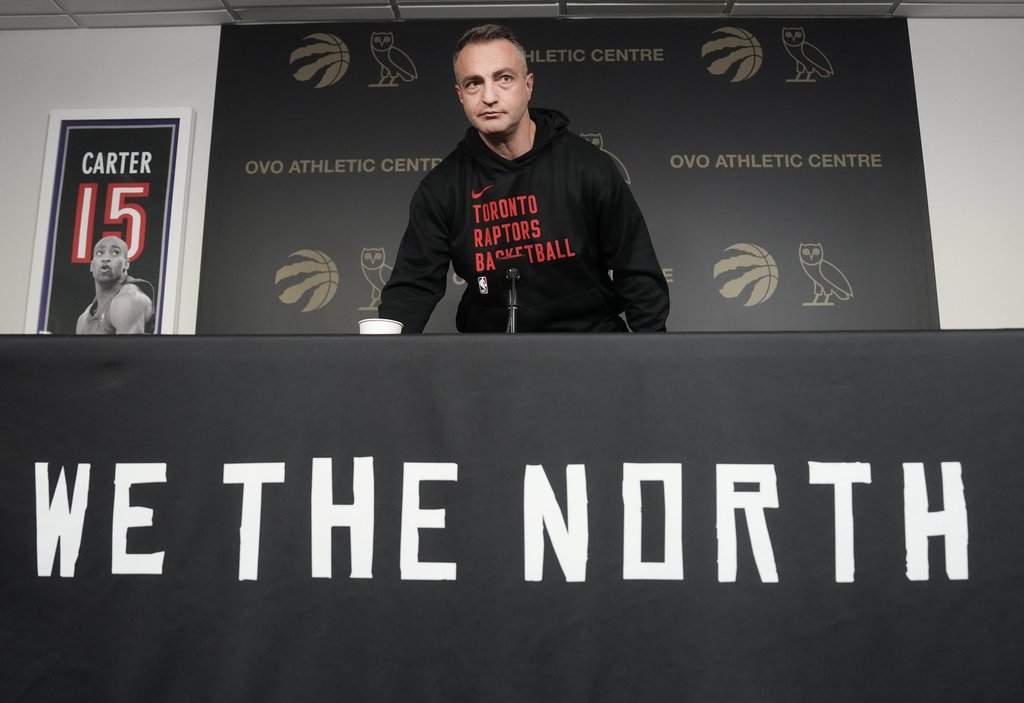
The multi-year contract extension granted to Darko Rajakovic by the Toronto Raptors represents a deliberate, calculated valuation of organizational stability over immediate variance-driven playoff results. While conventional sports commentary focuses on the raw binary of winning and losing a seven-game postseason series, an institutional analysis of Toronto’s front-office behavior reveals a classic asset-protection and team-building strategy. By aligning the contract of Rajakovic with the recent multi-year extension of General Manager and Executive Vice President Bobby Webster, the Raptors have neutralized the lame-duck coaching premium and locked in an operational framework designed to absorb a massive impending competitive catalyst: the reported return of Kawhi Leonard via trade.
To understand why a coach with a cumulative 101-145 regular-season record over three seasons receives a multi-year security commitment, one must model the modern NBA franchise as a long-term capital compounding machine rather than an entity managing week-to-week optics.
The Efficiency Frontier: Modeling the 16-Win Inflection
The primary justification for the renewal sits within the rate of year-over-year operational improvement. The Raptors concluded the 2025-26 season with a 46-36 record, securing the fifth seed in the Eastern Conference and snapping a three-year playoff drought. This performance marks a net positive variance of 16 wins relative to the prior campaign.
In professional sports analytics, win maximization is subject to a strict law of diminishing marginal returns. Moving a roster from 25 wins to 30 wins requires minimal structural efficiency; it can often be achieved through opponent injury variance or minor tactical adjustments. Scaling from 30 wins to 46 wins, however, requires crossing an efficiency frontier where a team transitions from a net-negative point differential to a positive baseline.
$$\Delta \text{Wins} = f(\text{Player Development}) + f(\text{Tactical Continuity}) + f(\text{Roster Stability})$$
The cause-and-effect relationship missed by surface-level breakdowns is that Rajakovic’s early sub-.500 record was an artifact of front-office structural engineering, not tactical incompetence. His inaugural 25-57 campaign in 2023-24 was defined by systemic disruption:
- The mid-season liquidation of the previous core via major trades.
- A severe injury bottleneck that sidelined franchise pillar Scottie Barnes.
- Exogenous operational shocks, specifically the lifetime ban of backup center Jontay Porter.
By holding Rajakovic’s tactical systems steady through the 30-win transitional phase and into the 46-win playoff breakthrough, the front office proved that they viewed his record as a lagging indicator. The true leading indicators were player development metrics and schematic execution.
The Two Pillars of Front Office Alignment
The timing of this transaction is functionally linked to the corporate restructuring of Toronto's basketball operations. Front offices operating under high-uncertainty environments cannot afford a mismatch between managerial timelines and coaching lifecycles.
1. Contractual Synchronization as Risk Mitigation
When a head coach enters the final years of an agreement, asymmetric incentives develop between the bench and the front office. A coach fighting for survival will systematically over-leverage young talent, over-play veterans to secure marginal regular-season victories, and abandon long-term developmental protocols in favor of short-term variance maximization.
By extending Webster and Rajakovic concurrently, the Raptors have unified the organization's macro-horizon. Rajakovic is insulated from the immediate pressure of the upcoming season's win-total demands, allowing him to maintain systemic discipline.
2. The Development Portfolio Strategy
Webster’s public endorsement specifically highlighted a "strong development philosophy." In an environment constrained by the NBA's strict collective bargaining agreement and luxury tax penalties, internal talent appreciation is the only sustainable mechanism for mid-market franchise health.
The growth trajectory of Toronto's young core illustrates this asset-appreciation strategy. Under Rajakovic, Scottie Barnes ascended to All-Star status, while rookies and young prospects like Jamal Shead, Ja'Kobe Walter, and recent addition Collin Murray-Boyles have been integrated into high-leverage roles. The coach’s background—spanning the developmental pipelines of the Oklahoma City Thunder and Memphis Grizzlies—provides a predictable framework for maximizing rookie-scale contracts.
The Kawhi Leonard Absorption Framework
The strategic calculus of this extension shifts dramatically when accounting for the macroeconomic shock of the reported acquisition of Kawhi Leonard from the Los Angeles Clippers. Inserting a high-usage, elite-tier veteran superstar into an established ecosystem introduces severe structural stress.
[System Input: Kawhi Leonard Trade]
             │
             ▼
┌────────────────────────────────────────┐
│     Structural Stress Factors          │
├────────────────────────────────────────┤
│ • Altered Usage Rate Distributions     │
│ • Heightened Postseason Expectations   │
│ • Defensive Scheme Realignment         │
└────────────┬───────────────────────────┘
             │
             ▼
┌────────────────────────────────────────┐
│    Mitigation via Rajakovic System     │
├────────────────────────────────────────┤
│ • Pre-established Defensive Floor      │
│ • Tactical Continuity for Young Core   │
│ • Neutralization of Coaching Volatility│
└────────────────────────────────────────┘
The underlying logic of extending Rajakovic before the formal integration of Leonard is to anchor the roster's cultural baseline. The current squad relies heavily on a high-energy, suffocating defensive identity featuring length and lateral quickness. Incorporating Leonard alongside Barnes, Murray-Boyles, and Shead projects an elite defensive ceiling, but it also disrupts the existing offensive hierarchy.
If the Raptors had retained Rajakovic on an expiring contract, the introduction of Leonard would have created an unstable power dynamic. Any early-season offensive stagnation or load-management friction would have triggered intense scrutiny regarding the coach's job security. This extension signals to the roster—and to incoming veterans—that the coaching staff possesses total institutional backing. The hierarchy is absolute, eliminating the potential for player-led schematic mutiny.
Structural Limitations and Tactical Friction Points
A rigorous analysis requires acknowledging the clear operational boundaries and historical vulnerabilities of Rajakovic's tenure. Total institutional alignment does not guarantee flawless execution.
The first limitation is localized within postseason adjustment windows. The Raptors' seven-game exit against the Cleveland Cavaliers highlighted a rigidity in Rajakovic’s half-court offensive design. When opponents successfully nullified Toronto's transition game and forced them into static sets, the offensive efficiency rating decayed rapidly. Rajakovic’s historical regular-season success must translate into fluid, game-to-game tactical counter-punches under playoff conditions.
The second limitation involves rotation management. Throughout his 101-145 tenure, Rajakovic has shown a strict adherence to structured rotation patterns, occasionally failing to ride the hot hand or pivot quickly when defensive matchups dictate an urgent substitution. With a deeper roster that now bridges elite veteran star-power and hyper-young developmental prospects, the variance in lineup optimization will become significantly more complex. Managing the minutes distribution between developmental mandatory play and win-now necessities is a delicate equilibrium.
The optimal operational playbook for the Toronto Raptors over the next twenty-four months requires exploiting this newly established stability. Rajakovic must leverage his contractual security to enforce rigorous defensive standards without fear of star-player alienation. The front office has effectively removed the coach's survival instinct from the tactical equation; the only remaining benchmark is the systematic compounding of the team's competitive ceiling toward true title contention.