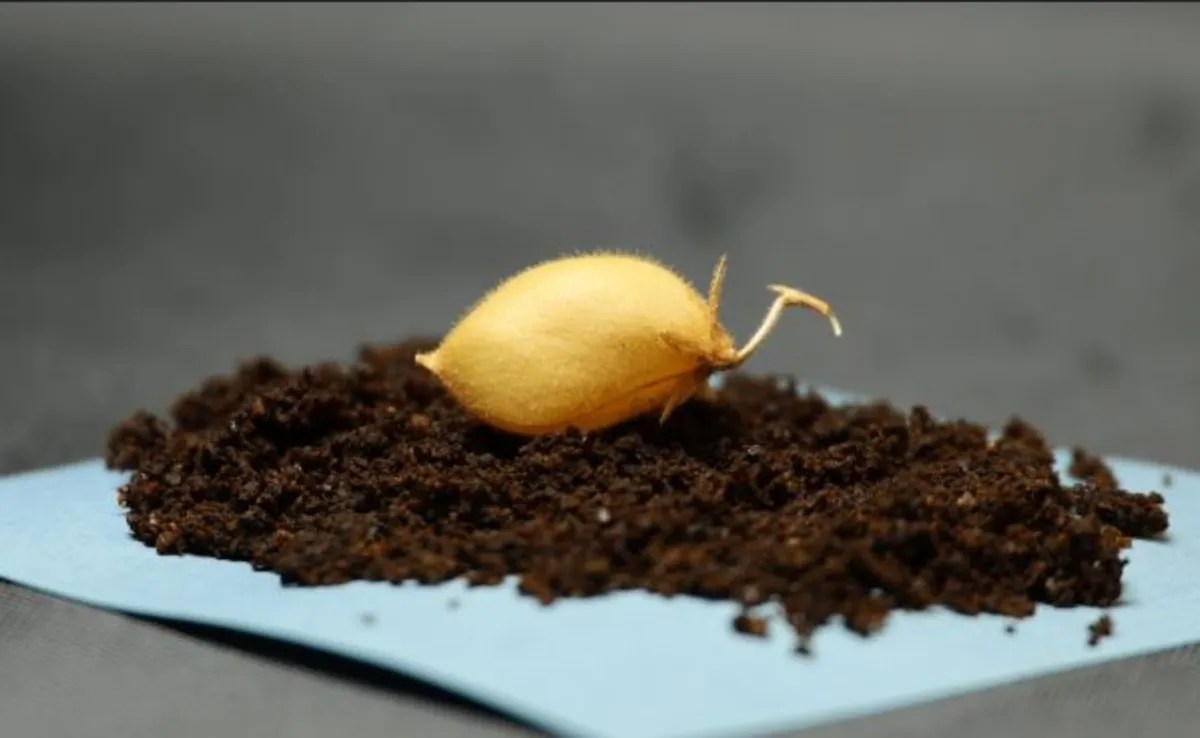
The headlines are breathless. They want you to believe that because a few chickpeas sprouted in a jar of simulated moon dust, we are on the verge of opening a celestial Whole Foods. It is a comforting lie. It suggests that space colonization is a matter of gardening skills.
The reality is far more grim. Growing crops in lunar regolith isn't a breakthrough; it’s a desperate attempt to fix a fundamental physics problem with a watering can. We are celebrating "lunar chickpeas" while ignoring the fact that the soil itself is a toxic, razor-sharp graveyard designed by physics to kill biological life.
The Regolith Myth: It’s Not Soil, It’s Shrapnel
The competitor pieces love to use the word "soil." Let’s correct that immediately. Earth has soil. Earth has a living, breathing ecosystem of microbes, decaying organic matter, and weathered minerals.
The Moon has regolith.
Regolith is a collection of jagged, microscopic shards of glass and rock created by billions of years of meteorite impacts. There is no wind to round the edges. There is no water to soften the grain. When you try to grow a plant in it, you aren't putting it in a "bed." You are burying it in a pile of tiny steak knives.
Researchers at the University of Florida and other institutions have shown that while plants can germinate in regolith, they hate it. Genetic sequencing of these plants shows they are in a state of extreme stress. They aren't thriving; they are dying slowly. Using lunar "dirt" to grow food is like trying to raise a child in a room full of asbestos and broken mirrors.
The Hydroponic Elephant in the Room
Why are we obsessed with the dirt anyway?
If you have the billions of dollars required to pressurized a habitat, shield it from lethal radiation, and maintain a constant temperature against the 300-degree swings of the lunar day/night cycle, you aren't going to mess around with buckets of dust.
You use hydroponics or aeroponics.
The "Moon Soil" narrative is a PR stunt designed to make space travel feel "grounded" and "earth-like" to taxpayers. It’s relatable. It’s also inefficient. Carrying the filtration systems needed to scrub the toxic perchlorates out of lunar regolith is a massive weight penalty. In the weight-sensitive math of spaceflight, every gram of "cleanup equipment" is a gram of oxygen or fuel you can’t carry.
Smart engineering dictates we leave the dust outside. If you’re bringing the water and the nutrients from Earth anyway—which you are—why involve the jagged glass at all?
The 14-Day Night: The Real Crop Killer
Most of these "breakthrough" experiments happen in labs with 24/7 LED arrays. They conveniently forget the Moon’s rotation.
A lunar night lasts about 14 Earth days.
Imagine your "lunar chickpea" crop sitting in total darkness for two weeks at -170°C. To keep those plants alive, you need a massive battery array or a nuclear reactor just to keep the lights on and the heater running. If your power grid flickers for even a few hours, your entire food supply turns into a frozen brick.
This isn't a "farming" problem. This is a high-stakes energy storage crisis. Unless we solve the problem of small-scale modular nuclear reactors (SMRs) on the lunar surface, these gardening experiments are nothing more than high-priced science fair projects.
The Toxic Truth: Perchlorates and Heavy Metals
Lunar regolith is saturated with metallic iron and volatile compounds that are biologically incompatible with human life. Even if you manage to grow a "clean" chickpea, the dust itself is an invasive nightmare.
Ask the Apollo astronauts. The dust got into everything. It smelled like spent gunpowder. It irritated their lungs. It jammed their equipment.
If you are farming in this stuff, you are creating a direct vector for that dust to enter the human food chain. You aren't just eating chickpeas; you're eating microscopic glass and heavy metals. We are decades away from the material science required to "wash" the Moon effectively enough to make its surface safe for ingestion.
Stop Asking if We Can Grow Food
The question isn't "Can we grow a plant in the dirt?"
The question is "Is the dirt the most expensive way to grow a plant?"
The answer is a resounding yes.
We are seeing a massive misallocation of intellectual capital. We are spending millions researching how to make plants tolerate garbage "soil" instead of perfecting closed-loop synthetic biology. If we want to stay on the Moon, we need to stop thinking like farmers and start thinking like chemists.
We don't need "Lunar Greenhouses" that look like 19th-century farmsteads. We need bioreactors that can churn out high-density caloric paste from recycled CO2 and urine. It’s not sexy. It doesn’t make for a good Instagram photo. But it’s the only way people don't starve when the first supply ship from Earth gets delayed.
The Actionable Pivot: What We Should Actually Fund
If you are an investor or a policy-maker looking at "Space Ag," stop looking at the dirt. Look at these three areas instead:
- Radiation-Hardened Mycology: Fungi are far more resilient than flowering plants. They don't need light. They can grow on waste.
- Electro-Agriculture: Research into bypass photosynthesis—where we use electricity to directly synthesize acetic acid to feed plants in the dark. This solves the 14-day night problem.
- Automated Perchlorate Remediation: If we must use regolith, we need industrial-scale chemical processing, not a handheld trowel.
The "lunar soil" success story is a distraction. It lures us into a false sense of security, making us think the Moon is just "Earth 2.0" with less gravity. It isn't. It’s a vacuum-sealed death trap.
Stop trying to turn the Moon into a garden. Start building the industrial life-support systems that treat the Moon for what it actually is: a chemical plant where humans happen to live.
The next time you see a picture of a sprout in lunar dust, don't cheer. Ask how much the electricity cost to keep it from freezing, and then ask why they didn't just use a lab-grown protein vat instead.
Space is for the bold, not the nostalgic. Leave the gardening to the suburbs.